AI Agent Reasoning Explained: How Agents Make Decisions
Ask a general-purpose chatbot to compare three laptops for video editing on a fixed budget, and it answers right away, from whatever it already knows. Ask an AI agent the same question, and something different can happen. It might search for current listings, open a few product pages, pull out specs like GPU and RAM, weigh each one against the budget, and only then answer, sometimes checking a detail a second time before it does.
That difference, acting in a loop instead of answering in a single pass, is what people mean by AI agent reasoning. This article breaks that loop into concrete parts: how an agent interprets a goal, gathers context, forms a plan, chooses an action, observes what happened, judges whether it’s done, and decides what to do next. We’ll use one running example throughout, clearly marked as hypothetical, separate reasoning from planning, tool use, and execution, and cover why AI agents fail and what that means for security.
One thing worth saying up front: there is no single official architecture that every AI agent follows. Anthropic, OpenAI, and Google have each published their own guidance on building agents, and while their descriptions overlap a great deal, they aren’t identical. What follows is a conceptual model, useful for understanding what’s happening inside most current systems, not a specification that any one product implements exactly.
What Is AI Agent Reasoning?
In short: AI agent reasoning is the process an AI system uses to decide what to do next while working toward a goal, instead of simply producing one answer. It typically involves a language model with access to tools, some form of memory or context, and instructions, all used together to interpret a request, choose actions, and judge progress.
This distinction matters because a plain language model, by itself, does one thing: given some input, it predicts what text should come next. It has no built-in way to know whether that output was correct, and no way to go check. Wrapping a model in a system that lets it search, call tools, look at what comes back, and try again is what turns a single generated response into something that pursues a goal over multiple steps. Anthropic’s engineering team frames this as a distinction between workflows, where predefined code decides what happens and when, and agents, where the model itself is given control over which steps to take and in what order. OpenAI describes it in similar terms: an agent uses a model to manage a task’s execution and decisions, rather than simply appearing somewhere inside a fixed sequence of steps.
It’s worth being precise about what reasoning is not. It isn’t evidence of human-like understanding, and it doesn’t guarantee a correct or even sensible outcome. It’s best understood as a mechanism: a way of structuring how a system moves from “here’s the goal” to “here’s what I’ll do about it,” which can work well or badly depending on the task, the tools on hand, and the quality of the information the system gathers along the way.
Because no single architecture is required, teams describe and build this mechanism differently. Google’s “Agents” whitepaper describes a model, a set of tools, and an orchestration layer that manages a cycle of reasoning and acting. OpenAI describes a model, tools, and instructions. Anthropic describes an “augmented LLM,” a model combined with retrieval, tools, and memory, that can be composed into increasingly independent systems. The vocabulary differs across these three, but the underlying shape is consistent enough to build a working mental model from.
How AI Agent Reasoning Works
Most descriptions of agent behavior, across industry guides and academic papers alike, come down to some version of the same loop:
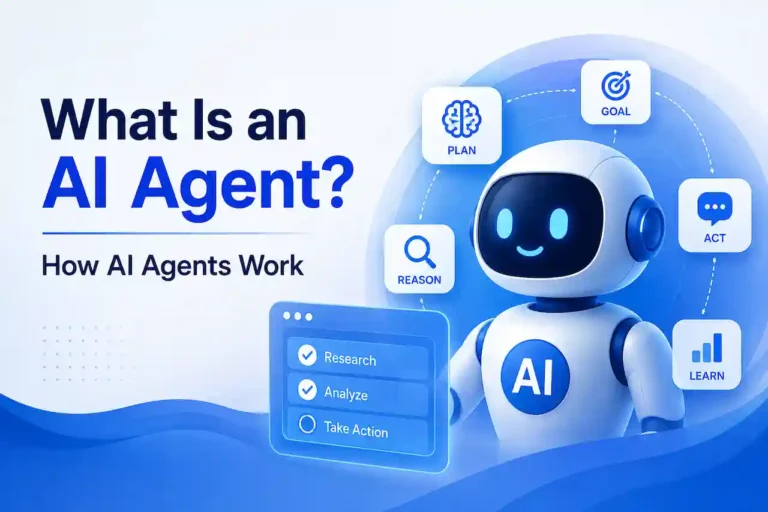
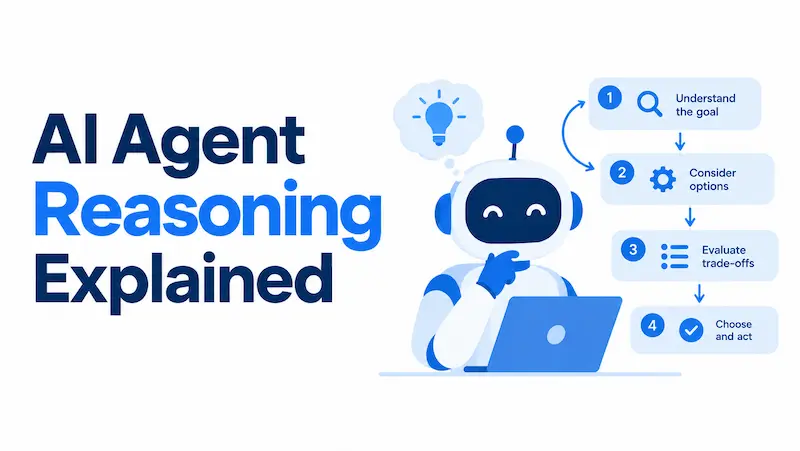
Goal → Context → Plan → Action → Observation → Evaluation → Replan or Finish
This is a conceptual framework, not a universal implementation standard. Some systems move through it explicitly and visibly; others blend steps together, or barely plan at all for a simple task. But naming the parts makes it much easier to see what any given agent is actually doing.
Throughout this section, we’ll use one hypothetical example: comparing three named laptops for video editing under a $1,500 budget and recommending one. This scenario is illustrative only. We have not run this comparison ourselves, and any prices, specs, or model names a real agent might return would need independent verification rather than being taken from this article.
Step 1: Understand the goal
The system first works out what’s actually being asked, including constraints that aren’t spelled out explicitly. Here, that means recognizing that “video editing” implies certain hardware priorities (a capable GPU, sufficient RAM, fast storage), that the budget is a hard limit rather than a suggestion, and that the deliverable is a single recommendation among three specific laptops, not a general buying guide.
Step 2: Build context
Next, the system gathers what it needs: the conversation so far, any files or data it can access, and a sense of which tools are available to it. If the three laptops were already named earlier in the conversation, that becomes part of the context; if not, an early step may be needed just to pin down the candidates.
Step 3: Plan
Planning means deciding on a sequence of steps that might reach the goal. This doesn’t have to mean writing out a full plan before doing anything. Many agent implementations plan dynamically: deciding the next single step, taking it, and revising the plan once they see the result. Here, an initial plan might be: check specs for each laptop, then check current prices, then weigh both against the budget, then decide.
Step 4: Choose an action
At each point, the system selects from whatever options are available: answering directly, asking a clarifying question, retrieving information, calling a tool, or taking some other permitted action. In this case, that might mean running a web search for one laptop’s specifications or opening a specific retailer’s page. For a deeper look at this process, see how AI agents use tools. Many current systems integrate outside tools through a standardized interface rather than custom-building each connection; the Model Context Protocol, an open specification Anthropic introduced in late 2024, is one example of this kind of standardization, letting a system connect to a growing set of external tools through a common interface instead of one-off integrations.
Step 5: Observe the result
Whatever the action returns, search results, a page’s contents, a tool’s output, becomes a new piece of information. This is where the system’s next move can genuinely change based on what it learns. If one laptop turns out to be discontinued, that changes the rest of the task.
Step 6: Evaluate
The system then judges whether that result actually helps. Does it satisfy part of the objective? Is it trustworthy? Is something missing? Finding a listed price counts as progress, but if that price comes from an unfamiliar third-party seller, a more careful process would treat it as provisional rather than final until it’s checked elsewhere.
Step 7: Replan or finish
Based on that judgment, the system either continues (try another source, ask a follow-up question, move to the next subtask) or, once it judges the goal met, produces a final answer. Well-designed systems also build in stopping conditions, such as a maximum number of attempts, so a stuck process doesn’t run indefinitely.
Reasoning vs. Planning vs. Tool Use vs. Execution
These words get used loosely, often as if they were interchangeable, but they describe different parts of the loop above. None of this implies that a given agent implements each one as a separate, distinct piece of software; in many systems, a single model call handles more than one of these at once.
| Concept | What it refers to | In the laptop example |
| Reasoning | Working out what matters and what to do next, given the goal and what’s known so far | Recognizing that GPU and RAM matter more than brand for this particular task |
| Planning | Deciding on a sequence or structure of steps toward the goal | Deciding to check specs before prices, and prices before writing the recommendation |
| Tool use | Invoking an external capability, such as search, a database, or a calculator | Issuing a web search or opening a product page |
| Execution | Actually carrying out the chosen action | The search request being sent and a response coming back |
| Observation | Receiving the outcome of that action | Reading the specs or price that came back |
| Evaluation | Judging whether the result is sufficient or trustworthy | Deciding a price from an unfamiliar seller needs a second source before it can be trusted |
The Role of the Language Model
It’s tempting to treat “the model” and “the agent” as the same thing, but they usually aren’t. The model supplies the parts that look like judgment: interpreting the request, weighing options, drafting a response, and, in many current systems, generating the specific call to a tool (which one to use and what arguments to pass it). What the model doesn’t typically supply on its own is the rest of the system: which tools actually exist and what they’re allowed to do, how many attempts are permitted, what counts as sensitive information, or when a person needs to approve an action before it goes ahead.
OpenAI’s guidance describes an agent as a combination of a model handling execution and decisions, tools for reaching outside systems, and explicit instructions that set boundaries on what the agent is allowed to do. That framing matters because it means agent behavior depends on more than the model’s raw capability. A highly capable model wrapped in a poorly designed tool set, with vague instructions and no error handling, can behave worse than a smaller model inside a carefully built system, and the reverse is also true: better tool design and clearer instructions can noticeably improve outcomes without touching the model at all. Anthropic’s own writing on this topic makes a related point: across the agent deployments its engineers have observed, the more successful ones tended to rely on a few simple, combinable patterns rather than elaborate, all-purpose frameworks. That’s a claim about how the surrounding system is put together, not about which model happens to be running inside it.
Reasoning Patterns
Researchers and practitioners have described several recurring ways of structuring agent reasoning. None of them is universal, and most real systems draw on more than one.
Reason-and-act loops. One influential approach, introduced in a 2022 paper under the name ReAct, has a model produce short pieces of reasoning text interleaved with actions, so that each piece of reasoning can help track and adjust a plan while each action pulls in new information from outside the model. Part of the appeal is interpretability: because the model writes down a reason before acting, someone reviewing the transcript can usually follow why a given tool was chosen, at least in terms of what the model stated at the time.
Task decomposition. Rather than tackling a complex request in one step, a system can split it into smaller subproblems and solve them in order, using earlier answers to inform later ones. Research on a technique called least-to-most prompting found that breaking a problem into a sequence of easier subproblems, each building on the answers to the ones before it, helped models handle harder cases than the examples they’d been shown. In agent systems, this shows up as splitting “plan a trip” into destination research, then logistics, then a day-by-day itinerary.
Reflection and self-evaluation. Some systems have a model review its own previous attempt and use that review to do better on the next one. A framework called Reflexion has an agent write out a reflection on why an earlier attempt fell short, store that reflection, and draw on it during later attempts, without retraining the underlying model. This can help on tasks with a clear pass-or-fail signal, such as a failing test in a coding task, but it depends heavily on the quality of the feedback available; reflecting on misleading feedback doesn’t reliably produce a better outcome.
Retrieval-supported workflows. Retrieval-augmented generation pairs a language model with a retrieval step that pulls in relevant external passages before the model generates a response, and it’s one of the most common ways agents ground answers in current or proprietary information rather than only what a model absorbed during training. Its main weakness is that it’s only as good as what gets retrieved; a document that’s outdated or beside the point can mislead a system just as easily as having no information at all.
A related caution applies across all of these patterns. The text a model produces while “reasoning” is not necessarily a complete or fully accurate account of what’s actually happening inside it. A model can write out a plausible-looking chain of reasoning that reaches the right answer for reasons other than the ones it stated, or that leaves out a factor that genuinely shaped its output. A growing body of interpretability research has found cases where a model’s written explanation and the process that actually produced its answer come apart, sometimes noticeably. That doesn’t make these reasoning traces useless. They’re genuinely helpful for spotting mistakes and for getting a rough sense of what a system is doing. It does mean they shouldn’t be treated as a guaranteed, complete window into the model’s internal computation.
Memory and Context
An agent’s decisions are shaped by whatever it currently has access to: the immediate conversation, information gathered during the task so far, persistent AI agent memory carried over from earlier sessions where a system has that capability, the state of any external systems it’s connected to, and the outputs of tools it has already called.
More context is not automatically better. A system handed a large amount of irrelevant information has to spend effort working out what matters, and material that’s off-topic or contradictory can drag a decision down rather than improve it. Context that’s well-scoped and genuinely relevant tends to beat context that’s simply large, which is a big part of why deciding what to expose to a model, and when, is treated as a serious design problem rather than an afterthought bolted on at the end.
Real-World Use Cases
Agent-style reasoning tends to earn its keep when a task has several steps, an uncertain path to the goal, and some way to check progress as it goes.
Research agents search, gather information from more than one source, compare it, and judge whether it actually answers the question, rather than stopping at the first plausible-sounding result.
Coding agents typically cycle through inspecting a codebase, forming a hypothesis about a bug or a needed change, editing the code, running tests, observing what happened, and iterating. Anthropic has described using agents of this kind internally to work on real GitHub issues using only the pull request description as a starting point, while still treating a person’s review as necessary to confirm that a technically passing fix actually matches what was intended.
Customer support agents move through understanding a request, pulling up relevant account or policy information, applying that policy, and either responding directly or handing off to a person, particularly for actions like refunds that carry real financial consequences.
Computer-use agents operate a graphical interface much like a person would: looking at the current screen, deciding where to click or what to type, acting, and checking whether the interface changed as expected before moving on.
Business workflows apply similar reasoning to document processing, routing requests between systems, and updating records, usually with a defined point where a person reviews or signs off on the outcome.
In every case, the value comes from combining iteration with a way to check the result, not from agent-style reasoning being worth applying for its own sake. OpenAI’s own guidance is fairly blunt about this trade-off: tasks that involve nuanced judgment calls, brittle or unwieldy rule sets, or heavy interpretation of unstructured text tend to be good candidates for an agent, while a simpler, deterministic piece of software is often the better choice when a task doesn’t actually need that flexibility.
Why Agent Reasoning Fails
A system can move through every step of the loop described above and still land on a wrong or harmful outcome. Common failure points include:
- Misunderstood goals. The system solves a plausible-sounding version of the request instead of the one that was actually asked.
- Incorrect assumptions. It fills a gap in its information with a guess, then proceeds as though the guess were confirmed.
- Hallucination. It states something, a fact, a citation, a tool result, as true without having actually verified it.
- Poor tool selection. It reaches for a tool that doesn’t fit the task, or uses the right tool with the wrong inputs.
- Bad or incomplete information. A tool call succeeds but returns outdated, biased, or partial data, and the system treats it as reliable regardless.
- Faulty evaluation. It judges a weak or partial result as good enough and stops sooner than it should.
- Incorrect stopping decisions. It stops before the goal is genuinely met, or, less often, keeps going well past the point of usefulness.
One useful way to think about handling all of this: notice something’s wrong, work out the likely cause, choose a response (try again, switch tools, ask the person, or escalate), then resume or stop. Systems that only manage the first half of that, noticing that something went wrong, without a sensible way through the second half tend to either give up too quickly or repeat the same failed approach on a loop.
Two points are worth underlining. First, each individual step in a failing chain can look locally reasonable. A tool call can succeed, an interpretation of its result can seem sound, and the final answer can still be wrong, because an early misunderstanding carried through every step that followed it. Second, adding more reasoning steps doesn’t automatically make a system more reliable. Every extra step is another place for an error to enter or compound, so a longer process isn’t inherently a safer one. What matters more is whether each step actually gets checked against something real, whether that’s a test result, a second source, or a person confirming it.
Security Considerations
Because agents take actions rather than only generate text, their security risks reach further than producing a wrong or offensive answer. Once a system is capable of sending messages, querying databases, calling APIs, and making decisions on its own initiative, its reach into other systems effectively becomes part of what an attacker can try to target.
The OWASP GenAI Security Project’s 2026 risk lists are a useful reference point, since they’re maintained by a large community of security practitioners and revised as new incidents come to light. A few categories from these lists are especially relevant to agent reasoning:
- Prompt injection, including the indirect kind, where instructions arrive hidden inside a document, webpage, or email the agent processes rather than typed directly by the user. This has, by most tallies, remained the most consistently top-ranked risk in the model-focused list since it was first published.
- Agent goal hijacking, described in OWASP’s dedicated top-ten list for agentic applications, where an attacker manipulates an agent’s objective or decision path, often by planting instructions in content the agent is expected to read rather than by attacking a user-facing interface directly.
- Excessive agency, which shows up when a system has been given broader functionality, permissions, or independence than the task in front of it actually needs, opening the door to actions nobody intended, sometimes made worse by too little human oversight of higher-risk steps.
- Identity and privilege abuse, where an agent’s credentials or inherited permissions let it reach further than intended, a risk that grows in systems built from multiple connected agents and tools.
These aren’t only theoretical concerns. In June 2025, security researchers at Aim Security disclosed a vulnerability, tracked as CVE-2025-32711 and nicknamed “EchoLeak,” in Microsoft 365 Copilot: a specially crafted email could reportedly cause the assistant to retrieve and expose internal data without any action from the person using it. Microsoft issued a server-side patch, and there’s no confirmed evidence the flaw was exploited outside the research setting, but it stands as a concrete, documented case of indirect prompt injection leading to real data exposure in a production system, not just a hypothetical risk.
Mitigations mirror standard security practice, adapted for systems that act on their own: scoping tool permissions to the minimum a task requires, requiring a person’s approval before high-risk or irreversible actions, sandboxing code execution, treating anything an agent retrieves from outside as untrusted input rather than as a trusted instruction, and layering several checks (content filters, permission checks, human review) rather than depending on any one safeguard. OpenAI frames its own guardrail recommendations the same way, describing layered defenses, classifiers for relevance and safety, filters for personal data, rules-based checks, and clear triggers for handing control to a person, precisely because no single guardrail is likely to catch everything on its own.
The field is still actively formalizing this work. OWASP published its first dedicated top-ten list for agentic applications in December 2025, and the U.S. National Institute of Standards and Technology announced a dedicated AI Agent Standards Initiative in February 2026, aimed at industry standards, open protocols, and security and identity research specific to agents. Both point to the same underlying recognition: securing a system that acts needs its own frameworks, not a straight reuse of guidance written for systems that only generate text.
How to Evaluate an AI Agent’s Reasoning
There’s no single certified test for whether an agent “reasons well.” What follows is a practical, editorial framework rather than an official industry standard, meant to give readers concrete questions to ask when sizing up a system.
- Goal understanding. Did it correctly identify the actual request, including any constraints the person stated?
- Plan quality. Is the sequence of steps sensible, and does it adjust when new information changes the picture?
- Action selection. Given the options available at each point, was the choice a reasonable one?
- Tool selection. Did it use tools suited to the task, without redundant or unnecessary calls?
- Evidence quality. Is the information it gathered current, relevant, and from a credible source?
- Error recovery. When something failed or came back wrong, did it notice, and did it respond sensibly?
- Verification. Did it check its own output against the goal, or cross-check facts, before finishing?
- Safety. Did it stay inside its permissions and avoid irreversible actions without appropriate approval?
- Consistency. Does it perform similarly on similar tasks, or is its behavior erratic from run to run?
- Task completion. Did the final result genuinely satisfy the original goal, rather than just resemble progress?
It’s also worth treating benchmark scores with some caution. Benchmarks such as GAIA and SWE-bench are genuinely useful for comparing systems on tool use, reasoning, or coding tasks, but performing well on one is evidence of capability within that specific set of tasks. It says comparatively little about whether the same system will hold up once the data, the tools, and the edge cases in question are your own.
AI Agent vs. Chatbot
The two terms overlap more than a strict comparison might suggest. Software that uses a model without letting it steer how a task gets executed, a simple chatbot or a single-turn tool, generally isn’t considered an agent in the sense discussed here, but a growing number of chat products now include agent-like features (tool use, multi-step retrieval) without sitting cleanly in one category or the other.
| Chatbot-style response | Agent-style workflow | |
| Interaction pattern | One question, one answer, generated in a single pass | Multiple internal steps before a final answer, often not shown to the user |
| Tool use | Optional; typically zero or one call | Often several calls, sometimes repeated or iterative |
| Handling gaps in the request | Answers with the most likely interpretation, or asks one clarifying question | May gather more information and revise its approach before answering |
| Self-checking | Rarely checks its own answer against outside evidence | May compare results across sources, though this isn’t guaranteed |
| Human involvement | Needed at essentially every turn | May only be needed at the start, at set checkpoints, or at the end |
What AI Agent Reasoning Does Not Mean
A short list of things worth ruling out explicitly:
- It does not mean the system thinks the way a person does, or that it’s conscious.
- It does not guarantee a correct answer. An agent can work through a task carefully and still land on the wrong conclusion.
- It does not mean the system always builds an explicit plan. Many systems plan implicitly, one step at a time.
- It does not mean results are automatically verified. Verification has to be deliberately built in; it isn’t a free byproduct of taking more steps.
- It does not mean full autonomy. Most production systems include defined checkpoints, permission limits, or a person’s approval for higher-stakes actions.
- It does not mean every agent works the same way internally. Architectures genuinely differ across vendors and use cases.
Putting It All Together: A Practical Mental Model
Return to the loop: Goal → Context → Plan → Action → Observation → Evaluation → Replan or Finish. In the laptop example, the goal was fixed at the outset (three named laptops, one budget, one recommendation). Context included whatever was specified up front plus anything retrieved along the way. The plan sequenced spec-checking ahead of price-checking. Actions were the individual searches and page lookups. Observations were whatever those actions returned. Evaluation judged whether each piece of information was sufficient and trustworthy. And the replan-or-finish step either sent the process back for another source or produced the final comparison.
The surrounding components fit around that loop rather than inside any one step of it:
- Tools give the system ways to act on, and learn about, the world beyond its own training data.
- Memory, short-term within a session and, where a system supports it, longer-term across sessions, supplies continuity.
- Retrieval brings in external or current information relevant to the specific task at hand.
- Policies and instructions define what the system should and shouldn’t do, independent of whatever the model might otherwise choose on its own.
- Guardrails catch problems, unsafe requests, disallowed actions, exposed sensitive data, before or after a step runs.
- Human approval sits at defined checkpoints for actions that are high-risk, hard to undo, or otherwise call for a person’s judgment.
None of these pieces make an agent reason correctly by themselves. What they do is shape the space its reasoning happens inside, and determine how much damage a bad decision can do before someone notices.
Conclusion
How do AI agents make decisions? By cycling through some version of the same loop: understanding a goal, gathering context, forming or adjusting a plan, choosing and taking an action, observing the result, judging whether it’s enough, and then either continuing or finishing. Tools extend what the system can do. Memory and retrieval extend what it knows. Policies, guardrails, and human approval define the boundaries it’s supposed to stay inside.
The quality of an agent should be judged not by how sophisticated its reasoning appears, but by whether it reliably selects appropriate actions, uses trustworthy information, handles failures, verifies outcomes, and operates within appropriate boundaries.