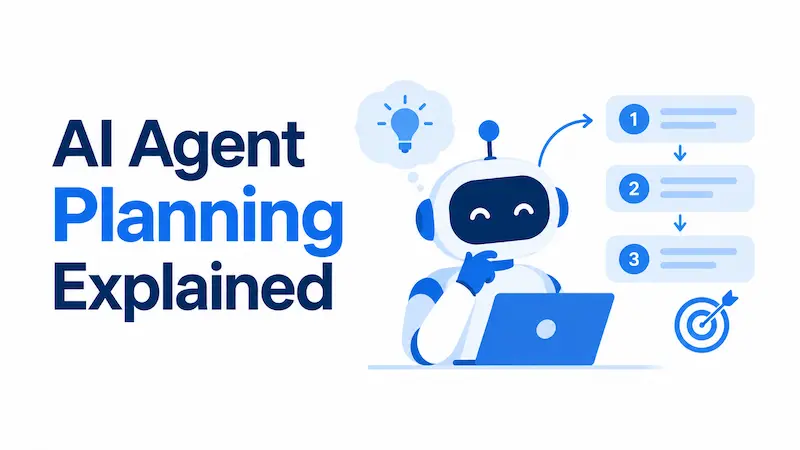
AI Agent Planning Explained: How Agents Plan Tasks
Ask an AI agent to find a hotel for a long weekend within a fixed budget, and something has to happen between that instruction and a booked room. The system has to figure out what “within budget” actually rules out, search for options, compare them, notice if the top choice is sold out, and decide what to try next. That process, turning a goal into a working sequence of decisions and actions, is what this article means by AI agent planning.
Planning is often pictured as writing a numbered list of steps before doing anything. In practice, many agents never produce that list at all. They decide on one action, see what happens, and only then decide on the next one. Other systems do draft a plan upfront and revise it only when something breaks. Both count as planning, and the difference between them has a real effect on how an agent behaves under pressure.
This article covers how AI agents actually plan: how they interpret a goal, work within constraints, choose and use tools, judge whether a step worked, and change course when it doesn’t. It also covers common approaches, where planning tends to fail, how to make it more dependable, and when a plain, predefined workflow is the better choice. For practical examples of how these systems can be used, see AI agent examples.
What Is AI Agent Planning?
AI agent planning is the process an AI agent uses to decide which actions to take, and in what order, to move from its current situation toward a defined goal, while respecting constraints such as available tools, time, and permissions.
A few pieces recur across most descriptions of planning:
- Goal: what a completed task looks like.
- Strategy: the general approach chosen to reach it.
- Actions: concrete steps, often tool calls, that make progress.
- Subtasks: smaller pieces a larger goal gets broken into.
- Constraints: budget, time, permissions, or rules the plan has to respect.
- Adaptation: the ability to revise the approach as new information arrives.
Not every agent has a distinct planning module that outputs a plan as a separate artifact. Some systems fold planning into the same step that chooses the next action, so there is no standalone plan a person could point to and read. Others produce something explicit, such as an ordered list of subtasks, that a separate part of the system then works through. Both patterns show up in production, and which one a given system uses depends on implementation rather than following one fixed architecture.
It also helps to be clear about what planning is not. A simple conversational exchange follows a basic pattern: input, then response. An agentic system adds a loop on top of that: a goal, a decision, an action or tool call, an observation of what happened, and another decision, repeated until the goal is met or the system gives up. Nielsen Norman Group’s definition of an AI agent draws a similar line, describing agents as systems that pursue a goal, take actions, evaluate progress, and decide their own next steps, in contrast to a system that simply follows a fixed, predetermined sequence.
Many modern products blur this line on purpose. A chat interface can sit in front of a system that plans and executes multi-step work behind the scenes, so “agent” and “chatbot” describe a spectrum of behavior rather than two separate product categories. Anthropic’s engineering team draws a related distinction between workflows, where models and tools are orchestrated through code paths a developer defines in advance, and agents, where the model directs its own process and tool use as the task unfolds.
How AI Agents Plan Tasks
One useful way to think about agent planning is as a loop:
Goal → Constraints → Plan → Action → Observation → Evaluation → Replan → Verify
Treat this as a description of what has to happen somewhere in a working system, not as a required architecture. Some implementations compress several of these stages into a single decision. Others split them across different components. The sections below describe what each part of the loop is doing conceptually.
Understand the Goal
Before anything else, the system needs a working interpretation of what it’s being asked to do: the desired outcome, any explicit instructions, relevant context from earlier in the task, and some notion of success criteria, meaning how the agent (or a person reviewing its work) would know the task is actually finished. A goal that’s vague at this stage tends to stay vague through everything that follows.
Identify Constraints
Constraints narrow the space of acceptable plans: a budget, a deadline, permissions (what the agent is actually allowed to touch, spend, or send), the tools it has access to, a required output format, or other requirements the user stated. Constraints don’t just rule out bad plans after the fact. They shape which plan makes sense to attempt in the first place.
Break the Goal Into Subtasks
Task decomposition means splitting a large, often vague goal into smaller pieces that are each easier to act on directly. Planning a team offsite, for example, decomposes reasonably well into finding a venue, checking attendee availability, arranging catering, and putting together an agenda. Each of those subtasks is concrete enough to act on, in a way the original goal, “plan the offsite,” is not.
Select Actions and Tools
Tools give an agent the capability to do things beyond generating text: searching the web, querying a database, running code, sending a message. For a deeper look at this capability, see how AI agents use tools. OpenAI’s function calling documentation describes the underlying mechanism: a model is given descriptions of the functions available to it, and when it determines one is needed, it returns a structured request that the surrounding application executes and reports back on. Planning is the layer that decides whether and when a given action is actually needed. Tool use is the mechanism that carries it out. A growing number of frameworks now rely on the Model Context Protocol, an open standard Anthropic introduced in November 2024 for connecting AI systems to external tools and data sources, which has since been adopted well beyond Anthropic’s own products.
Execute the Plan
Execution means actually carrying out the chosen action and getting back a real result: an API response, a file, a set of search results, or an error message. Up to this point everything has been a decision. This is the step where a decision turns into something that happened, at least within a database, an application, or a file system.
Observe and Evaluate Results
After an action runs, the agent needs to check what came back: did the tool call succeed, is the returned data usable, and does it actually move the task forward. This is where ground truth from the environment gets folded back into the process, rather than the agent continuing to operate on assumptions it made before it had this information.
Replan When Necessary
New information (a venue is already booked) or an outright failure (an API call timed out) can mean the current plan no longer fits. Replanning covers a wide range: sometimes it’s a small adjustment, like retrying with different parameters, and sometimes it means abandoning a subtask and picking a different approach entirely.
Verify the Result
Before returning an answer or marking a task complete, a well-designed agent checks its output against the success criteria it started with. Skipping this step is how a system ends up confidently presenting something that looks finished but doesn’t actually satisfy what was asked.
A Real-World Example of AI Agent Planning
Consider a hypothetical agent given the goal “find the best laptop for video editing under $1,500.” No actual system was tested to produce this walkthrough. It’s meant to illustrate how the stages above might play out together, not to document a real run.
- Goal interpretation: “best” isn’t defined yet. A reasonable agent has to operationalize it, likely as some mix of video-editing performance (processor, graphics capability, memory, storage speed) and value for the money, within the stated budget.
- Constraints: a hard budget ceiling of $1,500, and an implicit performance floor set by “video editing,” which rules out machines with minimal processors or graphics capability regardless of price.
- Task decomposition: research what specifications actually matter for video editing, search current listings that fit the budget, gather reviews for shortlisted models, and compare the finalists.
- Information gathering: search-tool calls retrieve current listings, prices, and specifications.
- Tool usage: a comparison step lines up the shortlisted models against the criteria from step one.
- Comparison: the agent scores or ranks the candidates, weighing processing power and memory against price.
- Missing information: partway through, the agent notices that battery life isn’t listed for one of the leading candidates.
- Replanning: rather than guessing, the agent either searches a different source for that spec, drops the model from consideration, or flags the gap and asks whether battery life matters for this use case.
- Final evaluation: with the gap resolved, the agent settles on a recommendation and notes the trade-offs, for instance a machine with slightly less memory but a faster storage drive.
- Verification: before presenting the recommendation, the agent confirms the chosen laptop is actually in stock at or under $1,500, and that it satisfies the original goal (a good laptop for video editing within budget), not just “a good laptop.”
Steps seven and eight are what separate this from a simple checklist. A fixed script would have no natural way to handle a missing spec partway through. A planning agent can notice the gap and change course without needing a person to rewrite its instructions.
Common AI Agent Planning Approaches
These are recurring architectural patterns, not a standard every agent follows. Many production systems combine more than one. The broader types of AI agents also differ in how they approach tasks, interact with their environment, and make decisions.
Direct or Incremental Planning
In this pattern, the system never produces a multi-step plan as a distinct object. At each turn, it looks at the current state and decides on a single next action, then repeats. This adapts well to surprises, since every decision incorporates the latest observation, but it can lose track of the bigger picture on long tasks, since there’s no explicit multi-step commitment steering it.
Plan-and-Execute
LangChain’s write-up on plan-and-execute agents describes the architecture as two components: a planner that prompts a model to generate a multi-step plan upfront, and one or more executors that carry out each step, often invoking tools to do so. Because the larger, more capable model is mainly needed for planning and re-planning rather than every single action, this pattern can be faster and cheaper than consulting a large model at every step. The trade-off is that a plan built on incomplete information can go stale as execution reveals new facts, which is why re-planning is usually built in rather than optional.
ReAct-Style Approaches
The original ReAct paper, from researchers at Google Research and Princeton, introduced a method that interleaves short reasoning traces with actions and the observations that follow, in a repeating loop, rather than separating “thinking” and “acting” into distinct phases. This is a more specific claim than generic “reasoning”: ReAct ties each piece of reasoning text directly to the choice of next action and to interpreting what came back from the environment. The researchers found this combination reduced certain failure modes, such as reasoning that drifts from the facts at hand, compared with reasoning or acting in isolation.
Hierarchical Planning
The idea of decomposing a goal into objectives, then subtasks, then concrete actions has roots in decades-old AI planning research, particularly hierarchical task network planning. In that classical framework, a complex, abstract task is broken down into progressively simpler compound tasks, using domain-specific decomposition rules, until only directly executable primitive actions remain. Some modern agent systems borrow this decomposition idea, for example a top-level objective spawning sub-agents or sub-plans for individual pieces of work, without necessarily implementing formal HTN methods underneath.
Dynamic or Iterative Planning
This describes continuous, small adjustments made after each new observation, rather than one large re-planning event. In practice, most production agent loops sit somewhere between the fully incremental, ReAct-style end of the spectrum and the fully upfront, plan-and-execute end, adjusting pieces of a plan as they go instead of treating it as either fixed or something to rebuild from scratch every time.
No single one of these counts as the standard architecture for “an AI agent.” Which pattern, or combination of patterns, a given system uses is a design decision made by whoever built it.
Do AI Agents Make the Entire Plan at Once?
Not universally. Some systems generate a full plan before taking any action, in the plan-and-execute style described above. Others choose one action at a time and never produce a complete plan as a distinct object, closer to ReAct-style planning. Many systems in between generate an initial plan and revise specific parts of it as execution proceeds, rather than fully committing to it or rebuilding it from nothing after every step. Whether a given agent works one way or another is a property of how it was built, not something inherent to the category “AI agent.”
What Information Does an AI Agent Need to Plan?
Planning quality depends heavily on what information is actually available to the agent at decision time. That typically includes the goal itself, relevant context from the conversation or task so far, the current state (what has already happened, what’s true right now), constraints, the tools available, the actions already taken and the results they returned, memory when the system has one (information carried over from earlier interactions), and the success criteria the plan is meant to satisfy.
An agent that’s missing a key piece of this, say, a budget the user mentioned early on that has since scrolled out of the model’s context window, can produce a plan that looks perfectly reasonable while quietly violating a requirement it never actually saw. This is one reason context management and AI agent memory design matter just as much as the planning logic sitting on top of them.
AI Agent Planning vs Workflow Automation
Traditional workflow automation runs a fixed, predefined sequence: if this happens, do that. A developer decides the path in advance, and the system’s job is to execute it reliably every time. An agentic system can select or change its actions at run time, based on the goal and what it observes, without every branch being pre-specified by a person.
This doesn’t make agents categorically better. Predictability is a workflow’s biggest strength: it’s far easier to test, audit, and reason about a system that performs the same steps in the same order every time than one that can, in principle, take a different path on each run. Hybrid designs, deterministic steps for the parts of a process that don’t require judgment and agentic steps for the parts that do, are common in practice for exactly this reason.
| Aspect | Workflow Automation | Agentic Planning |
| How actions are selected | Predefined by a developer in advance | Selected by the system at run time |
| Adaptability | Low; unanticipated cases usually need a human to update the workflow | Higher; can adjust to new information without a rebuild |
| Predictability | High; the same input tends to follow the same path | Lower; the path can vary between runs |
| Handling uncertainty | Struggles unless every case was anticipated | Generally better suited to open-ended situations |
| Human control | Every branch is explicit and human-authored | A human sets the goal and guardrails, not every step |
| Best-fit use cases | Repetitive, well-understood, compliance-sensitive processes | Open-ended tasks with several plausible paths to the goal |
Why AI Agent Planning Can Fail
A plan can look entirely reasonable and still fail, because a plausible-sounding plan is not evidence that it will actually work. The only real evidence is whether the actions taken, and the outcome they produced, satisfy the original goal. Common causes include:
- Incorrect assumptions: the agent infers something about the goal or the world that turns out not to be true, and never checks it.
- Poor decomposition: subtasks that don’t actually add up to the original goal, or that are broken down at the wrong level of detail.
- Missing information: the agent proceeds without a piece of context it actually needed.
- Hallucinated information: the model states something as fact that isn’t true, and later steps build on it.
- Incorrect tool selection: using the wrong tool for the job, or one that returns data in a format the rest of the plan doesn’t expect.
- Tool failures: an API times out, errors, or returns malformed data, and the agent doesn’t handle it gracefully.
- Ambiguous objectives: a goal like “the best laptop” without a defined “best.”
- Long action chains: small errors compound over many steps, and by step twenty a task can have drifted far from where it started.
- Context limitations: a model can only hold so much information in view at once, so details established early in a long task can effectively fall out of view.
- Error propagation: one step’s flawed output feeds directly into the reasoning behind the next step.
- Failure to verify: the agent stops once it produces something that looks complete, without checking it against the original goal.
Security adds another layer to this. OWASP’s Top 10 for LLM Applications lists prompt injection as its top risk category, and it bears directly on planning: if an agent treats untrusted content it reads, a webpage, an email, an uploaded document, as though it were an instruction from the person it’s actually working for, its plan can be redirected without anyone noticing until after the fact. The same list includes excessive agency as a separate risk category, covering agents granted more autonomy or permissions than a task actually requires, which turns an ordinary planning mistake into one with a much larger blast radius.
This isn’t a hypothetical concern. Benchmarks like GAIA and WebArena exist specifically to measure how often agents complete realistic, multi-step tasks end to end rather than just individual steps in isolation, and benchmark tracking from Evidently AI shows that even well-resourced systems on these benchmarks continue to fall short of the near-consistent completion rates a person achieves on the same tasks. Exact numbers shift with every model release, but the underlying pattern, that autonomous multi-step task completion remains a genuinely hard, actively measured problem, has held up across benchmark versions and model generations.
How to Make AI Agent Planning More Reliable
- Define measurable goals. State success criteria that a person, or the agent itself, can check objectively, rather than leaving “done” open to interpretation.
- Make constraints explicit. Don’t assume the system will correctly infer a budget or deadline that was only mentioned in passing.
- Use well-scoped tools. Anthropic’s guidance on writing tools for agents makes the case that a few thoughtfully designed, narrow tools tend to outperform one broad, generic tool that returns more than the agent actually needs, since the agent still has to sort through whatever comes back.
- Break complex tasks into manageable units. Smaller subtasks are easier to check individually, and easier to redo in isolation if one fails.
- Add checkpoints. Build in points where the system pauses to confirm progress before continuing, especially before costly or hard-to-reverse steps.
- Validate intermediate results. Catch a failed step when it happens rather than discovering it only once the whole task is “done.”
- Define stopping conditions. Give the system a clear rule for when to stop retrying or replanning, so a failing agent doesn’t loop indefinitely.
- Verify final outputs against the original goal. “The last step ran without an error” and “this actually satisfies what was asked” are different checks.
- Limit unnecessary autonomy. Don’t grant tool access or permissions beyond what a specific task genuinely requires.
- Use deterministic workflows where they fit. Not every part of a task benefits from agentic flexibility; some steps are simply better off scripted.
- Add human approval for high-impact actions. Sending money, deleting data, or publishing something publicly are reasonable places to insert a checkpoint, even in an otherwise autonomous system.
Planning, Memory, and Tool Use: How They Work Together
These three concepts get used loosely in everyday conversation about agents, but they aren’t interchangeable. A simplified version of how they connect looks like this:
Context or state → planning → action or tool call → result → updated state → next decision
Each pass through this loop updates what the system knows, which then feeds into the next planning decision.
| Concept | What it is | Its role in an agent |
| Planning | Deciding which actions to take, and in what order, to reach a goal | Connects a goal to a sequence of intended actions |
| Reasoning | Working through implications, weighing options, or drawing conclusions from available information | Can inform a planning decision, but is not itself the plan |
| Execution | Actually carrying out a chosen action | Turns an intended action into a real outcome or tool result |
| Memory | Information retained from earlier in a task, or carried across separate tasks | Supplies context planning can draw on, but doesn’t decide anything by itself |
| Tools | External functions, APIs, or systems an agent can call | Give an agent the capability to act; planning decides if and when to use one |
Memory can inform a plan (recalling that a user prefers window seats), but it doesn’t produce one. A tool can carry out an action (booking the seat), but it doesn’t decide whether that action is needed. Keeping these roles distinct makes it much easier to diagnose a failing agent: is it planning badly, forgetting something it should have retained, or choosing the wrong tool for an otherwise sound plan?
AI Agent Planning vs Simple Prompting
A prompt like “create a five-step plan for launching a website” produces a single, useful piece of text: a description of a plan, generated in one pass. Nothing gets executed, nothing is checked against reality, and there’s no mechanism for the model to notice if step three turns out to be wrong once step two didn’t go as expected.
Now compare that with treating “launch the website” as an agentic task. That requires several things the plain prompt didn’t need:
- Planning, to decide what launching entails for this specific site.
- Tool access, to actually register a domain, deploy files, or configure DNS.
- Execution, to carry out each step for real.
- State, to track what’s already been done.
- Feedback, to notice if a deployment step failed.
- Error handling, to decide what to do about that failure.
- Verification, to confirm the site is genuinely live, not just that a command returned without an error.
None of this implies an LLM can’t produce good multi-step reasoning on its own. It clearly can, as the five-step-plan example shows. The distinction is that generating a description of a plan in text, and actually executing, monitoring, and adjusting that plan in the world, are different capabilities. A system needs the second set to be called an agent in the sense this article has been using throughout.
Where AI Agent Planning Is Useful
Planning tends to earn its added latency and complexity in situations with several moving parts and real uncertainty about the right path forward.
Research
Multi-source research often depends on what the last search turned up. An agent that can plan its next query based on what it just found tends to outperform one following a fixed search sequence.
Software Development
A coding agent that plans a change, writes it, runs the tests, reads the failure output, and adjusts accordingly behaves very differently from one that produces a single code block and stops, regardless of whether it worked.
Data Analysis
Exploring an unfamiliar dataset means the useful next question usually depends on what the data actually shows. That’s difficult to fully script in advance, which is where planning that reacts to intermediate findings adds real value.
Customer Support
Resolving a nontrivial request might mean looking up an order, checking a policy, and choosing between several possible resolutions depending on what turns up. A single fixed script tends to handle the common case well and everything else poorly.
Business and Administrative Workflows
Coordinating a multi-step process, like scheduling, procurement, or onboarding, across several systems, with occasional exceptions, is exactly the kind of task where a rigid script tends to break the first time reality doesn’t match the happy path it was written for.
AI Agent Planning in Modern Agent Frameworks
Framework capabilities change quickly, so treat the specifics below as a snapshot rather than a permanent state of the field, and check current documentation before making a decision based on any single detail here.
LangGraph, maintained by the LangChain team, is a generally available, open-source, low-level orchestration library for building stateful agents as directed graphs, where nodes represent steps and edges represent control flow, including cycles, which is what makes it possible to represent a plan-observe-replan loop directly in the graph structure. LangGraph doesn’t dictate a specific planning approach; developers wire up whatever loop they want using its primitives, and the LangChain team also offers higher-level, prebuilt agent abstractions on top of it, along with a separate “Deep Agents” package aimed specifically at agents that plan, delegate to sub-agents, and manage longer-running tasks.
CrewAI is a generally available, open-source Python framework built around two complementary concepts: crews, which are teams of role-based agents collaborating with more autonomy, and flows, which provide more deterministic, event-driven control over execution. The project’s own documentation positions these as tools meant to be combined rather than as competing options.
Microsoft’s original multi-agent research framework, AutoGen, and its enterprise-oriented SDK, Semantic Kernel, have since been consolidated. Microsoft’s Agent Framework documentation describes the result as the direct successor to both projects, combining AutoGen’s multi-agent orchestration patterns with Semantic Kernel’s enterprise features such as state management and telemetry. Microsoft has described the framework as reaching general availability for both Python and .NET in 2026, though teams still running standalone AutoGen or Semantic Kernel deployments should check current migration guidance before assuming feature parity.
OpenAI’s Agents SDK is a generally available production framework providing agents, tool calling, handoffs that let one agent transfer a conversation to another, guardrails for validating input and output, and session-based memory. It’s the production successor to OpenAI’s earlier Swarm project, which OpenAI has described as an educational reference implementation rather than something meant for production use.
Across these frameworks, the more meaningful differences are less about whether a given tool can support planning (most can be wired up to implement some version of the loop described earlier) and more about the level of abstraction on offer: low-level graph control, higher-level role and task abstractions, or lightweight primitives built around handing work off between specialized agents.
When AI Agent Planning Is Not the Best Approach
Agentic planning isn’t the right default for every task. It tends to add less value, relative to its cost, for:
- Highly predictable tasks with one clear correct path.
- Strictly controlled or regulated processes where every step needs to be auditable in advance.
- Repetitive operations running at scale, where consistency matters more than flexibility.
- Tasks with high reliability requirements and low tolerance for variation between runs.
- Fixed business rules that rarely change.
- Situations with genuinely low uncertainty about the right next step.
In these cases, a deterministic workflow is often more auditable, cheaper to run, and easier to debug, since it does the same well-tested thing every time rather than making a fresh decision on each run. Hybrid architectures, deterministic steps for the predictable parts of a process and agentic decision-making for the parts that genuinely need judgment, are a common middle ground in production systems.
Common Mistakes When Designing AI Agent Planning Systems
- Vague goals that leave “success” undefined from the start.
- Excessive autonomy: granting broader permissions or tool access than the task requires.
- No success criteria to check the final output against.
- No verification step before treating a task as complete.
- Too many available tools, which can make tool selection itself unreliable.
- No failure handling for tool errors or unexpected results.
- Excessively long task chains that give small errors room to compound.
- No checkpoints, so nothing catches a problem until the very end.
- Poor state management, losing track of what’s already happened.
- Using an agent for a job a deterministic script would handle better, more cheaply, and more predictably.
Conclusion
AI agent planning is how a system turns a goal into a working sequence of decisions and actions, rather than a fixed checklist written once and followed blindly. Some agents draft a plan upfront; others decide one step at a time; many do some of both. What they tend to share is a loop: interpreting a goal, respecting constraints, choosing actions and tools, checking what actually happened, and adjusting course when reality doesn’t match expectations. Verification at the end matters as much as any step before it, since a plausible-looking result is not the same as a correct one.
None of this makes agentic planning the automatic right choice. Predictable, well-understood, high-stakes processes are often served better by a deterministic workflow, and many real systems combine both approaches rather than picking one. The practical mental model to keep in mind is simple enough to hold onto even as the underlying frameworks and terminology keep shifting:
Goal → Plan → Act → Observe → Evaluate → Replan → Verify