What Is Agentic AI? A Beginner’s Guide
The biggest shift in AI is not simply that models can produce better answers. It is that some AI systems can now take a goal, decide what to do next and carry work forward without waiting for a new human instruction at every step.
Agentic AI is artificial intelligence designed to pursue goals through a sequence of decisions and actions. It can interpret an objective, choose steps, use tools, observe what happens and adjust its approach as the task progresses.
A conventional generative AI system might draft an email explaining how to resolve a customer problem. An agentic system could potentially inspect the customer’s account, check relevant policy, decide what action is appropriate, update a business system and prepare or send the response, depending on its permissions.
Agentic does not mean conscious, independent of humans or unrestricted. Humans typically establish the objective, available tools, data access, permissions and boundaries. What changes is how much control the AI receives over the path from the initial goal to the outcome.
That leads to the most useful way to understand the concept:
Agentic AI is not simply AI that can act. It is AI that has some control over deciding what action should happen next.
Stanford HAI currently defines agentic AI around autonomous or semi-autonomous systems that can interpret goals, plan and sequence actions, use tools, respond to feedback and adapt over time.
Key Takeaways
- Agentic AI focuses on pursuing outcomes through decisions and actions rather than only generating content or predictions.
- A system becomes more agentic as it gains greater control over decision-making, action, adaptation and how long it can operate without intervention.
- Generative AI and agentic AI are not competing categories. A system can be both generative and agentic.
- An AI agent is usually the software actor, while agentic AI describes the capability or design approach centered on AI-driven agency.
- Autonomy and authority are different. An agent may independently make many decisions while still being unable to perform consequential actions without approval.
- Agentic architecture is most useful when the goal is clear but the correct path depends on what happens during execution.
What Is Agentic AI?
Agentic AI refers to AI systems designed to exercise agency, meaning they can make decisions and take actions in pursuit of a goal rather than requiring a person to specify every individual step.
A simple definition is:
Agentic AI is AI that can move from a goal toward an outcome by repeatedly deciding, acting, observing and adjusting.
There is no single universally enforced technical definition of agentic AI.
Stanford HAI describes agentic AI as autonomous or semi-autonomous systems that can interpret goals, plan actions, use tools and adapt from feedback. The terminology used by governments, researchers and technology companies overlaps considerably, but the exact boundaries differ.
This is why simply asking whether a product is “agentic” is not especially informative.
A better question is:
How much control does the system have over the path between its initial goal and final outcome?
That turns agentic AI from a marketing label into something we can actually evaluate.
Why Does Agentic AI Not Have One Exact Definition?
“Agentic AI” describes an emerging design approach rather than a single standardized technology.
The term is used across academic research, enterprise software, AI platforms, government guidance and product marketing. These groups do not always draw the boundary in exactly the same place.
Some definitions emphasize autonomy.
Others emphasize goal-directed action, planning, tool use or adaptation.
Some use “agentic AI” almost interchangeably with “AI agents.” Others use agentic AI to describe the larger system in which one or more agents operate.
The disagreement does not make the term meaningless. It means readers should focus on observable capabilities rather than product labels.
Four questions are particularly useful:
- How independently can the system decide?
- What can it actually do?
- Can it change its approach when conditions change?
- How long can it continue without new human direction?
Together, those questions form a more useful model for understanding agentic behavior.
The Four Dimensions of Agentic AI
Treating agentic AI as either “autonomous” or “not autonomous” hides important differences between real systems.
A clearer approach is to examine four dimensions.
| Dimension | Core question | Low agentic capability | Higher agentic capability |
| Decision autonomy | How much can it decide? | Human specifies each step | AI chooses intermediate steps |
| Action capability | What can it do? | Generates information | Uses tools and changes systems |
| Adaptability | Can it change course? | Follows fixed path | Responds to results and failures |
| Operational duration | How long can it continue? | One interaction | Extended multi-step execution |
A system can be strong on one dimension and weak on another.
For example, an AI research system might independently conduct dozens of searches and revise its research strategy, giving it substantial decision autonomy and operational duration.
But it might have almost no authority to change external systems.
Another agent might perform only one narrow automated decision but have permission to modify an important database.
This leads to a critical distinction.
Autonomy Is Not the Same as Authority
Autonomy describes how independently an AI system can decide what to do.
Authority describes what the system is permitted to affect.
They should not be confused.
Consider an AI support agent that can independently investigate an issue for 20 minutes, search multiple databases and determine the likely resolution.
If it cannot issue a refund without human approval, it has relatively high investigative autonomy but limited financial authority.
Now consider an automated system that follows one tightly defined rule but can immediately disable a production account.
Its decision autonomy may be low, but the authority attached to its action is significant.
A more complete way to evaluate an agentic system is therefore:
| Dimension | Question |
| Autonomy | How independently can it decide? |
| Authority | What is it permitted to change? |
| Scope | How broad is the objective? |
| Duration | How long can it operate without intervention? |
This distinction becomes especially important when evaluating agentic AI risk.
Greater autonomy does not automatically create greater risk. The consequences depend heavily on the authority, tools, credentials and environments connected to that autonomy.
How Does Agentic AI Work?
Most modern agentic AI systems can be understood through a recurring feedback loop:
Goal → Observe → Decide → Act → Observe Result → Adjust → Continue or Stop
The exact architecture differs between systems, but this pattern captures the central behavior.
1. The system receives a goal
A person might request:
Investigate why this software build failed and fix the problem if possible.
Or an application could trigger:
Resolve this customer-support request.
The system receives an outcome to pursue rather than a complete sequence of instructions.
2. It gathers relevant context
The AI needs information about the current situation.
Context could include user instructions, documents, application data, conversation history, available tools or results from previous actions.
3. It determines the next action
The model evaluates the available information.
It may decide to search for information, inspect a file, call an API, execute code, use another tool, ask for clarification, request human approval or complete the task.
The important difference from a fixed workflow is that every future step does not necessarily have to be specified beforehand.
4. It acts through a tool
Tools connect AI decisions to external capabilities.
An agentic system might be able to use search engines, databases, APIs, code execution environments, browsers, calendars, messaging systems or business applications.
Google Cloud’s 2026 agentic architecture guidance describes tools as a key mechanism that transforms an AI model from a text generator into a system capable of automating complex multi-step tasks.
5. It observes what happened
The environment returns a result.
The search may find nothing useful.
Code may fail.
An API may reject the request.
A database query may reveal information that changes the correct decision.
The agent now knows something it did not know before acting.
6. It adapts
The result becomes input to the next decision.
The system may conclude:
That source is outdated. Search again.
Or:
The test still fails. Inspect another file.
Or:
The next action requires human authorization.
This feedback loop is the heart of agentic behavior.
7. It stops or hands control back
A well-designed system also needs to know when not to continue.
It might stop because the objective has been completed, a policy blocks the next action, a limit has been reached, available evidence is insufficient or human approval is required.
Agentic AI is therefore not simply about enabling more actions. Reliable systems also need mechanisms that constrain action.
Where Did the Decide-Act-Observe Pattern Come From?
Modern AI agents did not appear from one single research paper, but an influential foundation for current LLM-agent design is the ReAct approach introduced by Shunyu Yao and colleagues and published at ICLR 2023.
The ReAct research explored interleaving model reasoning with task-specific actions. Actions allowed the model to interact with external sources or environments, while new observations could inform subsequent decisions.
Modern agent architectures have developed far beyond that original setup, but the underlying pattern remains recognizable:
determine what to do → interact with the environment → use the result to determine what happens next
That feedback structure is more fundamental to agentic AI than any particular model or product.
A Simple Agentic AI Example
Suppose an employee gives an agentic system this goal:
Find a suitable one-hour meeting next week for five colleagues and prepare the invitation.
A conventional assistant might explain how to coordinate the meeting.
An agentic system could potentially perform the coordination.
First, it checks everyone’s calendars.
There is no common availability on Monday.
Instead of stopping, it searches Tuesday through Friday.
Two possible times appear.
One conflicts with a travel event, so the agent rejects it.
The remaining option works.
The system prepares the invitation.
If company policy requires approval before messages are sent, it asks the employee to confirm.
The important feature is not calendar access.
It is that each intermediate result influences what the system decides to do next.
What Actually Changes When AI Becomes Agentic?
The shift toward agentic AI changes the relationship between a person and an AI system in several ways.
From commands to goals
Traditional software typically receives explicit commands.
Agentic systems can receive broader objectives and determine some of the intermediate steps themselves.
From one response to a task loop
Generative AI is often experienced as:
prompt → response
Agentic AI introduces:
goal → action → feedback → another action → completion
From human-led sequencing to AI-selected sequencing
With conventional AI assistance, a person often decides what happens after every response.
Agentic systems can assume some responsibility for sequencing those decisions.
From isolated models to connected systems
Models become more operationally useful when connected to tools, applications and data.
This also means the capability of an agentic system depends on much more than model intelligence alone.
What Components Does an Agentic AI System Need?
A production agentic system can contain many components, but beginners only need to understand five essential layers:
| Component | Purpose |
| Model | Interprets information and chooses possible actions |
| Context and memory | Supplies relevant information and task history |
| Tools | Allow the system to retrieve information or act |
| Orchestration | Manages the decision-action loop and coordination |
| Controls | Define permissions, approvals and operating boundaries |
More sophisticated architectures may also include specialized runtimes, multiple agents, persistent state, evaluation systems, tracing and dedicated identity infrastructure.
Google Cloud’s current architecture guidance separates these elements into components including models, tools, memory, agent frameworks and runtimes.
The important beginner takeaway is simpler:
The model provides intelligence, but the surrounding system determines what that intelligence can actually do.
How Do Agentic Systems Connect to Tools and Other Agents?
Tool connectivity is becoming an important part of agent infrastructure.
Three concepts are useful to understand.
APIs and function calling
An application can expose specific functions to an AI system.
The model selects an appropriate function and produces structured inputs. The surrounding software executes it and returns the result.
Model Context Protocol
Model Context Protocol, commonly called MCP, provides a standardized interface through which agentic applications can access tools, data and services.
Google Cloud’s 2026 architecture guidance describes MCP as an open protocol that decouples an agent’s reasoning logic from specific tool implementations, helping tools become reusable across agentic systems.
Agent2Agent
Agent2Agent, or A2A, is designed for communication between agents.
Google Cloud’s multi-agent architecture documentation describes A2A as an open protocol enabling agents built on different platforms or frameworks to communicate and collaborate.
Beginners do not need to understand these protocols to understand agentic AI. Their growing importance does, however, show how the field is moving from isolated demonstrations toward infrastructure for connecting agents, tools and services.
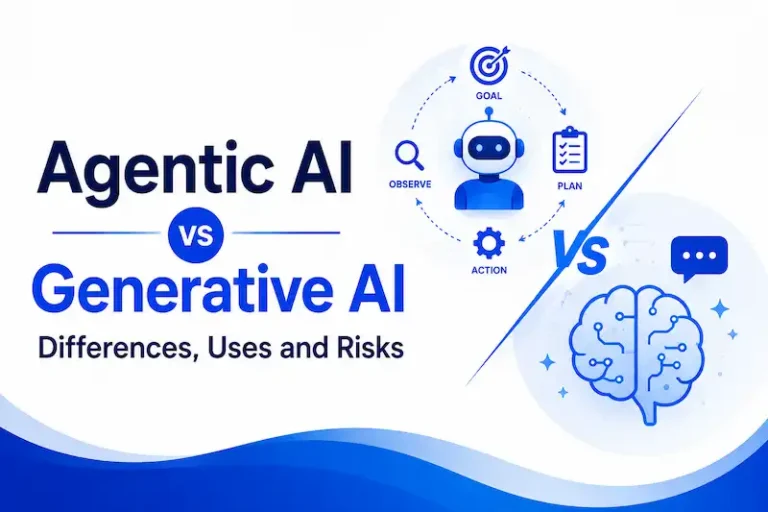
Agentic AI vs Generative AI
Agentic AI and generative AI are not opposing categories.
The clearest distinction is:
Generative AI describes what AI can produce. Agentic AI describes how an AI system can pursue an objective.
Generative AI can create text, images, code, audio or other content.
Agentic AI can use generation as one capability inside a larger process involving decisions and actions.
| Generative AI | Agentic AI |
| Focuses on generating outputs | Focuses on pursuing outcomes |
| Often operates prompt to response | Can continue across multiple steps |
| Human often selects the next task | System can select intermediate actions |
| Tools are optional | Tools are often central |
| Output may be the final product | Task completion may be the final product |
A system can therefore be both generative and agentic.
A generative model might write an email asking a customer for a missing document.
An agentic system might detect that the document is missing, decide that the customer should be contacted, generate the email, send it if authorized, process the response and continue the workflow.
Generation is part of the process.
Agency determines how the process progresses.
AI Agent vs Agentic AI vs Agentic System
These terms overlap in everyday usage, and there is no universally accepted rule requiring people to use them exactly this way.
Still, the following distinction is useful:
| Term | Practical meaning |
| AI agent | A software actor that pursues goals and chooses actions |
| Agentic AI | The capability or design approach centered on AI-driven agency |
| Agentic system | The complete operating system around one or more agents, tools and controls |
An agentic system does not need multiple agents.
A single AI agent connected to tools and operating through a decision-action loop can form an agentic system.
Multi-agent architecture is one possible design, not a requirement for agentic AI.
Agentic AI vs Chatbots, Assistants and Copilots
Product terminology makes this comparison difficult because “assistant,” “copilot” and “agent” are not universally standardized technical categories.
A useful behavioral distinction is:
| System | Typical interaction pattern |
| Chatbot | Human asks, AI responds |
| AI assistant or copilot | Human leads the task, AI helps |
| AI agent | Human delegates an objective, AI chooses some steps |
| Agentic system | AI may coordinate extended multi-step execution |
A chatbot can also contain agentic capabilities.
An assistant can become highly agentic.
The label does not determine the architecture.
Assistant and copilot generally describe a product role. Agentic describes system behavior.
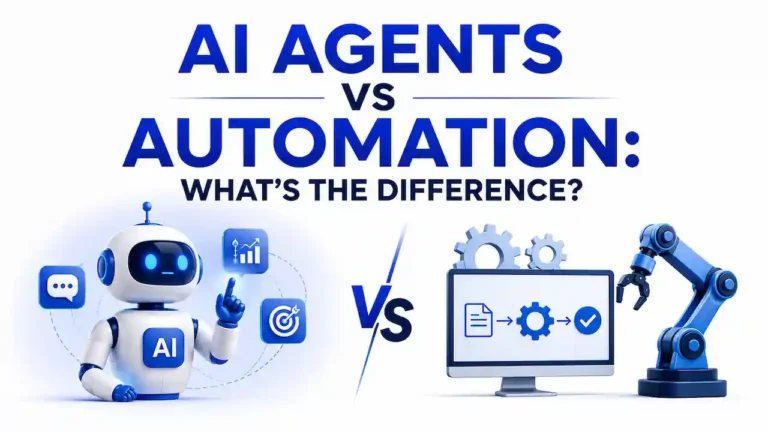
Agentic AI vs Traditional Automation
Traditional automation is strongest when the process is predictable.
Consider:
Invoice received → extract fields → validate supplier → route for approval
If those steps should always occur in the same order, conventional software may be ideal.
Now consider:
Investigate why this invoice cannot be processed and resolve the issue if possible.
The correct path could depend on what the system discovers.
That is where agentic AI becomes more relevant.
| Traditional automation | Agentic AI |
| Follows predefined logic | Can select actions dynamically |
| Best for predictable processes | Useful for uncertain paths |
| Highly repeatable | More adaptable |
| Usually easier to test | More difficult to evaluate |
| Lower decision autonomy | Potentially greater autonomy |
Google Cloud’s 2026 architecture guidance explicitly notes that tasks with deterministic requirements, such as basic summarization, translation or classification, may be handled more efficiently without an agentic architecture.
The goal is therefore not to replace every workflow with an agent.
Agentic AI vs RAG
Retrieval-augmented generation, or RAG, gives an AI model access to external information.
A typical RAG application might:
receive question → retrieve documents → generate answer
That retrieval path can be predetermined.
An agentic system can instead decide whether retrieval is needed, which source to query and what should happen after the result arrives.
RAG primarily addresses an information-access problem.
Agentic AI addresses a broader goal-execution problem.
RAG can also be one of the tools an agent uses.
Agentic AI vs Autonomous AI
“Agentic” and “autonomous” overlap, but they are not necessarily identical.
Agentic AI requires some degree of control over decisions and actions.
It does not require unlimited independence.
An AI system might autonomously investigate a problem, perform 20 internal steps and prepare a resolution while still requiring human approval before changing a customer account.
That system is clearly agentic despite having an important human checkpoint.
For many real deployments, bounded autonomy is therefore more useful than unrestricted autonomy.
Humans can define goals, available tools, permissions, budgets, approval requirements and stopping conditions while allowing the AI to decide what happens between those boundaries.
Anthropic’s 2026 analysis of millions of human-agent interactions provides real-world evidence that agent autonomy varies considerably by context. It also found that the longest-running Claude Code sessions were operating for longer periods before stopping, reinforcing the value of treating autonomy as a spectrum rather than a binary property.
What Are Multi-Agent Systems?
A multi-agent system uses several agents that cooperate, specialize or divide work.
A system might contain:
Research agent: gathers information.
Analysis agent: compares findings.
Verification agent: checks important claims.
Coordinator: decides how work should be distributed.
Agents can operate sequentially or in parallel.
Google Cloud’s multi-agent architecture documentation shows coordinator and specialist agents communicating through agentic flows and A2A-based interoperability.
Multiple agents are not automatically better.
They introduce more coordination, more state, additional model calls and more opportunities for communication errors.
A multi-agent architecture makes sense when specialization or parallel work provides enough benefit to justify that complexity.
Examples of Agentic AI
The difference between ordinary AI assistance and agentic behavior becomes clearer when the two are compared directly.
| Use case | Ordinary AI assistance | Agentic behavior |
| Software development | Suggests code | Inspects repository, runs tests, modifies code and retries |
| Research | Summarizes supplied documents | Chooses sources, retrieves evidence and changes research strategy |
| Customer support | Drafts a response | Checks records, applies policy and performs approved actions |
| Data analysis | Explains how to analyze data | Retrieves data, executes analysis and investigates unexpected results |
| IT operations | Suggests troubleshooting steps | Inspects logs, runs diagnostics and adapts to findings |
| Scheduling | Suggests meeting times | Checks calendars, resolves conflicts and prepares an invitation |
The difference is not whether AI is involved.
It is who determines the sequence of actions.
Why Does Agentic AI Matter Now?
Agentic ideas are not entirely new. What has changed is the capability and infrastructure surrounding them.
Modern AI models are increasingly capable of working across longer tasks, interacting with software and responding to complex instructions.
Agent frameworks now provide mechanisms for tool use, memory, orchestration and monitoring.
Interoperability protocols are emerging for connecting agents with tools and other agents.
Standards institutions are also paying closer attention.
On February 17, 2026, NIST launched its AI Agent Standards Initiative, focusing on areas including agent interoperability, open protocols, security and identity. NIST’s initiative page was subsequently updated in August 2026.
NIST’s separate February 2026 concept paper on software and AI agent identity and authorization also highlights the risks created when agents receive access to diverse data, applications and tools.
That does not mean agentic AI has reached a final standardized form.
It shows that the field is increasingly moving from isolated model demonstrations toward questions of infrastructure, interoperability, identity and production deployment.
What Are the Benefits of Agentic AI?
The most important benefits come from changing how work is delegated.
Less step-by-step direction
A user can provide an objective rather than manually coordinating every action.
Adaptation to unexpected results
If an action fails or reveals new information, an agent can potentially modify its approach.
Longer task execution
Agentic systems can continue across multiple decisions instead of ending after one response.
Cross-system coordination
Agents can potentially choose between tools, applications and information sources as the task develops.
More flexible automation
Tasks that are difficult to express as rigid decision trees may become easier to automate when the system can select actions dynamically.
These are potential benefits, not guarantees. Performance depends on the model, task, integrations, permissions and quality of the overall system.
What Are the Limitations of Agentic AI?
Agency creates flexibility, but it also creates new failure modes.
Errors can propagate
If an agent makes a poor decision early in a long task, later actions may build on that mistake.
Long tasks remain difficult
Each additional decision creates another opportunity for incorrect interpretation, tool failure, lost context or unexpected environmental behavior.
External systems fail
APIs change. Credentials expire. Websites move. Databases return incomplete information.
A capable model cannot eliminate these operational problems.
Agents can cost more
A single generative response might require one model call.
An agentic task can require many model calls, searches and tool interactions.
Evaluation is harder
A deterministic workflow follows a known route.
An agent can choose different routes across separate executions, meaning evaluation must consider outcomes, tool choices, policy compliance and failure handling.
What Are the Main Risks of Agentic AI?
The risk of an agentic system is not determined by model intelligence alone.
A more useful conceptual model considers four factors:
capability + autonomy + authority + exposure
This is not a mathematical risk formula. It is a way to identify where consequences can increase.
Capability asks what the model and system are technically able to do.
Autonomy asks how independently the system can make decisions.
Authority asks which resources and actions it is permitted to access.
Exposure asks what untrusted information, users or environments can influence it.
An agent with modest autonomy and read-only access may present limited operational risk.
A capable agent with broad permissions, powerful tools and exposure to untrusted external content requires much stronger controls.
Excessive permissions
Agents should not receive access simply because it makes a task easier.
Least-privilege principles remain relevant for agent identities.
Prompt injection
Agentic systems may consume content from websites, emails, files or other external sources.
Malicious instructions embedded in that content can attempt to manipulate an agent’s decisions.
Anthropic’s 2026 work on trustworthy agents identifies prompt injection as a significant concern as agents gain greater ability to interact with external systems.
Sensitive-data exposure
An agent may have legitimate access to private information but use an inappropriate tool or destination when acting on it.
Unintended actions
An agent can misunderstand the user’s objective or pursue it through a route the user did not expect.
Weak accountability
Organizations need to understand which agent acted, what identity it used, which tools it accessed and whether a human approved consequential actions.
These issues help explain why NIST’s current AI Agent Standards Initiative includes agent security, identity and interoperability among its strategic areas.
How Can Agentic AI Be Used More Safely?
The amount of control should reflect the consequence of the action.
A low-risk research agent may be able to perform many searches independently.
An agent capable of sending payments, changing production infrastructure or exposing sensitive information should operate under much stronger controls.
Several principles follow from that distinction.
Limit permissions. Give agents only the resources required for the task.
Use approval gates for consequential actions. An agent can investigate independently while still requiring authorization before an irreversible step.
Give agents attributable identities. Organizations should be able to determine which non-human actor performed an action.
Enforce boundaries technically. A prompt saying “never access this system” is weaker than credentials that make access impossible.
Monitor execution. Logging and tracing should make important actions inspectable.
Evaluate complete tasks. A model that answers individual questions well does not automatically create a reliable agent.
Anthropic’s April 2026 guidance on trustworthy agents similarly emphasizes meaningful human control alongside security, transparency and privacy as agent capabilities expand.
When Should You Use Agentic AI?
Agentic AI is most useful when the objective is clear but the path cannot be completely predetermined.
| Task characteristic | Better starting point |
| One answer or transformation | Standard generative AI |
| External knowledge is needed | RAG |
| Fixed, predictable steps | Deterministic workflow |
| Next step depends on intermediate results | Agentic AI |
| Genuine specialist coordination is needed | Possibly multi-agent AI |
Agentic architecture becomes more compelling when the task is multi-step, intermediate results determine later decisions, useful tools are available and the system can safely receive enough autonomy to choose its path.
When Should You Not Use Agentic AI?
More agency is not automatically better.
If a task follows a stable sequence of known rules, deterministic software may be faster, cheaper, easier to test and easier to audit.
A simple translation task usually does not require an agent to develop a plan.
A fixed calculation should not become open-ended simply because an AI model is available.
Google Cloud’s 2026 architecture guidance similarly recommends considering non-agentic approaches for deterministic problems because they can be more efficient and cost-effective.
A useful design principle is:
Use as much agency as the problem requires, not as much as the technology allows.
Does Agentic AI Mean AGI?
No.
Agentic AI and artificial general intelligence describe different ideas.
Agentic AI concerns the ability of an AI system to pursue goals and take actions.
A system can have substantial agency within a narrow environment without possessing broad human-level intelligence.
A coding agent, for example, could autonomously inspect software, execute tests and modify files while remaining unsuitable for many unrelated tasks.
Agency does not establish consciousness, general intelligence or independent desires.
Is Agentic AI Already Real?
Yes.
Agentic systems are already operating in software development, research and other digital workflows.
NIST stated when launching its 2026 standards initiative that AI agents can already operate autonomously for extended periods and perform activities including coding and managing digital tasks.
Anthropic’s real-world autonomy research likewise examined millions of human-agent interactions rather than only laboratory demonstrations.
But existing agentic capability should not be confused with universal reliability.
Performance varies significantly according to the task, model, environment, tools and level of autonomy.
Some systems can complete substantial multi-step work. Others still require frequent correction.
The most accurate conclusion in 2026 is:
Agentic AI is already operational, but dependable autonomy remains highly dependent on the task and environment.
That distinction avoids both hype and unnecessary skepticism.
Conclusion: Agentic AI Is About Who Decides What Happens Next
Agentic AI is best understood as AI that has some control over the path from a goal to an outcome.
Its defining pattern is:
goal → decide → act → observe → adjust
That moves AI beyond the familiar prompt-and-response model.
But “more agentic” does not simply mean “more intelligent.”
A useful evaluation considers four dimensions: decision autonomy, action capability, adaptability and operational duration. For risk and governance, authority matters too. An agent may make many decisions independently while still having tightly restricted permission to affect the outside world.
This is also why generative AI and agentic AI should not be treated as competing technologies. Generation describes what AI can produce. Agency describes how a system can pursue an objective.
The practical question is therefore not whether every organization should maximize AI autonomy.
It is:
How much control should the AI have over what happens next?
For predictable tasks, conventional software, RAG or a fixed workflow may remain the better choice. When the goal is clear but the correct path depends on changing information and intermediate results, agentic AI offers something fundamentally different.
The strongest agentic systems will not necessarily be those given the most autonomy. They will be the ones given the right amount of agency, the right amount of authority and clear boundaries for the task they are expected to complete.