AI Agents vs Chatbots: Differences, Examples and How to Choose
A conversational interface can hide a major difference in what an AI system is permitted to do.
A chatbot is designed primarily to communicate with users, while an AI agent can direct tools and workflow steps to pursue a defined outcome with some degree of independence.
It is what separates answering a customer’s refund question from investigating the order, applying the relevant policy, preparing the refund and updating connected systems. It is why organizations must evaluate control and authority, not simply how intelligent the conversation sounds.
The distinction is not absolute. Advanced chatbots can retrieve data or trigger predetermined actions, while many AI agents use chat as their main interface. The clearest dividing line is who controls the next step: the user, predefined software logic or the AI model.
Key Takeaways
- Chatbots are conversation-first systems, while AI agents are outcome-first systems.
- Tool access alone does not turn a chatbot into an AI agent.
- The defining agent capability is model-directed workflow execution.
- Chatbots suit predictable questions, guidance and controlled transactions.
- AI agents suit variable, multi-step work that cannot be scripted reliably.
- Greater autonomy requires stronger permissions, testing, monitoring and human control.
AI Agents vs Chatbots: The Direct Answer
AI agents pursue goals by selecting tools and directing workflow steps, while chatbots primarily exchange messages with users. A chatbot may retrieve information or trigger predetermined actions, but an AI agent controls at least part of the task path. Chatbots suit predictable conversations; agents suit variable, multi-step work.
OpenAI defines agents as systems that independently accomplish tasks on a user’s behalf. Its guidance distinguishes agents from applications that contain an LLM but do not let the model control workflow execution. It identifies the model, tools and instructions as three foundational components of an agent. See OpenAI’s guide to building AI agents.
This leads to a useful classification rule:
If the system mainly decides what to say, it is probably a chatbot. If the model can also decide what to do next and execute those steps, the system has agentic capabilities.
The rule is more dependable than judging a system by its interface, product name or marketing description.
Scope note: This article focuses on modern software agents that use large language models to select tools or direct workflows. “AI agent” can have a broader meaning in computer science, including intelligent systems that do not use generative AI.
What Is a Chatbot?
A chatbot is software that interacts with people through text or voice. Depending on its design, it can answer questions, retrieve information, collect details, guide users through a process or trigger a limited action.
Not every chatbot uses artificial intelligence. The IBM chatbot overview distinguishes traditional chatbots that follow rules and scripted conversation flows from AI chatbots that use technologies such as natural language processing and large language models.
Rule-Based Chatbots
A rule-based chatbot follows paths designed in advance. It might identify keywords, match a recognized intent or ask users to select from menu options.
An employee benefits chatbot, for example, might provide choices such as annual leave, health insurance and payroll. Each selection opens an approved answer or another branch in the conversation.
These systems are limited, but that limitation can be useful. A narrow chatbot is often easier to test and control when requests are repetitive and the correct responses are already known.
AI-Powered Chatbots
An AI chatbot uses language models or other AI techniques to interpret less structured requests and produce more natural responses. It may maintain conversational context, search a knowledge base and summarize retrieved information.
An AI chatbot can therefore be sophisticated without being an autonomous agent. It might understand a complicated question and retrieve a personalized answer while still waiting for the user to direct every consequential action.
Can a Chatbot Take Action?
Yes. A chatbot might create a support ticket, retrieve an order status, update an appointment or submit a form. Tool use alone does not make the system an agent.
The distinction depends on how the action is selected. If predetermined software calls a specific order-tracking function whenever it recognizes an order-status request, the system remains close to conventional conversational automation.
If the model can select among several tools, evaluate the result of one action and determine which action should follow, the system is operating more like an AI agent.
What Is an AI Agent?
A modern AI agent is a software system in which an AI model controls at least part of the process for pursuing a goal. That control may include choosing tools, evaluating results, revising an approach or deciding when the task is complete.
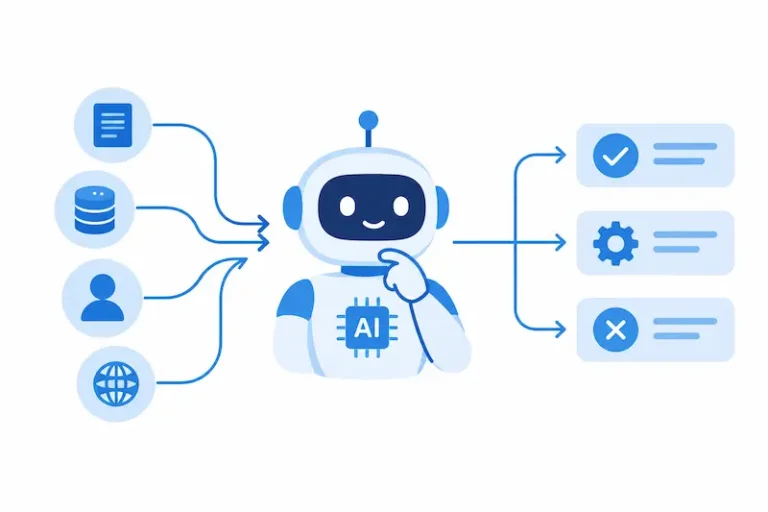
An agent normally begins with a goal or request. It gathers relevant context, selects an available action, observes the result and determines what should happen next. It may continue working, revise its approach, ask for clarification, pause for approval or escalate the task to a person.
Not every agent performs every step independently. Autonomy exists on a spectrum. Some agents can complete low-risk work without intervention but must obtain approval before sending a message, changing a record, spending money or taking another consequential action.
Anthropic distinguishes predefined workflows from agents. In a workflow, code determines the sequence of model and tool calls. In an agent, the model dynamically directs its process and tool usage. Anthropic also recommends starting with the simplest suitable system because greater agentic complexity can increase latency and cost. See its guidance on building effective agents.
AI Agent, Agentic AI and Agentic Workflow
The language surrounding AI agents is not fully standardized, and vendors sometimes use the same terms differently.
An AI agent usually refers to an individual system or software component that works toward a goal and controls part of the task process.
Agentic AI is a broader description of AI systems that exhibit capabilities such as planning, tool use, adaptation, task decomposition or autonomous execution.
An agentic workflow combines models, tools and process controls to complete work. It may contain one agent, several agents, deterministic software and human approval checkpoints.
An AI assistant describes the system’s role in helping a user. Some assistants only answer questions or draft material, while others include agentic capabilities.
A virtual agent is frequently used in customer service, but its meaning varies. It can refer to an advanced chatbot, a workflow-enabled assistant or an AI agent.
Because these labels overlap, buyers should compare actual capabilities. Examine who chooses the next step, which tools the system can access, what it can change and when human approval is required.
AI Agents vs Chatbots: Side-by-Side Comparison
| Comparison area | Chatbot | AI agent |
| Primary purpose | Conduct a conversation | Complete an outcome |
| Typical trigger | User message | Request, event or scheduled condition |
| Control flow | User-led, scripted or response-based | Model-directed within enforced boundaries |
| Tool use | None, retrieval or predetermined actions | Dynamic selection among approved tools |
| Task length | Usually short or user-directed | Potentially multi-step and adaptive |
| Memory | Conversation context or stored preferences | Task state, observations and optional persistent memory |
| External changes | Limited or explicitly triggered | May update systems or initiate actions |
| Error handling | Fallback response or human transfer | Retry, revise, stop or escalate |
| Predictability | Generally higher | Generally lower as autonomy increases |
| Testing focus | Answer quality and routing | End-state accuracy and action safety |
| Operational cost | Usually lower | Often higher due to repeated model and tool calls |
| Main risk | Incorrect or inappropriate responses | Incorrect responses plus harmful actions |
| Best suited to | FAQs, guidance and predictable transactions | Variable, multi-system and outcome-based work |
The categories can overlap. A customer-support platform may use a chatbot as its interface, deterministic software for identity verification and policy rules, and an AI agent for investigating unusual cases.
The Defining Difference: Who Controls the Next Step?
The most reliable way to classify an AI system is to identify what controls task progression.
User-Led Conversation
In a chatbot interaction, the user usually controls the sequence. The chatbot responds to each message, asks a follow-up question or offers a fixed set of options. It does not continue performing substantial work unless the user supplies another instruction.
Success may mean providing a correct answer, finding relevant information, capturing required details or routing the user to the correct service.
Rule-Led Workflow
In deterministic automation, software rules control the sequence. The workflow might contain several model calls and integrations, but its path is designed in advance.
For example, software could collect a customer’s order number, check a return deadline and offer a refund only when predefined conditions are met. An LLM may interpret the request, but the model does not decide which policy applies or invent the next workflow step.
Model-Led Execution
In an agentic system, the model controls at least part of the process. It may decide which source to search, which tool to invoke or whether a previous result is sufficient.
This flexibility is useful when the correct path depends on what the system discovers. It also creates more possible execution paths, making permissions, testing and monitoring more demanding.
Examples of Chatbots, Workflows and AI Agents
| System | Typical example | Why it fits the category |
| Rule-based chatbot | Answers FAQs from scripted responses | Conversation follows predetermined paths |
| AI chatbot | Interprets questions and searches approved content | Language is flexible, but task control is limited |
| Deterministic workflow | Creates a ticket through fixed processing steps | Software rules control the sequence |
| AI agent | Investigates an issue and selects approved tools | The model controls part of the workflow |
| Hybrid system | Combines chat, rules, agent decisions and approvals | Different components control different stages |
These classifications describe architecture rather than branding. A commercial product may function as a chatbot in one configuration and as an AI agent in another.
When Should You Use a Chatbot?
Choose a chatbot when the central need is conversational access to information or a tightly controlled transaction.
Chatbots work well for repetitive questions, product guidance, policy searches, initial support intake, appointment scheduling and routing. They are especially suitable when the interaction has a predictable beginning and end, approved content contains the answer, and users should retain control over consequential steps.
A chatbot can also be the better choice in sensitive environments where consistency and traceability matter more than flexibility. If retrieval or deterministic rules can solve the problem reliably, adding autonomous decision-making may create cost and risk without delivering enough additional value.
When Should You Use an AI Agent?
Consider an AI agent when completing a task requires adaptive decisions across several steps or systems.
Suitable tasks often involve unstructured inputs, changing conditions, exceptions or information that must be gathered during execution. Examples include investigating unusual support incidents, assembling a report from several repositories, triaging complex documents or coordinating an approved operational process.
An agent is a stronger candidate when the intended outcome can be defined and measured, but the path varies from case to case. The required tools should be narrowly scoped, mistakes should be detectable and consequential actions should be reversible or subject to approval.
If developers can express the entire task through dependable rules, a deterministic workflow will normally offer better consistency and simpler governance.
AI Agent or Chatbot Decision Matrix
The following matrix is editorial guidance for assessing a use case. It is not a formal standard.
| Workflow condition | Chatbot | Fixed workflow | AI agent |
| Mainly answers questions | Best fit | Possible | Usually unnecessary |
| Steps are known in advance | Good fit | Best fit | Usually unnecessary |
| Path changes based on findings | Limited | Moderate | Strong fit |
| Requires several systems | Limited | Strong if the order is fixed | Strong if the order varies |
| Includes irreversible actions | Require confirmation | Use approval gates | Use strict human approval |
| Needs repeatable execution | Strong | Strongest | Requires additional controls |
| Handles ambiguous inputs | Moderate with an LLM | Moderate | Strong fit |
| Has no measurable completion state | May be sufficient | Poor fit | Poor agent candidate |
A sound selection process starts by defining the outcome. If success cannot be observed or verified, the task is a poor candidate for autonomous execution.
Next, separate decisions that can be expressed through fixed rules from judgments that depend on context. Identify which tools only retrieve information and which can change a system. Rate those actions by sensitivity, reversibility and potential impact.
The final design should use the minimum level of autonomy needed to complete the task reliably. More autonomy is not automatically better.
Worked Example: Resolving a Customer Refund
Consider a hypothetical online retailer. This example is an illustration and does not describe a real company or measured result.
A customer writes: “My package arrived damaged. Please replace it or refund me.”
Chatbot Approach
The chatbot identifies the return request, explains the policy, asks for the order number and provides a return form. If the situation falls outside the approved policy, it transfers the conversation to an employee.
The chatbot succeeds if it provides accurate information and routes the request correctly.
Deterministic Workflow Approach
The system collects the order number, checks whether the purchase falls within a predetermined return period and offers a refund or replacement according to fixed rules. It asks the customer to confirm before submitting the request.
This approach works well when policy conditions cover nearly every case.
AI Agent Approach
The agent could retrieve the order, review submitted evidence, check delivery records, interpret the applicable policy and prepare a recommended action. If the amount or circumstances cross a defined threshold, it pauses for employee approval. After approval, it could update the order system and notify the customer.
The agent can handle more variation, but it also requires stronger identity controls, narrow permissions, audit logs, exception handling and end-to-end evaluation.
The right choice depends less on conversation volume than on workflow variability and the consequences of a mistake.
Why Hybrid Systems Often Work Better
Organizations do not have to choose one architecture for an entire customer or employee journey.
A hybrid system might use a chatbot to understand the request, retrieval to answer questions from approved content, deterministic code to verify identity, an agent to investigate an unusual case and a human approval gate before a consequential decision.
This approach allocates flexibility only where it adds value. It also allows security, authorization and policy enforcement to remain outside the model.
An agent may recommend a refund, for example, but deterministic software should verify the customer’s identity, the permitted amount and the approval status before the payment system accepts the request. Authorization should not depend solely on the model stating that an action is permitted.
Cost and Operational Differences
Chatbots generally require conversation design, a reliable knowledge source, testing, analytics, integration work and ongoing content maintenance. AI-powered chatbots also need grounding, model evaluation and controls for inaccurate or inappropriate responses.
An agent introduces additional requirements. Teams must design the execution loop, define tools, establish stopping conditions, manage agent identities and configure permissions. They also need procedures for tool failures, timeouts, retries, human escalation, incident response and safe shutdown.
Agent tasks may involve several model calls and external operations, increasing latency and computing cost. Performance should therefore be measured per completed outcome rather than per conversation.
Useful measures include task-completion rate, escalation rate, unauthorized-action rate, average completion time, cost per completed task, recovery success and user correction rate. A fluent final response is not enough if the system reached the wrong end state or used an unsafe action path.
Security, Privacy and Governance Differences
Both chatbots and agents can generate inaccurate content, expose sensitive information or behave inconsistently. Agents add side-effect risk because an incorrect output can become an incorrect action.
OWASP describes excessive agency as a condition in which excessive functionality, permissions or autonomy enables damaging actions. Its recommended controls include restricting available functions, applying minimum permissions and requiring human approval for high-impact actions. See the OWASP excessive agency guidance.
Prompt injection also becomes more consequential when an agent can call tools. Malicious instructions may appear in user input, retrieved documents, webpages or tool results. A secure design should treat untrusted content as data, not as authority to change the agent’s instructions.
Google Cloud’s AI security and safety guidance recommends giving agents distinct identities, granting only the permissions needed for their tasks, isolating state between users and requiring appropriate human control over actions.
Organizations should also make agent actions observable. Logs should record which tool was invoked, what resource was accessed, whether authorization was confirmed and what result the action produced. High-impact operations should pass through deterministic controls rather than relying solely on model judgment.
The voluntary NIST AI RMF Playbook can help organizations govern, map, measure and manage risks across the AI lifecycle. It is not specific to agents, but its lifecycle approach applies to both chatbot and agent deployments.
In 2026, NIST also launched an AI Agent Standards Initiative focused on interoperable, secure and trustworthy agent ecosystems, including agent identity, authorization and security evaluation.
For organizations, the main governance lesson is straightforward: the controls should reflect what the system can access, decide and change. A public FAQ chatbot and an agent with permission to update customer records should not pass through the same approval process.
Build AI governance capability: As AI systems gain access to business data, tools and external workflows, governance responsibilities expand beyond reviewing generated content. Structured AI governance training can help professionals define ownership, approval boundaries, access controls and monitoring requirements before agentic systems move into production.
Common Selection and Implementation Mistakes
One common mistake is selecting an agent because it appears more advanced. If a chatbot or deterministic workflow can meet the objective reliably, an agent may add complexity without improving the outcome.
Another is classifying systems by vendor terminology. Product labels are inconsistent. Buyers should inspect the control flow, tools, permissions and approval requirements behind the interface.
Broad pilot permissions create another serious weakness. Experimental systems should begin with task-specific, preferably read-only access. Permissions can be expanded only after the system demonstrates reliable performance and the organization has implemented monitoring and recovery controls.
Testing only successful scenarios is equally risky. Evaluations should include ambiguous requests, missing information, malformed tool responses, unavailable services, adversarial content and attempts to trigger unauthorized actions.
Finally, organizations should not use the model itself as the only approval mechanism. The same component that proposes an incorrect action should not have final authority to declare that action safe. Consequential approvals should be enforced through independent software rules or accountable human review.
How to Move from a Chatbot to an AI Agent Safely
A chatbot should not become an agent simply by receiving broad access to every relevant system. Capability should expand in controlled stages.
- Improve information quality. Ground chatbot responses in current, approved sources and establish a dependable human escalation path.
- Add authorized read-only retrieval. Allow the system to retrieve relevant account or workflow information without changing it.
- Introduce narrow deterministic actions. Add specific functions such as preparing a ticket, generating a draft or completing a controlled form.
- Require explicit confirmation. Keep the user in control of submissions and other state-changing operations.
- Add model-directed tool selection. Permit adaptive tool use only for well-defined tasks with measurable completion criteria.
- Gate consequential actions. Use independent policy checks and human approval for sensitive, external or difficult-to-reverse operations.
- Monitor and reassess. Review failures, permission use, tool changes, costs, user corrections and emerging risks after deployment.
At every stage, the organization should be able to explain what the system can access, what it can change, when it must stop and who remains accountable.
Conclusion
The difference between AI agents and chatbots is best understood as a question of control and authority.
A chatbot centers on conversation. It can be rule-based or AI-powered, and it may retrieve information or execute limited predetermined actions. An AI agent pursues an outcome by controlling part of a task process, such as selecting tools, evaluating results or deciding the next step.
Choose a chatbot for predictable questions, guidance and tightly controlled transactions. Choose deterministic automation when the required steps are known. Consider an AI agent when the path varies, contextual judgment is necessary and the outcome can be measured.
The strongest design is often hybrid. Conversation, fixed rules, model-directed reasoning, secure tools and human approval can each handle the part of the process they are best suited to perform.
The objective should not be maximum autonomy. It should be the minimum autonomy needed to deliver a useful, measurable and controllable result.