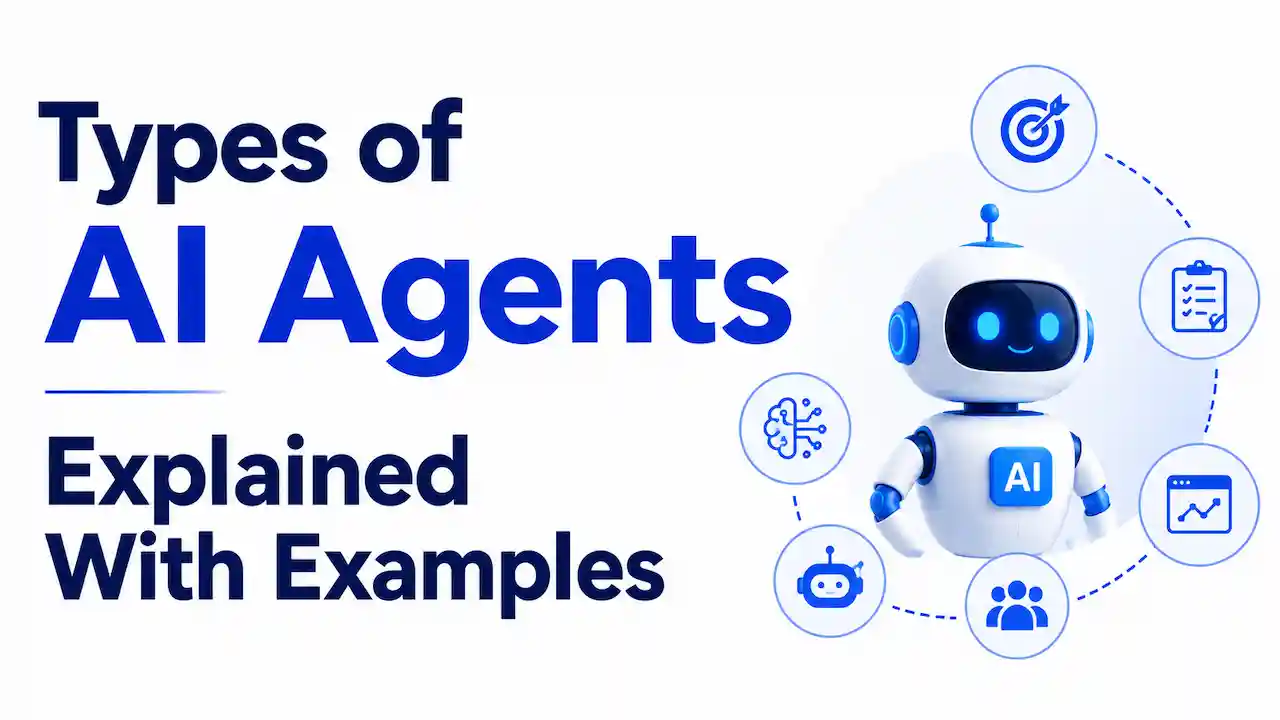
5 Types of AI Agents Explained With Clear Examples
Calling every AI-powered chatbot or automated workflow an “agent” makes it difficult to understand what a system can actually decide, remember, learn, or do.
An AI agent is a system that perceives an environment, selects actions, and acts toward an objective with some degree of independence.
It is what turns available information into decisions and actions. It is why the design of an agent matters as much as the AI model that powers it.
AI agents are commonly presented in five categories: simple reflex, model-based reflex, goal-based, utility-based, and learning agents. More precisely, the foundational academic taxonomy identifies four basic agent structures and explains that learning can be added to any of them.
Key Takeaways
- Four foundational structures describe how agents select actions.
- Learning can improve reflex, goal-based, or utility-based agents.
- Simple reflex agents react without remembering previous conditions.
- Model-based agents maintain state when information is incomplete.
- Goal-based agents plan, while utility-based agents compare outcomes.
- Multi-agent and LLM-based describe architecture, not additional intelligence levels.
What Are the Five Common Types of AI Agents?
The five types commonly used in introductory explanations are simple reflex agents, model-based reflex agents, goal-based agents, utility-based agents, and learning agents.
However, there is an important technical distinction. The official materials for Stuart Russell and Peter Norvig’s Artificial Intelligence: A Modern Approach describe four basic agent types and explain that all four can become learning agents. Learning is therefore an improvement capability rather than a completely separate decision structure.
The popular five-category model remains useful as long as that distinction is understood.
| Common category | What guides its decisions | Memory | Planning | Learning |
| Simple reflex | Current input and fixed rules | No | No | No |
| Model-based reflex | Current input, rules, and internal state | Yes | No | Optional |
| Goal-based | Actions expected to reach a goal | Usually | Yes | Optional |
| Utility-based | Comparative value of possible outcomes | Usually | Yes | Optional |
| Learning-enabled | Data, feedback, or experience improve behavior | Usually | Possible | Yes |
A simple way to remember the progression is:
React → Remember → Plan → Compare → Improve
The first four words describe how an agent selects actions. “Improve” describes what learning adds to the agent.
What Is an AI Agent?
An AI agent is a software or physical system that receives information about its environment, decides what action to take, and performs that action toward an objective.
In a physical system, the agent may receive information from cameras, microphones, temperature sensors, or location data. It may act by moving a robot, adjusting machinery, or activating a safety control.
A software agent may receive user instructions, documents, database records, API responses, or web results. It may act by retrieving information, updating a record, generating a report, sending a message, or requesting human approval.
Modern LLM-powered agents often contain three core elements:
| Element | Function |
| Model | Interprets information and helps select actions |
| Tools | Retrieve data or perform external actions |
| Instructions | Define objectives, limits, and permitted behavior |
OpenAI’s agent-building guide describes agents as systems that independently complete tasks on a user’s behalf. It distinguishes them from applications that use an LLM without allowing the model to control workflow execution.
A chatbot that produces one response is not automatically an agent. A system becomes more agentic when it can select actions, use tools, inspect results, adjust its approach, and continue until it completes the task or reaches a stopping condition.
How Do AI Agents Work?
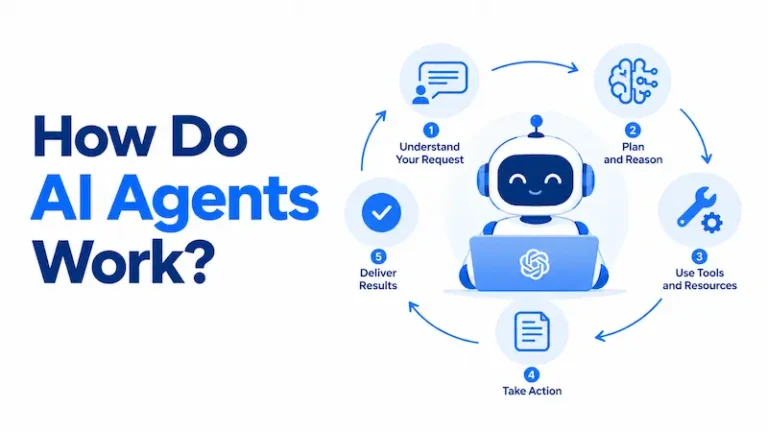
Most agents can be understood through a repeating decision cycle.
- Perceive: The agent receives information from a user, sensor, database, application, or external tool.
- Interpret: It identifies the current situation and relevant context.
- Decide: It selects an action using rules, state, goals, utility, or learned behavior.
- Act: It performs the action through software or physical mechanisms.
- Observe: It inspects the result and updates its understanding of the environment.
- Continue or stop: It repeats the cycle, requests human input, or ends the task.
The decision stage primarily separates the foundational agent types. A simple reflex agent applies fixed rules. A model-based agent also considers stored state. A goal-based agent evaluates future actions. A utility-based agent compares possible outcomes.
Learning can improve any of these decision processes by changing behavior based on feedback or experience.
1. Simple Reflex Agents
A simple reflex agent selects an action using only the current input. It applies a condition-action rule such as:
If condition X is detected, perform action Y.
It does not remember earlier conditions, predict future consequences, or maintain an internal representation of its environment.
A temperature controller provides a familiar illustration. If the measured temperature falls below a threshold, the controller activates the heating system. When the temperature reaches the target, it switches the system off.
In a customer-support workflow, a simple reflex agent might route any message containing “cancel my order” to a cancellation queue. The rule is fast and predictable, but it does not consider order status, customer history, or whether cancellation is still possible.
Simple reflex agents work best in stable, fully observable environments where the correct response to each condition can be defined in advance.
Their advantages include low cost, fast execution, predictable behavior, and straightforward testing. Their main weakness is brittleness. If the rules do not represent a situation correctly, the agent may take the wrong action or fail to act.
Under the classical definition, a rule-based controller can be considered an agent even if it does not use machine learning. In current business language, such a system may be described more accurately as deterministic automation.
2. Model-Based Reflex Agents
A model-based reflex agent maintains an internal state representing information that is not available in the current observation.
It still uses rules, but it applies them to a combination of current input and stored context. The agent may update its internal model by tracking how the environment changes and how previous actions affected it.
A robotic vacuum illustrates this capability. It cannot see an entire room at once, but it can maintain information about areas already cleaned, remembered obstacles, battery status, and its last known location.
In customer support, a model-based agent could consider the customer’s order history, shipment status, previous conversations, and unresolved cases before deciding where to route a request.
This makes model-based agents useful in partially observable environments. They can make decisions without treating every input as an isolated event.
Their reliability depends on the accuracy of the internal state. Missing, outdated, duplicated, or incorrectly linked information can cause the agent to behave as though the environment is different from reality.
3. Goal-Based Agents
A goal-based agent evaluates possible actions according to whether they move the system toward a desired outcome.
Instead of responding only to “What is happening now?”, it considers “Which action is likely to reach the goal?”
A route-planning agent is a clear example. Its goal is to reach a destination. It evaluates possible routes, selects a path, monitors progress, and replans if conditions change.
In customer support, a goal-based agent may work toward resolving a return request. It could gather missing information, verify the order, check the returns policy, determine the available resolution, and request approval if an exception is required.
Goal-based agents are useful when there are several possible action sequences and the system must plan before acting.
Their main limitation is that a goal identifies an acceptable destination but does not necessarily distinguish the best destination. If several actions all satisfy the goal, the agent needs additional criteria to choose among them.
4. Utility-Based Agents
A utility-based agent evaluates possible outcomes and selects the action expected to produce the highest overall value.
A goal-based agent asks whether an action will achieve the desired result. A utility-based agent asks which acceptable result is preferable.
For example, a delivery-planning agent may compare routes according to travel time, cost, reliability, energy use, and contractual service levels.
A customer-support agent may compare several valid resolutions:
| Resolution | Policy fit | Customer impact | Cost | Human approval |
| Refund | High | High | High | Sometimes |
| Replacement | High | High | Medium | Sometimes |
| Store credit | Medium | Medium | Low | Rarely |
| Specialist escalation | High | Varies | Medium | Yes |
The values in this table are illustrative. An actual organization would need to define its own policies, constraints, and evaluation criteria.
Utility-based agents are useful in scheduling, logistics, resource allocation, recommendations, and other situations where several objectives compete.
The difficult part is designing the utility function. If the selected measures do not represent what people actually value, the agent may optimize the wrong outcome.
For example, a support system optimized only for short handling time may close conversations quickly without resolving the customer’s problem. Critical requirements such as safety, legal compliance, and authorization should therefore be treated as fixed constraints rather than factors that can always be traded against speed or cost.
5. Learning-Enabled Agents
A learning-enabled agent changes its behavior based on data, feedback, or experience.
The classical learning-agent model commonly includes four functions:
| Component | Purpose |
| Performance element | Selects the agent’s current actions |
| Learning element | Improves how actions are selected |
| Critic | Evaluates results against a standard |
| Problem generator | Encourages informative exploration |
A recommendation agent may receive feedback when users select, reject, ignore, or rate its suggestions. It can use that information to improve future recommendations.
A customer-support routing agent may learn from corrected classifications. If human reviewers repeatedly move a particular kind of request from billing to fraud review, the system can use those labelled outcomes to improve later routing decisions.
Learning may involve supervised learning, reinforcement learning, online learning, or another adaptation process. The method depends on the task, available data, and quality of feedback.
Learning is not a competing structure in the same way as reflex, goal, or utility logic. A model-based, goal-based, or utility-based agent may also contain a learning component.
For example, a delivery agent could maintain an internal traffic model, plan toward a destination, compare routes by expected utility, and learn better travel-time estimates from completed journeys.
Learning creates adaptability, but it also creates control problems. Feedback may be incomplete, delayed, biased, or manipulated. A learning system can also optimize a proxy measure that does not reflect the intended result.
One Scenario Across All Five Categories
The differences become clearer when every type is applied to the same task.
Consider an illustrative customer-support system handling a product-return request.
| Agent category | How it handles the request |
| Simple reflex | Routes messages containing “return” to a fixed queue |
| Model-based reflex | Uses order status and conversation history to select a rule |
| Goal-based | Plans the steps needed to resolve the request |
| Utility-based | Compares refund, replacement, credit, and escalation options |
| Learning-enabled | Improves routing or recommendations using reviewed outcomes |
A real customer-support platform could combine all five capabilities. Fixed rules might block prohibited actions, stored state could preserve account context, planning could organize the resolution process, utility logic could compare permitted options, and learning could improve predictions.
Classical AI Agent Types vs Modern Agent Architectures
Classical and modern labels often appear in the same lists even though they classify different aspects of an agent.
The foundational taxonomy asks:
How does the agent select its next action?
Modern architecture labels often ask:
What powers the agent, how independently can it act, and how is it organized with other agents?
LLM-powered agents can use generative AI models to interpret information, plan actions, and interact with tools.
| Classification dimension | Example labels | Question answered |
| Decision logic | Reflex, goal-based, utility-based | How does it choose an action? |
| Adaptation | Fixed, learning-enabled | Can behavior improve from feedback? |
| Technology | Rule-based, ML-based, LLM-based | What powers the agent? |
| Organization | Single-agent, multi-agent, hierarchical | How are responsibilities distributed? |
| Autonomy | Assistive, supervised, autonomous | How independently can it act? |
| Control flow | Fixed workflow, dynamically directed | Who selects the next step? |
These categories can overlap. An LLM-powered customer-support agent, for example, may be goal-based, operate as one member of a multi-agent system, and require human approval before issuing a refund.
What Is an LLM Agent?
An LLM agent uses a large language model as a central reasoning or decision component. The model may interpret instructions, form a plan, select tools, inspect results, and decide what to do next.
An LLM alone is not necessarily an agent. An agentic system goes further by allowing the model to participate in a multistep process, use tools, and adapt its actions based on results. It becomes part of an agentic system when it has some control over a multistep process and can interact with tools or an external environment.
Anthropic distinguishes workflows, where models and tools follow predefined code paths, from agents, where the model dynamically directs its process and tool use. Its agent-development guidance recommends using the simplest suitable design because additional autonomy generally increases cost and latency.
An LLM agent may maintain state, pursue goals, compare options, and use stored feedback. This does not mean the underlying model learns during every interaction. Using conversation context or retrieving a memory is different from updating a model or learning policy.
Single-Agent, Multi-Agent, and Hierarchical Systems
A single-agent system gives one agent responsibility for completing the task. The agent may use several tools and perform many steps, but one decision loop remains in control.
A multi-agent system distributes work across several coordinated agents. Each agent may have a separate role, set of tools, instructions, or area of specialization.
A hierarchical system places agents at different levels. A supervising agent may divide the task, assign work to specialist agents, review their outputs, and decide when the overall task is complete.
Common multi-agent orchestration patterns include:
| Pattern | How it works | Suitable use |
| Sequential | Agents work in a predefined order | Staged processing |
| Concurrent | Agents handle independent subtasks in parallel | Parallel analysis |
| Manager | A central agent delegates to specialists | Central coordination |
| Handoff | Agents transfer control based on context | Dynamic specialization |
| Group collaboration | Several agents exchange and refine outputs | Iterative review |
Microsoft documents sequential, concurrent, handoff, group-chat, and manager-led approaches to agent orchestration. These are organizational patterns rather than additional levels of agent intelligence.
OpenAI recommends maximizing a single agent’s capabilities before adding multiple agents. Multiple agents may be justified when one agent struggles with complex instructions, overlapping tools, or clearly separated specialist tasks.
AI Agents vs Chatbots and Traditional Automation
AI agents, chatbots, and automated workflows can overlap, but they are not interchangeable. The distinction between AI agents and AI assistants largely comes down to how independently they can make decisions and take actions.
| System | Selects its own steps | Uses tools | Maintains task state | Acts externally |
| Basic chatbot | Usually no | Not necessarily | Limited | Usually no |
| Traditional automation | No, follows coded steps | Often | Often | Yes |
| AI workflow | Partly constrained | Often | Often | Sometimes |
| AI agent | Yes, within defined limits | Usually | Usually | Often |
Traditional automation is normally preferable when the process is stable and every step can be specified reliably.
An agent becomes more useful when the task involves ambiguous information, frequent exceptions, contextual judgment, or decisions that are difficult to express through fixed rules.
Replacing a predictable workflow with an autonomous agent can reduce reliability without creating additional value. The agent should solve a problem that ordinary software cannot address efficiently.
How to Choose the Right Type of AI Agent
The best agent is usually the least complex design that can meet the task’s requirements safely and consistently.
The following matrix is editorial decision guidance, not a universal technical standard.
| Task requirement | Suitable starting point |
| Current input contains everything needed | Simple reflex or deterministic automation |
| Relevant information must be remembered | Model-based agent |
| Several actions can reach a defined result | Goal-based agent |
| Outcomes involve competing priorities | Utility-based agent |
| Performance must improve from feedback | Add a learning component |
| One model can manage the tools reliably | Single-agent system |
| Work requires separate specialist contexts | Multi-agent or hierarchical system |
| Actions may cause significant harm | Human approval and restricted permissions |
A Five-Step Selection Method
- Define the task boundary. Document the trigger, required outcome, available information, permitted actions, and stopping condition.
- Test whether deterministic automation is sufficient. If the decision can be represented through stable rules, an AI agent may introduce unnecessary cost and uncertainty.
- Identify the missing capability. Determine whether the task requires memory, planning, comparison between outcomes, learning, or specialist delegation.
- Match autonomy to consequences. Separate low-risk reversible actions from actions affecting money, employment, legal rights, privacy, security, safety, customers, or public communications.
- Evaluate the complete trajectory. Check whether the agent selected appropriate tools, respected constraints, recovered from errors, and stopped correctly. Do not assess only whether the final answer sounds plausible.
Risks and Limitations of AI Agents
Greater autonomy expands both capability and the number of ways a system can fail.
| Risk | Why it occurs | Useful control |
| Incorrect action | Model output is treated as reliable instruction | Validate high-impact decisions |
| Excessive permissions | Tools provide more access than required | Apply least-privilege authorization |
| Error propagation | One incorrect step affects later decisions | Verify intermediate results |
| Uncontrolled loops | The agent fails to recognize completion | Set time, cost, and iteration limits |
| Memory exposure | Sensitive context is retained or retrieved | Apply retention and access controls |
| Unclear accountability | Several agents influence one result | Assign a named human owner |
| Weak evaluation | Only the final response is assessed | Evaluate actions, state changes, and outcomes |
NIST has highlighted security concerns involving authentication, memory management, and the combination of AI-generated outputs with software-system capabilities.
Google’s secure-agent guidance emphasizes defined human controllers, carefully limited powers, and observable actions and planning.
Agent evaluation must also cover more than the final answer. Agents operate across multiple steps, use tools, modify state, and adapt to intermediate results. Anthropic’s agent evaluation guidance recommends evaluations that reflect the full complexity of the deployed system.
Common AI Agent Design Mistakes
| Mistake | Better approach |
| Calling every LLM feature an agent | Check whether the model controls workflow execution |
| Starting with the most complex architecture | Begin with rules, a workflow, or one agent |
| Treating more agents as more intelligence | Require evidence that specialization improves results |
| Giving an agent broad tool permissions | Authorize only the required actions and data |
| Defining goals without constraints | Add policies, limits, and escalation conditions |
| Optimizing one proxy measure | Test for undesirable side effects |
| Evaluating only final answers | Inspect decisions, tool calls, and state changes |
| Allowing indefinite execution | Set explicit termination and budget limits |
Conclusion
The five commonly cited types of AI agents provide a useful introduction, but the underlying distinction is more precise. Simple reflex, model-based reflex, goal-based, and utility-based agents describe four ways of selecting actions. Learning is a capability that can improve any of those structures.
Modern terms such as LLM agent, multi-agent system, hierarchical agent, and autonomous agent describe other dimensions, including technology, organization, and independence.
Begin with the task rather than the label. Determine whether the system needs memory, planning, trade-off analysis, or learning. Use deterministic automation when rules are sufficient, and introduce greater autonomy only when evaluation, permissions, monitoring, and human accountability can support it.