AI Agents vs Automation: What’s the Difference?
Choosing an AI agent for a process that only needs straightforward automation can increase cost, complexity and risk without improving the result.
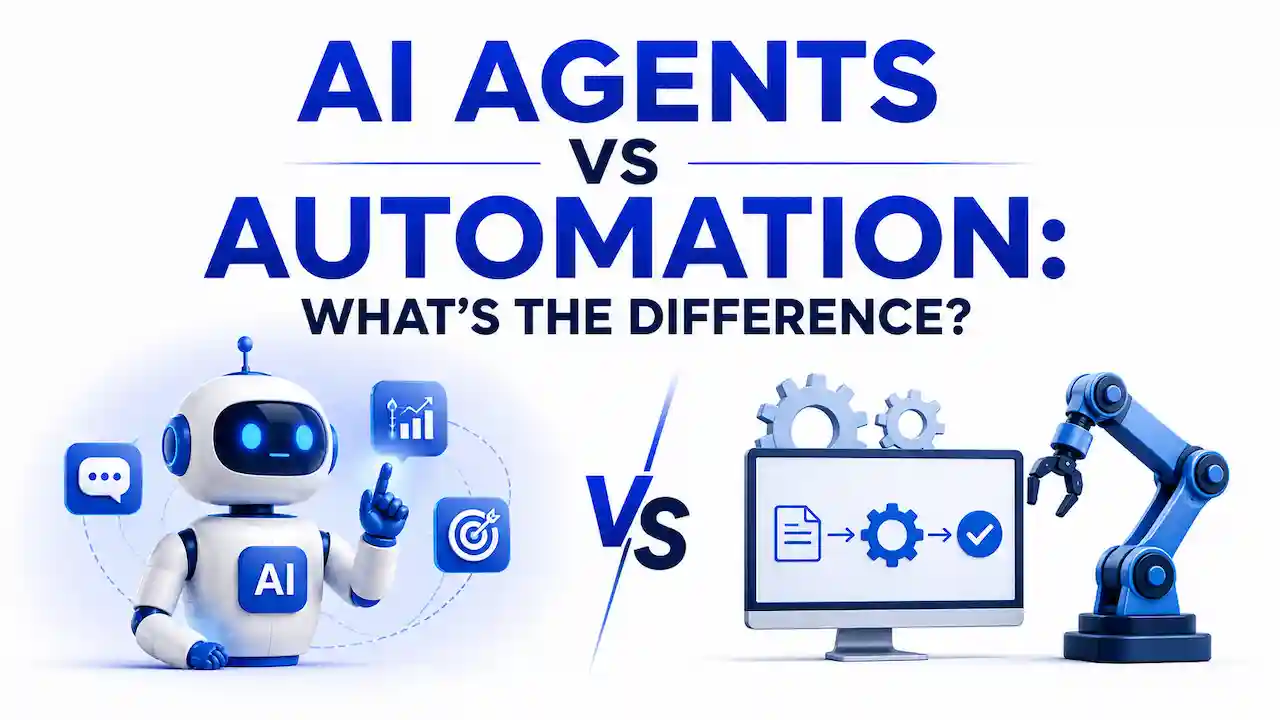
Automation follows a process whose steps and rules are largely defined in advance. An AI agent receives a goal and determines at least some of its steps, tool choices or responses dynamically as the task unfolds.
It is what separates a system that executes a designed path from one that helps choose the path. It is why agents can handle more ambiguity, but also require stronger evaluation, monitoring and control.
The choice is not limited to two extremes. An organization can use traditional automation, place AI inside a controlled workflow, deploy a bounded agent or combine these approaches.
Key Takeaways
- Automation follows predefined process logic, while an AI agent makes some decisions during execution.
- A workflow can use AI for classification, extraction or summarization without becoming an AI agent.
- Automation is usually better for predictable, rules-based and high-consistency work.
- Agents are more suitable when the goal is clear but the necessary steps vary by case.
- Decision rights matter more than whether a product is marketed as “agentic.”
- Hybrid systems often provide the best balance of adaptability, cost and control.
AI Agents vs Automation: The Short Answer
Automation executes a workflow designed in advance, while an AI agent can determine some of its steps and tool choices during execution. Use automation for stable, rules-based work. Use an agent when the goal is clear but the path varies. Use a hybrid system when AI judgment is useful but consequential actions require strict controls.
Anthropic’s guidance on building effective agents draws a similar architectural distinction. It describes workflows as systems in which models and tools follow predefined code paths, while agents allow models to direct their processes and tool use dynamically. Anthropic also recommends starting with the simplest solution and adding agentic complexity only when it produces sufficient value.
The most reliable question is therefore not simply, “Does this system use AI?”
It is:
Who decides what happens next?
If developers have encoded the next step for every meaningful condition, the system is primarily automation. If an AI model selects the next step based on context, available tools and the current state of the task, the system is behaving more like an agent.
What Is Automation?
Automation uses software to execute tasks according to configured triggers, conditions and actions.
A simple automated workflow might detect a submitted form, validate required fields, create a database record and send a confirmation email. More sophisticated automation may contain hundreds of conditions, integrations and approval stages.
The complexity of a workflow does not make it an AI agent. A large workflow can still be deterministic if its permitted paths were defined before execution.
Microsoft describes business process flows as configured sets of stages and steps that guide work toward an intended outcome. Its Power Automate business process overview illustrates the defining characteristic of conventional workflow automation: people design the process path, even when it contains several branches.
Automation can also contain AI. A workflow might use a language model to summarize a support message, classify a document or extract invoice fields before sending the result into a predefined process.
In that case, the model performs a bounded task. It does not control the overall workflow.
What Is an AI Agent?
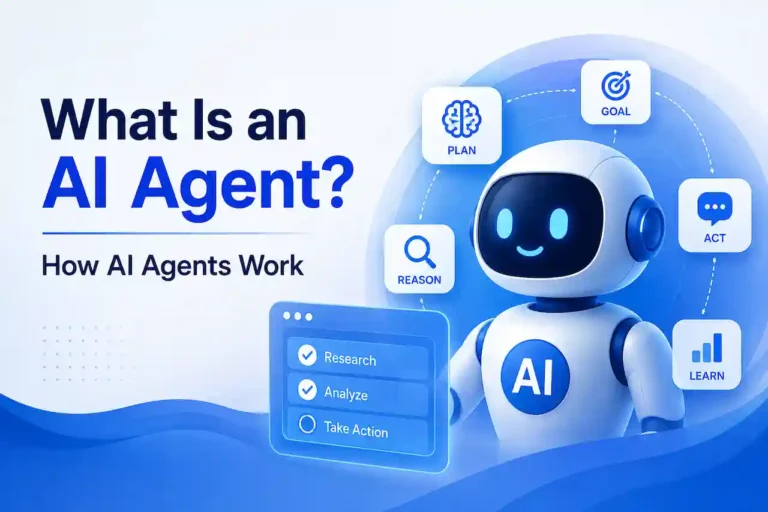
An AI agent is a software system that uses an AI model to pursue a defined goal, interpret context, choose among permitted actions and interact with tools or external systems.
OpenAI describes agents as systems that independently accomplish tasks on a user’s behalf. According to its guide to building agents, an agent uses a language model to manage workflow execution, select tools, recognize when a task is complete and return control when it cannot proceed safely.
A typical agent operates through a repeated cycle:
- Receive a goal and relevant context.
- Assess the current state of the task.
- Select an action or tool.
- Observe the result.
- Decide whether to continue, revise its approach, request help or stop.
Agent architectures commonly combine a model with instructions, tools, state or memory, orchestration, guardrails and evaluation.
An IEEE survey of LLM agents similarly identifies planning, memory and tool use as core modules surrounding the language-model component of an agent.
Not every agent learns permanently from each interaction. Some retain information only for the current task. Others use controlled external memory or improve through a separate development process. Continuous learning is not required for a system to behave as an agent.
AI Agents vs Automation: Key Differences
| Dimension | Traditional automation | AI agent |
| Starting point | Trigger, schedule or event | Goal, request or event |
| Process path | Defined before execution | Partly determined at runtime |
| Decision method | Programmed rules and conditions | Model judgment plus rules |
| Input | Best with structured, stable inputs | Can interpret variable, unstructured inputs |
| Tool selection | Chosen by workflow designers | May be chosen dynamically |
| Exceptions | Uses predefined handling or escalation | Can investigate within permitted boundaries |
| Output | Usually consistent for the same input | May vary between runs |
| Latency | Typically lower and predictable | Often higher and more variable |
| Evaluation | Rules, branches and integration tests | Scenario evaluation, tool tests and outcome checks |
| Primary advantage | Reliability and repeatability | Flexibility and contextual interpretation |
| Primary limitation | Difficulty handling unanticipated cases | Lower predictability and greater control requirements |
| Best fit | Stable, rules-based processes | Variable but bounded tasks |
These differences are tendencies rather than universal rules. Automation can be highly complex, and agents can be tightly constrained.
The meaningful difference is how much discretion the model receives during execution.
AI Automation Is Not Always an AI Agent
“AI automation” is a broad category. It may refer to a fixed workflow containing one AI step or to an agent that controls a multi-step process.
Consider a customer-service workflow that performs the following sequence:
- Receive an email.
- Use AI to summarize the message.
- Use AI to classify the request.
- Route it to a predefined queue.
- Notify the assigned team.
The workflow uses AI, but it is not necessarily an agent. The model performs defined tasks inside a process controlled by software.
Now consider a system that receives the goal “resolve this account problem.” It reviews the account, searches documentation, chooses diagnostic tools, requests missing information, attempts an approved correction and verifies the outcome.
That system behaves more like an agent because the action sequence is determined during execution.
This creates an autonomy spectrum:
| Architecture | Who controls the path? | Suitable example |
| Fixed automation | Predefined software logic | Send a receipt after payment |
| AI-assisted workflow | Software controls the path; AI handles a bounded step | Extract fields from an invoice |
| Bounded AI agent | Agent chooses among limited tools and actions | Investigate an IT support issue |
| High-autonomy agent | Agent plans and executes a broad task | Research and modify multiple software files |
Organizations should move along this spectrum only when additional discretion creates measurable value.
What Decisions May the System Make?
Product labels are inconsistent. A more reliable evaluation examines the decision rights assigned to the system.
| Decision right | Question to ask | Safer default |
| Interpretation | May AI classify, summarize or extract information? | Permit with output validation |
| Planning | May AI determine the next step? | Limit it to a defined task domain |
| Execution | May AI change another system? | Use narrow, task-specific tools |
| Commitment | May AI create financial, legal or customer-facing consequences? | Require rules or human approval |
| Escalation | When must control return to a person? | Define explicit thresholds |
| Termination | How does the system know the task is complete? | Use verifiable completion criteria |
This distinction matters because two products marketed as AI agents may have very different authority.
One agent may only research and recommend actions. Another may create records, send messages, change accounts or initiate transactions. The second requires stronger security, monitoring and accountability even if both systems use the same underlying model.
When Should You Use Automation?
Automation is usually the better choice when the process path is known and the correct outcome can be expressed through rules.
Strong candidates include scheduled reporting, field validation, data transfer, calculation, standard notification, access provisioning after approval and policy-based routing.
Automation is also preferable when consistency matters more than flexibility. Financial postings, access changes, formal submissions and other sensitive actions may require deterministic controls even if AI assists with earlier analytical work.
A useful test is whether process owners can describe the workflow accurately as conditions and actions. If they can specify what should happen for every meaningful input, an agent may add complexity without creating proportional value.
When Should You Use an AI Agent?
Consider an AI agent when the goal is clear but the exact steps vary by case.
Agents are better candidates when work involves unstructured information, contextual interpretation, changing conditions, tool selection or exceptions that would require an impractical number of rules.
Examples include investigating unfamiliar technical incidents, conducting multi-source research, resolving unusual customer requests and modifying code across an unfamiliar repository.
OpenAI recommends considering agents for workflows involving complex judgment, difficult-to-maintain rule sets or extensive unstructured data. Anthropic similarly identifies open-ended problems with unpredictable steps as a stronger fit for agents.
A variable process path is not sufficient on its own. The task also needs clear boundaries, reliable context, observable actions, defined escalation conditions and a credible method for determining whether the result is correct.
If success cannot be evaluated and mistakes cannot be contained, the system should support a qualified person rather than act independently.
How to Choose Between Automation and an AI Agent
Use the following sequence to reach a decision.
1. Can a wrong action create an irreversible or high-impact outcome?
Examples include releasing a payment, deleting data, changing access rights, sending a legally significant communication or making a decision that materially affects a person.
If yes, retain deterministic enforcement, authorized approval or both. An agent may investigate or recommend, but it should not receive unrestricted execution authority.
2. Can the process path be specified in advance?
If yes, begin with traditional automation. A well-defined workflow is usually easier to test, audit and maintain than an agent.
If no, continue to the next question.
3. Is only one step ambiguous or dependent on unstructured information?
If the workflow is predictable but one step requires document extraction, classification, summarization or interpretation, use an AI-assisted workflow.
The model handles the ambiguous step while conventional automation controls the rest of the process.
4. Must the system select tools or determine steps dynamically?
If the required tools or sequence depend on information discovered during execution, a bounded agent may be appropriate.
Give the agent only the tools, data access and actions necessary for the defined task.
5. Can success be verified?
An agent is a stronger candidate when completion can be checked through tests, system state, reconciliation rules, supporting evidence or qualified review.
If no credible verification method exists, do not give the agent independent authority to complete consequential work.
6. Does the additional flexibility justify the cost?
Compare the proposed agent with the simplest viable alternative. Include model inference, tool calls, evaluation, monitoring, security, human review and maintenance.
The relevant measure is not the cost of one model call. It is the cost per correctly completed task.
Why a Hybrid System Is Often Better
Most business processes contain both predictable and ambiguous work. This makes a hybrid architecture more useful than an all-or-nothing choice.
A hybrid system uses an agent for interpretation or investigation while conventional automation controls permissions, policy gates, approvals and final execution.
For example, an agent may investigate a refund request and prepare a recommendation. Deterministic controls can then verify the customer, apply refund limits, request approval when required and execute the approved transaction.
In this design, AI interprets ambiguous information, the agent selects among narrowly permitted investigative actions, rules enforce policy, a person approves high-impact exceptions and automation executes the authorized outcome.
This preserves adaptability where it adds value without delegating every decision to a probabilistic model.
Worked Example: Processing Supplier Invoices
The following example is illustrative and does not describe a specific company.
A business receives supplier invoices in several formats. Most match an approved purchase order, but some contain missing details, unfamiliar service descriptions or price discrepancies.
Automation-only approach
A conventional workflow extracts required fields, validates the supplier, compares the invoice with purchase-order data and routes discrepancies to an employee.
This is efficient for standard invoices. It does not independently investigate unusual discrepancies unless that investigation has been encoded.
Agent-only approach
An agent receives the goal of processing each invoice. It determines which records to retrieve, compares documents, evaluates discrepancies and decides how to proceed.
This offers flexibility, but allowing the agent to approve suppliers or release payments would create unnecessary exposure.
Hybrid approach
Automation handles intake, validation, matching and payment execution. A bounded agent investigates exceptions by retrieving relevant contracts, purchase orders and approved correspondence. It produces a recommendation with supporting evidence.
Deterministic controls apply approval thresholds. An authorized employee reviews exceptions and any proposed action that affects payment.
The hybrid design fits because ambiguity exists in the investigation, not in the company’s payment authority.
Cost and Resource Differences
Traditional automation requires process mapping, integration, testing and maintenance. Its runtime costs are generally more predictable because the system follows known paths.
An AI-assisted workflow adds model usage, output validation and monitoring for the AI step.
An agent may incur repeated model calls, tool usage and longer execution time as it plans, acts, observes and revises. It also requires broader scenario testing, action logs, permission management, stopping conditions and human escalation.
A complete cost comparison should consider initial design, integration, model use, tool calls, evaluation, monitoring, security, exception handling and maintenance after process or system changes.
An agent may still be economically justified when it handles valuable exceptions or variable work that would otherwise require substantial manual effort. The decision should be based on verified task outcomes rather than assumed productivity.
Risks and Required Controls
Automation and AI agents fail differently.
Traditional automation may fail when an interface changes, required data is missing or an exception was not anticipated. These failures are often repeatable and can usually be traced to a specific rule or integration.
Agent failures may vary between runs. An agent can misunderstand the objective, rely on unreliable context, select an unsuitable tool, repeat unsuccessful actions or base later decisions on an earlier mistake.
Greater autonomy can also increase the impact of malicious or manipulated input.
OWASP identifies excessive functionality, excessive permissions and excessive autonomy as major causes of damaging agent behavior. Its guidance on excessive agency recommends limiting available tools, applying least-privilege access, enforcing authorization in downstream systems and requiring approval for high-impact actions.
| Risk | Appropriate control |
| Incorrect interpretation | Reliable context and output validation |
| Wrong tool selection | Narrow tool catalog and tool-level testing |
| Excessive permissions | Least-privilege identities and scoped access |
| Prompt injection | Input controls and separation of untrusted content |
| Repeated actions | Tool-call budgets, retry limits and stopping conditions |
| Irreversible action | Human approval and downstream policy enforcement |
| Poor traceability | Logs of inputs, actions, tool results and approvals |
| Performance drift | Continuous evaluation and change-triggered review |
The NIST AI Risk Management Framework provides voluntary guidance for incorporating trustworthiness considerations into the design, development, use and evaluation of AI systems. Its Generative AI Profile provides additional guidance for risks associated with generative AI.
How to Pilot the Selected Approach
1. Define the outcome
Specify what successful completion means. Use an observable result such as a correctly routed case, reconciled record or resolved ticket.
2. Map the existing process
Document inputs, normal steps, exceptions, decisions, systems, owners and approval points. This reveals whether the work is genuinely open-ended or simply poorly documented.
3. Establish a baseline
Measure the current workflow or simplest viable automation before introducing an agent. This creates a defensible comparison for accuracy, completion time, cost and escalation.
4. Separate analysis from authority
Identify which steps interpret information and which create consequences. An agent may assist with analysis without receiving permission to execute every resulting action.
5. Start with minimum autonomy
Provide read-only access where possible. Add narrowly defined write actions only after evaluations show that they are necessary and adequately controlled.
6. Test normal, difficult and hostile cases
Test representative tasks, incomplete information, conflicting instructions, tool failures, edge cases and manipulated inputs. Measure completion quality and error severity, not only whether the agent produced an answer.
7. Monitor after deployment
Record tool calls, outputs, approvals, failures, overrides and costs. Review the system whenever its model, instructions, tools, data sources, permissions or business process changes.
Common Mistakes to Avoid
The first mistake is building an agent because it sounds more advanced. Technology selection should begin with the process and required decision rights.
Another mistake is calling every workflow containing AI an agent. A summarization or classification step does not make the surrounding process agentic if software still controls what happens next.
Organizations also create risk by giving agents broad tools and permissions. A system that only needs to read product data should not be able to update or delete records.
Model instructions should not be treated as access controls. Authorization must be enforced by the systems the agent calls, not left to the model’s judgment.
Finally, teams often test whether an agent can complete ideal examples without examining incorrect actions, edge cases and escalation behavior. A production evaluation must consider both the likelihood and consequences of failure.
Conclusion
AI agents and automation differ primarily in how workflow decisions are made and how much authority the system receives.
Automation is usually the better choice when inputs, rules and process paths are stable. An AI-assisted workflow fits when the overall path is predictable but one step requires interpretation. A bounded agent becomes useful when the goal is clear but the necessary tools or steps vary during execution.
Greater flexibility brings greater responsibility. Agents require limited permissions, reliable evaluations, observable actions, stopping conditions and approval gates for consequential decisions.
Select one candidate process and divide it into interpretation, planning, execution, approval and escalation decisions. Automate every step that can be governed reliably by rules. Use AI where contextual interpretation adds value, and grant execution authority only after the system has demonstrated that it can operate within defined limits.