How AI Agents Make Decisions
Imagine asking an AI agent to research several project-management tools and recommend the best option for a five-person startup. (This is an illustrative scenario we will return to throughout this article, not a documented real-world event.) A few seconds after your request, the agent begins searching documentation, comparing pricing pages, and weighing trade-offs. Eventually it produces a recommendation.
Here is the question that matters: how did it decide what to do at each step?
Answering a question is not the same as deciding what to do. The more interesting problems sit between the request and the response. Should the agent search the web first, or ask you clarifying questions? Which sources should it trust? When has it gathered enough evidence? Should it recommend one tool, present a shortlist, or ask you to decide? When should it stop?
Those are decisions, and modern AI agents make them at two distinct levels. Operational decisions are small and frequent: whether to search, which tool to call, what arguments to pass, whether to retry. Task-level decisions are larger and rarer: whether the evidence supports a recommendation, whether the task is complete, whether to escalate to a human. Understanding how AI agents work requires understanding both levels, and the system that surrounds them.
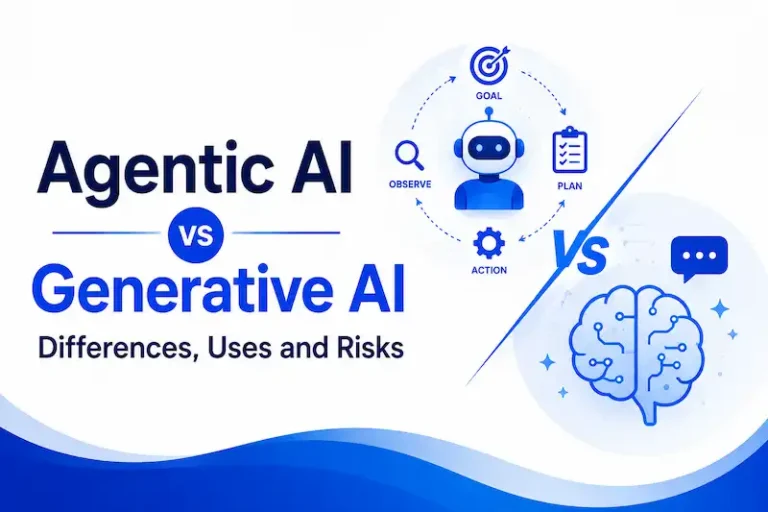
The conceptual model this article uses is a loop: Goal → Current State → Available Actions → Constraints → Select Action → Execute → Observe → Evaluate → Continue, Change, Ask, Escalate, or Stop. This is an explanatory model, not a universal technical pipeline. Real agent architectures skip steps, repeat steps, branch, run actions in parallel, delegate subtasks, follow deterministic workflows, and combine model-driven logic with hard-coded rules. We will return to that variation repeatedly, because it is central to the honest answer.
One more scope note: this article focuses on modern software agents built around foundation models, tools, orchestration layers, and application runtimes. The broader concept of software agents, systems that perceive an environment and act toward goals, predates today’s LLM-based systems by decades. IBM’s overview of agent types, for example, describes classic reflex, goal-based, utility-based, and learning agents that have nothing to do with language models. This is not a history article, but that lineage matters: not every agent uses an LLM, and not every decision an agent makes is a language-model inference.
What Does an AI Agent Actually Decide?
The word “decision” gets used loosely in discussions of AI agents, often as a synonym for “the model picked the next tool call.” That is too narrow. A more useful definition: a decision is any point where the system selects among available behaviors when more than one behavior is possible.
Operational decisions occur inside the execution of a task:
- Whether to gather more information before acting
- Which tool to use, and with what arguments
- Whether to verify a result before relying on it
- Whether to retry a failed action, change strategy, or ask a clarification question
- Whether to escalate or stop
Task-level decisions concern the substance of the work itself:
- Which alternative best fits the stated requirements
- Whether a recommendation is justified by the available evidence
- Whether the evidence is sufficient to proceed
- Whether the task has been adequately completed
Some agentic systems are primarily execution-oriented: they retrieve, fill forms, and move data. Others support decision or recommendation workflows, where the agent’s output is a judgment a human will act on. The project-management example is the second type. It would be a mistake to assume every agent has unrestricted authority to make high-level decisions. In well-designed systems, the agent’s authority is bounded by design.
The action space: decisions are made from a menu, not a universe
A critical and often overlooked concept is the action space: the set of actions an agent can actually take. An agent never chooses from an unlimited universe of options. Its available actions are constrained by the tools and APIs it has been given, its permissions, the policies governing it, the application design, its data access, and the environment it operates in. “Action” should be understood broadly. It includes tool calls and retrieval, but also internal computation, workflow transitions, sending messages, asking clarification questions, producing a recommendation, escalating to a human, and stopping.
Controlling the action space is one of the most powerful levers developers have. An agent that can only read a database and draft text operates within a very different risk envelope than one that can send emails, move money, and delete records. A bounded action space improves reliability (fewer ways to go wrong), safety (fewer ways to cause harm), and predictability (fewer behaviors to test and monitor). When you hear that an agent “decided” to do something, a good follow-up question is always: was that action even available to it, and who made it available?
Bounded autonomy: inform, recommend, request approval, act
Autonomy exists on a spectrum, and a useful progression describes most production systems:
Inform → Recommend → Request Approval → Act
At the lowest level, the agent supplies information. At the next, it makes a recommendation. Then it can prepare an action but require explicit human approval before executing. Only at the highest level does it act without per-action human involvement. IBM’s comparison of agentic AI and generative AI makes the same point: agentic systems “can operate with varying levels of autonomy” and can involve a human “for approvals, oversight or decisions that require judgment.” The level of autonomy depends on permissions, capabilities, policies, the environment, application design, and system controls. An agentic system is not automatically an autonomous one.
The model decides things; it is not the whole system
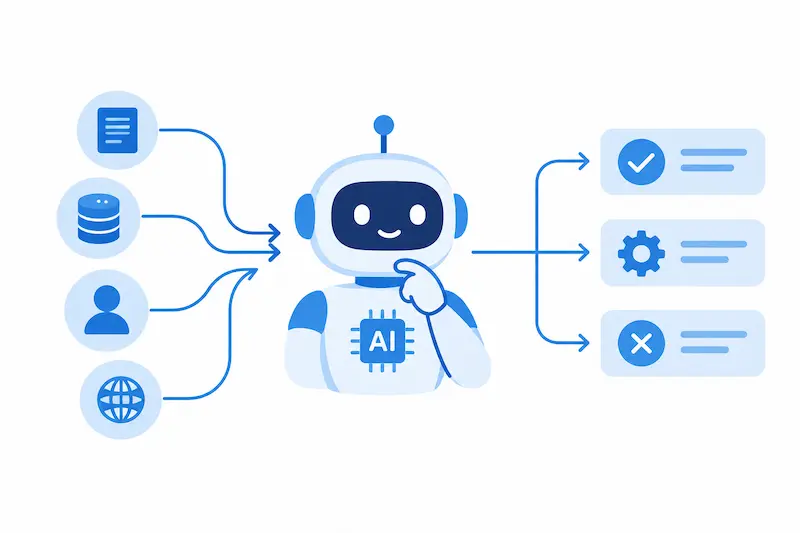
A common oversimplification says “the AI model decides everything.” In practice, the decision emerges from a larger system. OpenAI’s practical guide to building agents describes an agent’s fundamental components as a model (the LLM powering reasoning and decision-making), tools (external functions or APIs), and instructions (guidelines and guardrails defining behavior). Depending on the architecture, the model may propose an action while a different component determines whether and how it executes: the orchestration layer, the tool layer, permission checks, validation logic, guardrails, or a human approval step. The model is one decision-making contributor inside a larger decision-making system, and implementations vary widely.
How the AI Agent Decision Loop Works
With those foundations in place, here is the conceptual loop in detail. Remember: this is a model for understanding, not a claim about how any particular agent is implemented.
Goal. Everything begins with an objective, whether a direct command or an interactive discussion that clarifies what the user wants. The goal shapes every later judgment: what counts as progress, what information is relevant, when the work is done.
Current state. The agent assesses what it knows: the conversation so far, retrieved context, prior tool results, its position within a workflow. In a well-designed system, the agent gains “ground truth” from its environment at each step rather than relying only on assumptions, a design principle Anthropic emphasizes in its essay on building effective agents.
Available actions. From its action space, the agent identifies which actions are relevant and permitted right now. A search tool is only useful if something needs searching; a refund tool is only legal if the policy allows it.
Constraints. Permissions, policies, budgets, and approval requirements filter the candidate actions before selection. Some constraints are hard (the runtime simply will not execute a forbidden call); others are soft (instructions that tell the model what to avoid).
Action selection. The system chooses among the remaining candidates using whatever decision mechanisms it implements, which we will discuss in the next section.
Execution. The selected action is carried out by the appropriate component: the tool layer executes an API call, the runtime transitions a workflow state, or the system presents a question to the user.
Observation. The agent observes the result: tool output, an environment change, a validation result, or the user’s reply.
Evaluation. The system interprets the result. Did the action succeed? Did it produce the intended effect? Is the task closer to complete? Is new information missing, conflicting, or surprising?
Continue, change, ask, escalate, or stop. Based on the evaluation, the system either continues with the next step, changes course, asks for information or approval, escalates to a human, or stops.
This interleaving of reasoning and acting has a direct research lineage. The ReAct paper, presented at ICLR 2023 by researchers from Princeton and Google, showed that language models generating reasoning traces and task actions in an interleaved manner outperformed methods that did either in isolation. The authors’ explanation is instructive: reasoning traces help the model induce, track, and update action plans and handle exceptions, while actions let it gather information from external sources such as knowledge bases and environments.
Anthropic’s agents essay describes the same pattern from an engineering perspective: agents “begin their work with either a command from, or interactive discussion with, the human user,” then plan and operate independently, checking tool results and execution output at each step to assess progress, and pausing “for human feedback at checkpoints or when encountering blockers.”
Now the necessary caveat, stated plainly: no universal pipeline exists. A survey of emerging agent architectures documents dozens of variations on how models, planners, tool callers, and memory components can be composed. Some systems are reactive, deciding one step at a time. Some plan explicit multi-step sequences in advance. Some follow deterministic workflows with model calls at fixed points. Some delegate subtasks to other agents. Some stop early when a validation gate fails. The loop above is a map of the territory, not the territory.
What Determines Which Action an Agent Chooses?
When an agent selects an action, what is it actually weighing? There is no single mechanism, but there is a consistent set of factors that can influence selection:
- Goal alignment: does this action advance the stated objective?
- Current state and context: what has happened so far, and what does this situation require?
- Available capabilities: which tools and data can actually help here?
- Permissions and constraints: what is this agent allowed to do?
- Expected usefulness: is this action likely to produce information or progress that matters?
- Evidence quality: how trustworthy is the information the action would rely on?
- Uncertainty: how confident is the system in its read of the situation?
- Risk and side effects: what could go wrong, and what else would this action affect?
- Cost and latency: what does this action consume in time, money, or compute?
- Reversibility: can the action be undone if it turns out to be wrong?
- Task progress: is this the right action for this stage of the task?
Be skeptical of any explanation that reduces this to a tidy formula. Different systems implement decision criteria through different mechanisms: model judgment (the LLM weighs factors implicitly in its output), explicit rules, policies, heuristics, scoring functions, learned policies from training, deterministic workflow logic, or combinations of these. A rules engine and a language model can both implement “prefer low-risk actions when uncertainty is high” with completely different machinery. What matters for understanding is not the arithmetic but the logic: action selection is a matching process between what the situation calls for, what the system knows, what it can do, and what it is allowed to do.
Reversibility deserves special attention because it appears explicitly in production guidance. OpenAI’s agent guide recommends assessing each tool’s risk, considering factors such as whether it is read-only or write-capable, whether its effects are reversible, and its potential financial impact, then routing high-risk actions through additional checks or human escalation. An agent deciding between reading a knowledge base and issuing a refund is, at least in well-governed systems, operating under different decision rules for each.
How Models, Planning, and Tools Contribute to Agent Decisions
Reasoning, planning, and tool use are distinct concepts that are constantly blurred together. Separating them clarifies how AI agents make decisions.
AI agent reasoning is model inference applied to the situation: interpreting the goal, analyzing available information, comparing alternatives, formulating a plan, interpreting tool results, noticing missing information, judging whether more work is needed. Reasoning is a contributor to decision-making, not a synonym for it. The decision to stop might come from a hard iteration limit, not from any reasoning at all.
One qualification is essential here: internal model reasoning is not fully observable. Modern frontier models may produce extended internal reasoning before responding, but tool traces and logs show you what the system did, not everything the model considered. Do not assume that a visible chain of actions exposes every internal deliberation step, and do not assume every model reasons the same way. The honest distinction is between observable behavior (which you can audit) and internal reasoning (which you generally cannot, at least not completely).
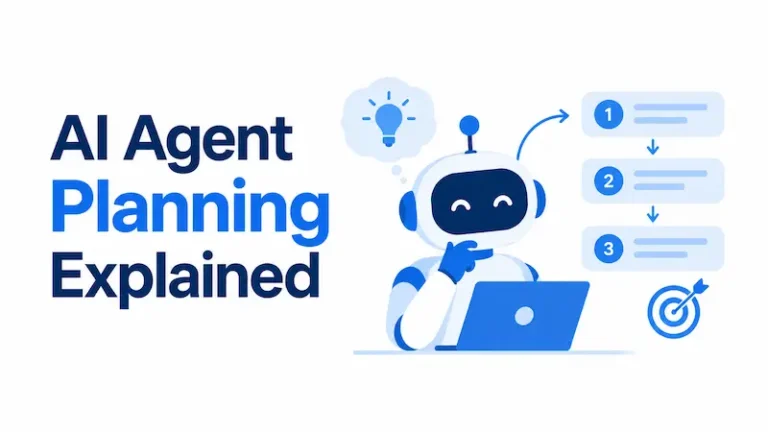
AI agent planning is the organization of actions over time. Decision and planning answer different questions:
| Concept | Main Question | Role |
| Decision | What should happen next? | Selects an action or outcome |
| Planning | What sequence could achieve the goal? | Organizes possible steps |
| Tool selection | Which capability should be used? | Chooses an available tool |
| Execution | How is the action performed? | Carries out the action |
| Evaluation | Did it work? | Assesses the result |
| Replanning | Should the approach change? | Revises the strategy |
| Stopping | Is enough work complete? | Ends the process |
Not every agent plans explicitly. Architectures range from explicit upfront planning (generate a full plan, then execute it), to dynamic planning (plan one or a few steps, then re-plan), to reactive behavior (no plan beyond the current step), to deterministic workflows (the plan is the code), to hybrids that mix all of these. ReAct sits in the middle: it plans and adjusts continuously, using reasoning traces to update action plans as observations arrive.
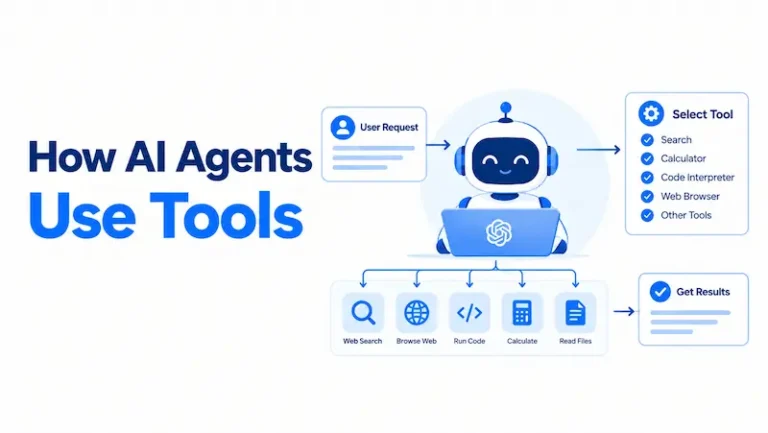
Tool selection and execution is where decisions become consequential, because understanding how AI agents use tools helps explain how agents connect their decisions to the outside world. Here the research is illuminating: ToolFormer, a 2023 Meta AI research project, demonstrated that a language model could be trained in a self-supervised way to decide which APIs to call, when to call them, what arguments to pass, and how to incorporate the results. The trained 6.7-billion-parameter model outperformed much larger models on tasks involving math and factual lookup, precisely because it learned when tool use was worthwhile. The finding generalizes: tool selection is itself a learnable decision skill, not just a hard-coded routing rule. Modern function calling follows the same pattern at larger scale and with more capable models.
Deterministic logic deserves equal billing. Many production agents wrap model inference in code: workflow states, validation gates, retry policies, approval checks, and budget limits. In these systems, some decisions belong to the model and others belong to the runtime, and part of designing an agent is deciding which is which.
How Context, Feedback, and Uncertainty Change the Next Decision
Every decision an agent makes is provisional, because the next observation can change everything. Three concepts organize this.
Context is the information currently available to the system during the task: the conversation, retrieved documents, tool outputs, configuration. State is information about the task’s current condition and progress: which steps are done, what has failed, what remains. AI agent memory is information retained for later, across interactions or sessions. Memory is often discussed as if it were mandatory; it is not. Many useful agents operate entirely within a single session, and persistent memory introduces its own risks (corrupted or poisoned memory can bias future decisions, a risk category the security community now tracks explicitly).
What matters for decision-making is that changes in context and state change subsequent decisions. A search result that contradicts an earlier assumption should trigger re-evaluation, not continuation on autopilot. Conflicting retrieved documents should raise the evidentiary bar. A failed tool call should change the plan. Agents that fail to update on new information are not exercising judgment; they are executing inertia.
Feedback is the mechanism that makes updating possible. The conceptual pattern is:
Action → Result → Evaluation → Next Decision
Feedback sources include tool outputs, environment changes, validation checks, user responses, system-level checks, and observable task progress. Not every agent has sophisticated feedback mechanisms; a simple chained workflow may check almost nothing between steps. But without some form of feedback, there is no evaluation, and without evaluation, “decision” reduces to “script.”
Uncertainty deserves its own treatment, because it is where agent behavior becomes most interesting and most variable. Uncertainty means the system lacks enough information or confidence to proceed safely or appropriately. Possible responses include:
- Gather more information (search, retrieve, run another tool)
- Verify a result before relying on it (cross-check a second source)
- Ask the user a clarifying question
- Choose a lower-risk action (recommend instead of execute)
- Defer or escalate to a human
- Stop, if proceeding would be worse than not proceeding
A simplified uncertainty decision path looks like this:
Proceed (confidence is adequate, risk is acceptable) → Gather information (the gap is fillable) → Verify (a claim needs cross-checking) → Ask (the user has information the system lacks) → Escalate (the situation exceeds the system’s authority or competence) → Stop (no safe path forward)
Do not assume all systems estimate uncertainty the same way. Some systems model confidence explicitly; others rely on the model’s implicit judgment, which can be poorly calibrated; others use voting, self-consistency checks, or verification sub-agents. The mechanisms differ; the underlying logic, that uncertainty should change behavior, is the constant.
How an Agent Evaluates Progress and Knows When to Stop
Stopping is a decision, and it deserves to be treated as seriously as starting. An agent may stop because:
- The objective has been sufficiently achieved
- Enough evidence has been gathered to support the deliverable
- Further work has diminishing value relative to its cost
- Additional actions would exceed constraints (permissions, budgets, scope)
- Uncertainty is too high to proceed responsibly
- Human approval is required for the next step
- The task cannot safely continue
- An iteration or step limit has been reached
- A resource budget (time, tokens, money) has been exhausted
Notice that most of these reasons are not “the perfect answer was found.” Real agents operate under the logic of satisficing, a concept from decision science associated with Herbert Simon: for most tasks, the goal is an outcome that is good enough given the constraints, not a provably optimal one. A recommendation backed by three solid, current sources is normally more valuable than a theoretically exhaustive comparison that takes ten times as long and still cannot remove every uncertainty.
The alternatives to stopping are equally decision-like: continue with the next planned step, retry a failed action, replan around an obstacle, ask for missing information, or escalate. Good agent design makes these options explicit rather than hoping the model picks the right one.
The research literature confirms that termination is a genuine failure surface. In the multi-agent failure taxonomy study, researchers analyzing execution traces from multiple LLM-based agent systems identified 14 distinct failure modes, including agents being “unaware of termination conditions,” failing to ask for clarification when information was missing, and mismatches between what an agent reasoned and what it actually did. Termination behavior is not automatic; it is something systems get wrong in observable, classifiable ways.
Example: An AI Agent Researching and Recommending Project-Management Tools
Let us return to the running example and walk through it decision by decision. Again: this is an illustrative scenario constructed to demonstrate decision points, not a record of a real run.
The request: “Research several project-management tools and recommend the best option for our five-person startup.” (D1, a task-level decision implied by the request: the agent must eventually commit to a recommendation.)
Interpreting the goal. The agent parses the request and immediately notices ambiguity (D2, an operational decision: ask, or assume?). “Best” by what criteria: price, features, ease of setup, scalability? For a five-person startup, pricing and simplicity likely dominate, but the agent cannot know the team’s actual needs. A well-behaved agent asks a short set of clarifying questions: Do you need Gantt charts or is a simple kanban enough? Any must-integrate tools? Monthly budget?
Determining available actions. The agent’s action space includes web search, browsing documentation, reading comparison data, and drafting output. It may or may not include executing sign-ups or purchases (in most designs, it would not; recommending is within scope, buying is not). (D3: the action space itself, set by a developer, has already shaped what decisions are even possible.)
Selecting an initial plan. Based on the clarified requirements, the agent forms a working plan: identify candidate tools, gather structured data on each, compare against the criteria, produce a recommendation with justification. Whether it writes this plan out explicitly or simply proceeds step by step depends on the architecture. (D4, a planning decision.)
Gathering information. The agent searches for candidate tools (D5, operational: which search query captures the requirement set?) and retrieves pricing and feature pages. At some point it encounters conflicting information: one source lists a pricing tier that another contradicts. (D6, an evaluation decision: trust the vendor’s own documentation over a third-party summary, and flag the discrepancy.)
Identifying gaps and refining. The agent realizes it has feature and pricing data but no information about migration effort or support quality, which matter for a small team. It decides to gather more (D7) rather than proceed on incomplete evidence.
Comparing alternatives. With a shortlist assembled, the agent weighs candidates against the criteria: one tool is cheapest but lacks integrations the team requires; another is more expensive but covers everything; a third is free but imposes per-user limits that will bite within a year. (D8, task-level: the evidence must be translated into a justified judgment.)
Producing the recommendation. The agent drafts a recommendation with reasoning, notes the key trade-off, and presents confidence honestly, including what it could not verify. (D9, task-level: the recommendation itself is the deliverable, and its quality depends on every prior decision.)
Deciding to stop. Finally, the agent evaluates whether the work is complete (D10). The criteria are met: requirements clarified, multiple candidates compared on current data, trade-offs documented, recommendation justified. Further searching would add cost without materially changing the answer. It stops and delivers.
Read the scenario again and notice the layering: D2, D5, and D6 are operational decisions about process; D1, D8, and D9 are task-level decisions about substance; D10 is a stopping decision; D3 was made by a developer before the agent ever ran. That layering is what people mean when they say agent decision-making is more than picking the next tool call.
What Happens When an Agent Makes a Bad Decision?
Failures become much easier to understand when organized around the decision loop rather than around vague labels like “hallucination.”
Goal failure happens when the system misunderstands the objective: it optimizes for the wrong criteria, or silently fills an ambiguity with a bad assumption instead of asking.
Context and state failure happens when important information is missing, stale, conflicting, or misread: the agent relies on outdated pricing, loses track of prior steps, or acts on poisoned retrieved content.
Action-selection failure happens when the system chooses an inappropriate action: calling the wrong tool, retrying an action that keeps failing, or continuing to search when it should escalate.
Tool execution failure happens when the selected tool fails, times out, or returns something unexpected, and the system either fails to notice or responds incorrectly.
Evaluation failure happens when the system misinterprets a result: accepting an unverified claim, treating a partial success as complete, or declaring success against the wrong criteria.
Replanning failure happens when circumstances change and the system keeps executing the old strategy: it is the failure to make a decision that was needed.
Stopping failure happens in both directions: stopping too early with inadequate evidence, or continuing past the point of diminishing value, sometimes looping until an iteration limit saves it.
Security and control failure happens when the system attempts something outside appropriate boundaries or is manipulated into doing so. The OWASP Top 10 for Agentic Applications (2026), a peer-reviewed risk framework, catalogs these explicitly: agent goal hijacking (manipulating an agent’s objectives through injected instructions), tool misuse and exploitation, identity and privilege abuse, and rogue agents that drift beyond intended scope. As Microsoft’s analysis of the framework notes, agentic failures are rarely just “bad output”; they are bad outcomes, because a single compromised decision can propagate across chained tools and workflows.
The empirical record supports this framing. The multi-agent failure study cited earlier found that failures cluster not only in model capability but in specification, coordination, and verification, and that simple interventions did not fully fix them. Weak verification mechanisms were a significant contributor: systems accepted results at face value that a modest check would have caught.
Finally, one distinction that experienced evaluators keep in mind: a correct final answer does not prove a reliable process, and a flawed intermediate step does not mean total failure. An agent that reaches the right recommendation through sloppy reasoning and unverified sources got lucky; an agent that hits a tool error, detects it, and recovers cleanly demonstrated exactly the decision behavior you want. Judge the process, not just the output.
How Developers Control AI Agent Decisions
Everything an agent decides happens inside boundaries that developers set. The main control mechanisms:
- Bounded action spaces: restricting which tools exist at all
- Tool restrictions and schemas: constraining what each tool can accept and do
- Permissions: least-privilege access to data and systems
- Policies: rules about what may happen under which conditions
- Deterministic controls: hard gates the model cannot negotiate with
- Approval gates: human sign-off before consequential actions
- Human-in-the-loop checkpoints: pauses at defined moments, not just on request
- Sandboxing: executing code and actions in isolated environments where applicable
- Iteration and step limits: bounding how long the loop can run
- Budget limits: bounding cost, tokens, or time
- Validation: checking outputs and intermediate results against criteria
- Logging, tracing, and monitoring: making behavior observable and auditable
- Evaluation: systematic testing of decision quality, not just final outputs
Production guidance converges on a few principles. OpenAI’s agent guide treats guardrails as critical at every stage (input filtering, tool use, output checks, human-in-the-loop intervention) and recommends rating tools by risk so that high-risk actions trigger escalation. Anthropic’s guidance advises showing the agent’s planning steps explicitly for transparency and crafting the agent-computer interface through careful tool documentation and testing. Security frameworks like OWASP’s push least-privilege identity, governed tool use, and continuous oversight.
The overarching principle: more consequential actions warrant stronger controls, appropriate to the risk. Read-only research needs lighter controls than sending emails; sending emails needs lighter controls than moving money. And no single control guarantees safety. Approval gates fail if humans rubber-stamp; permissions fail if scope creeps; guardrails fail if the threat model was wrong. Controls work as a system, or not at all.
How Agent Decision-Making Differs From Fixed Automation
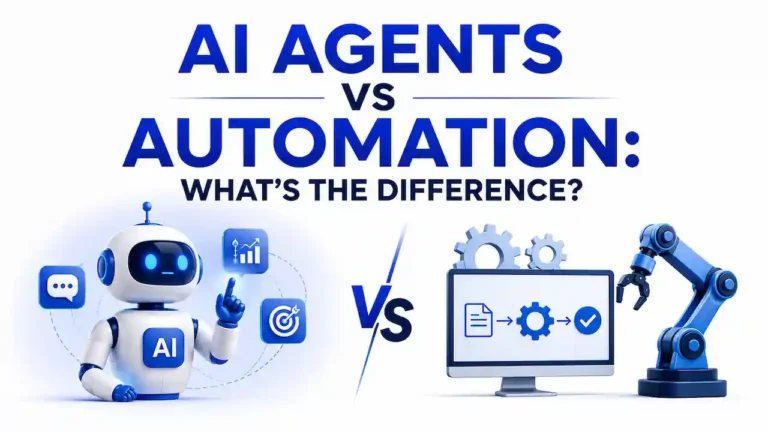
Traditional automation follows predefined workflow logic: if this, then that, with branches and conditions written in advance. It can be sophisticated, adaptive in limited senses, and very reliable within its envelope. Agentic systems differ in how actions are selected: dynamically, based on current context and state, by a model exercising judgment over a defined action space, rather than by a path fixed entirely in advance.
Anthropic’s distinction is the cleanest version of this: workflows are “systems where LLMs and tools are orchestrated through predefined code paths,” while agents dynamically direct their own processes and tool usage. Neither is universally better. Deterministic workflows are preferable when the task is stable, auditable, and well-specified; agents earn their complexity when tasks are open-ended and the right next step genuinely depends on information that only becomes available mid-task. The meaningful distinction is not “automation is dumb, agents are smart.” It is where the decision about what happens next lives: in the code, written in advance, or in the loop, made in the moment.
The Simplest Mental Model for AI Agent Decision-Making
If you take one framework from this article, take this:
Goal → State → Options → Constraints → Action → Result → Evaluation → Next Decision
An agent operates within an available action space. It uses its goal, its current state, its context, its capabilities, its constraints, and whatever decision mechanisms it implements (model judgment, rules, policies, scoring, or combinations) to select what should happen next. It observes the result, evaluates progress, and continues, changes course, asks, escalates, or stops. The exact mechanism varies by architecture. Model inference is one part of the complete system, never the whole of it.
The key idea is dynamic selection based on current state and available actions, not a universal fixed sequence. When someone shows you an agent demo, the questions this model suggests are consistent: What was the goal? What did it know at each step? What actions were available? What constrained it? How did it evaluate results? When did it decide to stop, and why?
Conclusion
How AI agents make decisions is not a mystery, and it is not a single mechanism. Agents operate within an available action space, and that space is a design decision made before the agent runs. Their decisions depend on goals and current state, expanded by tools and shaped by constraints. Feedback changes what they do next; uncertainty can trigger verification, clarification, escalation, or stopping, depending on how the system was built. Autonomy is granted by permissions and controls, not assumed.
The conceptual loop, Goal → State → Options → Constraints → Action → Result → Evaluation → Next Decision, will not describe any production agent exactly, and that is the point. It describes the logic that agent architectures implement in different ways: some in model inference, some in deterministic code, most in a combination, wrapped in policies, validation, and human oversight. When you evaluate any agent, that is the frame to bring: not “what did it answer,” but “how did it decide, within what boundaries, with what feedback, and under whose control.”