Best AI Agent Platforms in 2026
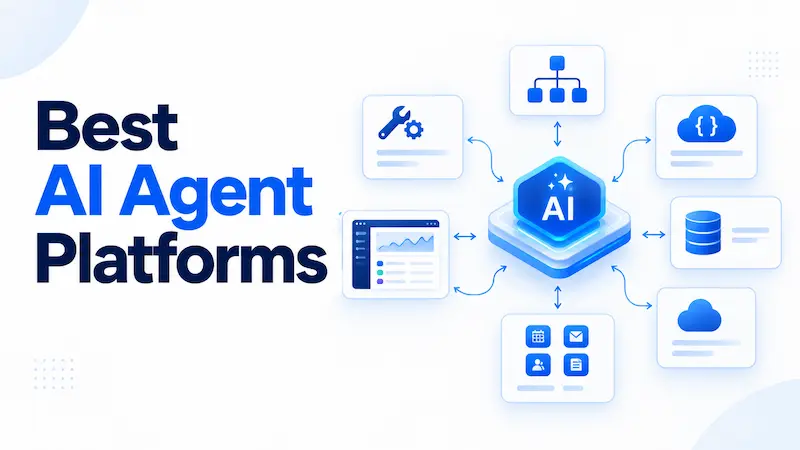
The best AI agent platforms in 2026 include Microsoft Copilot Studio, Google Gemini Enterprise Agent Platform, Amazon Bedrock AgentCore, Salesforce Agentforce, ServiceNow AI Agent Studio, IBM watsonx Orchestrate and OpenAI Frontier. The right choice, however, depends on where your data lives, which systems an agent must access, how much control developers need and what governance the organization requires.
For example, Copilot Studio is a natural candidate for Microsoft-centric organizations. Salesforce Agentforce is better aligned with CRM workflows, while ServiceNow AI Agent Studio suits processes already running on the Now Platform. Developers building custom agent architectures may prefer Amazon Bedrock AgentCore, OpenAI AgentKit or LangGraph with LangSmith.
An AI agent platform is software for building, connecting, deploying and managing AI systems that can interpret goals, access approved information, use tools and complete multistep tasks.
The challenge is that vendors use “AI agent platform” to describe several different products. Some are visual builders for business teams. Others provide managed infrastructure, agent governance or code-level orchestration. Comparing them as if they were identical can lead to the wrong purchase.
In this guide, you will learn which AI agent platforms stand out in 2026, how their roles differ, what each is best suited to and how to build a defensible shortlist.
Editorial disclosure: This comparison is based on official product documentation, current pricing information, deployment options, integration architecture and published governance capabilities reviewed on September 7, 2026. It does not claim undisclosed hands-on testing, vendor certification or paid product endorsement. Features, availability and pricing should be reconfirmed before purchase.
Best AI Agent Platforms by Use Case
| Platform | Category | Best for | Build approach | Pricing structure |
| Microsoft Copilot Studio | Enterprise builder and runtime | Microsoft 365 and Power Platform organizations | Low-code | Credits or usage-based |
| Google Gemini Enterprise Agent Platform | Cloud agent platform | Google Cloud AI programs | Low-code and code-first | Consumption-based |
| Amazon Bedrock AgentCore | Managed agent infrastructure | AWS engineering teams | Code-first | Consumption-based |
| Salesforce Agentforce | Application-native agent platform | CRM, sales and customer service | Low-code | Credits and product editions |
| ServiceNow AI Agent Studio | Application-native agent platform | IT and employee workflows | Low-code | Enterprise packaging |
| IBM watsonx Orchestrate | Orchestration and governance platform | Cross-vendor agent estates | Low-code and code | Subscription or custom pricing |
| OpenAI Frontier | Enterprise agent platform | Cross-functional enterprise agents | Managed enterprise platform | Contact sales |
| UiPath | Agentic automation platform | AI, RPA and human workflows | Low-code and code | Platform licensing and usage |
| Rasa | Conversational agent platform | Governed customer and employee agents | Developer and visual tooling | Developer and enterprise tiers |
| OpenAI AgentKit | Agent-development toolkit | OpenAI-native applications | Visual and code-first | API and model usage |
| LangGraph with LangSmith | Framework and managed deployment | Stateful custom agents | Code-first | Open-source plus managed plans |
| n8n | Workflow and agent automation | Self-hostable business automation | Low-code | Hosted or self-hosted plans |
| Zapier Agents | No-code agent builder | Small teams and SaaS workflows | No-code and low-code | Task and usage-based |
There is no credible universal winner across these categories. The most useful comparison starts by identifying what type of platform the organization actually needs.
AI Agent Platforms, Builders and Frameworks Explained
The market contains five overlapping product categories.
| Category | What it provides | Typical buyer | Examples |
| Agent builder | Visual tools, templates and packaged integrations | Business and automation teams | Copilot Studio, Zapier Agents |
| Enterprise agent platform | Building, runtime, deployment and lifecycle controls | Enterprise technology teams | OpenAI Frontier, Agentforce |
| Managed agent infrastructure | Runtime, identity, memory and tool connectivity | Cloud engineers | Amazon Bedrock AgentCore |
| Developer framework | Code-level orchestration and agent primitives | Software developers | LangGraph, CrewAI |
| Governance control plane | Inventory, security and oversight across agents | IT, security and AI governance teams | Microsoft Agent 365, watsonx Orchestrate |
One product can span several categories. Copilot Studio, for instance, provides a low-code builder and managed runtime. Microsoft Agent 365 addresses governance across a broader agent estate. Similarly, OpenAI AgentKit provides development components, while OpenAI Frontier is positioned as an enterprise platform.
This distinction matters because a nontechnical operations team may struggle with a developer framework, while a highly regulated engineering team may find a simple no-code builder too restrictive.
How These Platforms Were Evaluated
The shortlist is based on nine buyer-focused criteria:
- Use-case fit: The workflows and users the product is designed to support.
- Development approach: Whether it supports no-code, low-code, code-first or mixed teams.
- Integration depth: How agents connect to applications, APIs, data and existing automation.
- Deployment flexibility: Managed cloud, private networking, hybrid or self-hosted options.
- Model flexibility: Whether builders can use one model family or choose among providers.
- Security and governance: Identity, tool permissions, approvals, audit trails and administrative control.
- Evaluation and observability: Testing, tracing, monitoring, replay and production analysis.
- Pricing structure: The predictability of credits, tokens, actions, tasks, licenses and infrastructure costs.
- Ecosystem fit: The advantage created by using a platform alongside technology the organization already owns.
The ordering below is not a universal performance ranking. Each recommendation identifies the context in which a platform is most useful.
Best Enterprise AI Agent Platforms
1. Microsoft Copilot Studio: Best for Microsoft-Centric Organizations
Microsoft Copilot Studio is a low-code environment for creating, deploying and managing agents and agent workflows. It is particularly relevant to organizations already using Microsoft 365, Microsoft Entra, Power Platform, Dynamics 365 or Azure.
Its principal advantage is ecosystem alignment. Agents can participate in Microsoft-based workflows without requiring an entirely separate business automation environment. The platform supports visual creation, connectors, knowledge sources and managed deployment.
Microsoft currently offers pay-as-you-go access and prepaid Copilot Credit capacity. Its official Copilot Studio pricing lists packs of 25,000 Copilot Credits at $200 per month at the time of review. Different capabilities consume different numbers of credits, so buyers should estimate costs using representative workflows rather than the pack price alone.
Microsoft also offers Agent 365, which became generally available for commercial customers in May 2026. Agent 365 is a control plane for observing, securing and governing agents across an organization. It complements Copilot Studio but does not serve exactly the same function.
Best suited to:
- Microsoft 365 employee agents
- Dynamics 365 sales and service workflows
- Power Platform automation
- Organizations using Microsoft identity and security controls
- Business teams that need low-code development
Important limitations:
- Credit consumption may be difficult to forecast.
- Azure services or external models may create separate charges.
- The managed runtime is closely tied to Microsoft’s cloud ecosystem.
- Permissions inherited from connected systems require careful testing.
Verdict: Copilot Studio is one of the strongest starting points when Microsoft already provides the organization’s identity, productivity and workflow foundation.
2. Google Gemini Enterprise Agent Platform: Best for Google Cloud AI Programs
Gemini Enterprise Agent Platform is Google Cloud’s unified environment for building, deploying, governing and improving enterprise agents. It brings together capabilities previously associated with Vertex AI Agent Builder and related Google Cloud services.
The platform supports visual and code-first development, managed agent runtime services, enterprise data connections, evaluation and access to a broad model catalog. Google’s official Agent Platform overview describes support for more than 200 foundation models.
This makes the platform especially relevant to organizations already using Google Cloud for data, analytics, machine learning and application infrastructure.
Best suited to:
- Google Cloud environments
- Agents grounded in enterprise data
- Teams seeking access to multiple models
- Organizations developing and operating agents within a broader cloud AI program
Important limitations:
- Costs may be distributed across models, runtime, search, storage and networking.
- Older Vertex AI terminology still appears in some documentation and comparisons.
- Secure implementation requires Google Cloud architecture and identity expertise.
- Service availability can vary by region.
Verdict: Gemini Enterprise Agent Platform is a strong choice when agents form part of a larger Google Cloud data and AI architecture.
3. Salesforce Agentforce: Best for CRM and Customer Workflows
Salesforce Agentforce is built for agents operating across Salesforce sales, service, customer and employee processes. Its greatest advantage is direct access to the records, workflows and business context already managed within Salesforce products.
An Agentforce implementation can combine topics, instructions, business data and approved actions. This is useful for customer-service resolution, sales support, CRM updates and other processes that require an agent to work directly with Salesforce records.
Current Agentforce pricing includes consumption-based Flex Credits. At the time of review, Salesforce listed 100,000 Flex Credits at $500 for covered use cases. Product editions, actions, voice services and other Salesforce components can affect the actual cost.
Best suited to:
- Customer-service automation
- Sales and CRM workflows
- Salesforce knowledge and records
- Organizations already using Salesforce extensively
- Customer-facing digital agents
Important limitations:
- Its value is highest inside the Salesforce ecosystem.
- Consumption requires careful forecasting.
- Data quality directly affects agent performance.
- Data 360 and other services may affect implementation scope and cost.
Verdict: Agentforce should be shortlisted when the agent’s work primarily begins, continues and ends inside Salesforce.
4. ServiceNow AI Agent Studio: Best for IT and Employee Workflows
ServiceNow AI Agent Studio lets organizations create, test and manage AI agents and agentic workflows within the Now Platform.
Its advantage is process context. IT service management, employee service, customer service and operational workflows may already have defined records, roles, approvals and escalation paths in ServiceNow. Agents can be introduced into that existing structure.
The official AI Agent Studio documentation describes a unified environment for creating, managing and testing agents and self-executing workflows.
Best suited to:
- IT service management
- Employee-service workflows
- ServiceNow case management
- Organizations with mature Now Platform processes
- Low-code enterprise automation
Important limitations:
- The business case is less compelling without existing ServiceNow adoption.
- Product entitlements and implementation requirements must be confirmed.
- Sensitive ticket actions still require approval and access controls.
- Connected-system permissions can expand the agent’s risk surface.
Verdict: ServiceNow AI Agent Studio is a strong choice when the target processes already run through the Now Platform.
5. IBM watsonx Orchestrate: Best for Cross-Platform Agent Governance
IBM watsonx Orchestrate combines agent building and workflow orchestration with controls for discovering, connecting, monitoring and governing agents.
Its cross-platform orientation is important for enterprises that expect to use agents from multiple vendors. IBM’s watsonx Orchestrate overview describes centralized orchestration, agent evaluation, policy controls, consumption monitoring and the ability to connect external agent environments.
Best suited to:
- Organizations operating agents from several vendors
- Central agent inventory and governance
- Cross-application workflow orchestration
- Enterprises prioritizing oversight and policy control
- IBM-aligned technology environments
Important limitations:
- Full pricing and deployment scope may require consultation.
- Heterogeneous agent estates still require integration work.
- Responsibilities cannot be solved through a control plane alone.
- The platform may overlap with existing automation and governance tools.
Verdict: watsonx Orchestrate deserves consideration when the main challenge is governing and coordinating an agent estate rather than building a single agent.
6. OpenAI Frontier: Best for Enterprise-Wide AI Agents
OpenAI Frontier is an enterprise platform for building, deploying and managing AI agents across business systems. It is designed around shared organizational context, agent onboarding, permissions, feedback and operational boundaries.
The OpenAI Frontier announcement distinguishes the platform from isolated agent-development projects. Frontier is positioned for agents that work across systems of record and support roles, teams or end-to-end business processes.
Frontier should not be confused with AgentKit. Frontier is an enterprise operating platform, while AgentKit provides development components for building agent applications.
Best suited to:
- Cross-functional enterprise agents
- Agents working across systems of record
- Organizations adopting OpenAI at enterprise scale
- Centralized permissions and operational oversight
- Complex business processes spanning multiple tools
Important limitations:
- Public self-service pricing is not available.
- Buyers must confirm availability, deployment and integration requirements.
- Organizations still need their own governance, risk and accountability model.
- The platform may be excessive for a small, isolated automation project.
Verdict: Frontier is relevant to large organizations seeking to operate AI agents across the business, rather than deploy independent agent applications one at a time.
7. UiPath: Best for Combining Agents, RPA and Human Work
UiPath combines agentic automation with robotic process automation and human workflow orchestration. This is useful when a process contains both uncertain decisions and deterministic actions.
An agent might interpret a request, a software robot could enter validated information into a legacy application, and a person could approve an exception. UiPath Maestro provides an orchestration layer across these participants.
UiPath’s agent management documentation describes centralized monitoring, testing and management for deployed agents.
Best suited to:
- Existing UiPath customers
- Legacy applications without modern APIs
- Document-heavy back-office processes
- Workflows combining agents, software robots and people
- Processes that need both probabilistic and deterministic automation
Important limitations:
- Platform breadth can increase implementation complexity.
- Teams must decide which steps should remain deterministic.
- Licensing can span several platform components.
- Older agent-building experiences may require migration.
Verdict: UiPath is particularly valuable when AI agents need to work alongside established RPA rather than replace it.
8. Rasa: Best for Governed Conversational Agents
Rasa is a self-hostable developer platform for building and operating enterprise conversational agents. It is especially relevant when an organization needs control over deployment, dialogue behavior, model choice and the balance between flexible reasoning and guided workflows.
Rasa’s official AI information page describes a platform with runtime orchestration, memory, integrations and observability for agents operating across voice and chat.
Best suited to:
- Customer-service and employee-service agents
- Regulated or privacy-sensitive deployments
- Voice and conversational workflows
- Technical teams seeking deployment control
- Processes mixing guided logic with model-based reasoning
Important limitations:
- Implementation requires more technical expertise than basic no-code builders.
- It is more specialized around conversational experiences.
- Enterprise capabilities and support require commercial evaluation.
- Self-hosting transfers more operational responsibility to the buyer.
Verdict: Rasa is a strong candidate when conversational reliability, deployment control and governed dialogue matter more than rapid no-code setup.
Best Developer Platforms and Agent Infrastructure
9. Amazon Bedrock AgentCore: Best for Flexible AWS Deployments
Amazon Bedrock AgentCore provides managed infrastructure for deploying and operating agents on AWS. It is designed to support different models and development frameworks rather than force teams into one orchestration approach.
AWS states that AgentCore can work with LangChain, OpenAI Agents SDK, Claude Agent SDK, Strands Agents and custom frameworks. Its official overview highlights managed runtime, tool connectivity, identity and access control.
AgentCore uses consumption-based pricing without a general upfront commitment or minimum fee, according to the official documentation.
Best suited to:
- AWS engineering teams
- Custom agent applications
- Organizations seeking framework and model flexibility
- Production workloads requiring managed cloud infrastructure
- Teams already using AWS identity, networking and monitoring
Important limitations:
- It requires cloud engineering expertise.
- The complete solution may involve several AWS services.
- Model, runtime, memory, networking and tool costs can accumulate separately.
- Flexible architecture can create operational inconsistency if teams use too many frameworks.
Verdict: AgentCore is compelling for engineering teams that want managed AWS infrastructure without committing to one agent framework.
10. OpenAI AgentKit: Best for OpenAI-Native Applications
OpenAI AgentKit is a collection of tools for building, deploying and improving agent applications.
Its components include:
- Agent Builder for visual workflow construction
- Agents SDK for code-first development
- ChatKit for embedded agent interfaces
- Evaluation tools for testing agent behavior
The official AgentKit announcement presents these components as an integrated development path. The Agent Builder documentation explains how teams can visually assemble workflows, define inputs and outputs, preview runs and export SDK code.
Best suited to:
- Applications using OpenAI models and APIs
- Teams combining visual prototyping with code
- Embedded conversational experiences
- Developers wanting integrated agent evaluations
- Custom tools and multistep workflows
Important limitations:
- API, model and tool usage determine operating costs.
- Teams must design authorization for external systems.
- Enterprise-specific logging and approval controls may require additional work.
- Heavy use of proprietary features may increase switching costs.
OpenAI states that business and API data is not used for model training by default. Organizations should still review the applicable retention settings, product terms and enterprise privacy information.
Verdict: AgentKit is a strong development toolkit for OpenAI-native applications, but it should not be presented as identical to a complete enterprise control plane.
11. LangGraph with LangSmith: Best for Stateful Custom Agents
LangGraph is an open-source framework for building stateful agent workflows with branching, retries, checkpoints and human intervention. LangSmith adds tracing, evaluation, observability and managed deployment.
The distinction is important:
- LangGraph defines agent orchestration.
- LangSmith supports testing, monitoring and deployment.
LangChain’s deployment documentation confirms that the former LangGraph Platform was renamed LangSmith Deployment in October 2025.
Public LangSmith pricing includes a developer tier and a Plus plan listed at $39 per seat per month at the time of review, followed by usage charges. Enterprise plans include additional hosting, access-control and support options.
Best suited to:
- Stateful and long-running agents
- Engineering teams requiring explicit orchestration
- Applications needing detailed traces and evaluations
- Multi-model architectures
- Teams that want open-source building components
Important limitations:
- It requires more development and maintenance work.
- Teams remain responsible for secure tool implementation.
- Managed platform, model and infrastructure costs are separate.
- Effective evaluation requires both tooling and well-designed test datasets.
Verdict: LangGraph with LangSmith offers strong architectural control, but it is agent engineering infrastructure rather than a turnkey business platform.
Best Low-Code AI Agent Platforms
12. n8n: Best for Self-Hostable Agent Workflows
n8n combines low-code workflow automation with AI agent capabilities, custom logic and API connectivity. It is particularly useful when a team wants to mix deterministic workflow steps with selected model-based decisions.
The official n8n AI agents page describes support for production AI agents, workflow controls and self-hosting. Teams can use prebuilt integrations, custom API requests and code within the same automation.
Best suited to:
- Technical operations teams
- Self-hosted automation
- Workflows combining AI and deterministic logic
- Organizations that need custom API connectivity
- Teams seeking more control than a simple no-code agent builder
Important limitations:
- Self-hosting creates infrastructure and security responsibilities.
- Complex workflows still require technical design.
- Pricing differs between hosted and self-hosted plans.
- It is a broad automation platform, not a dedicated enterprise agent-governance suite.
Verdict: n8n is a strong option for teams that want low-code automation, technical extensibility and self-hosting flexibility.
13. Zapier Agents: Best for Small Teams and SaaS Automation
Zapier Agents lets business users create agents that work with company information and connected cloud applications. Its main advantage is access to Zapier’s large integration ecosystem.
The Zapier Agents page states that agents can work across more than 9,000 applications. This makes the product useful for recurring sales, marketing, administrative and operations tasks involving familiar SaaS tools.
Best suited to:
- Small and midsize teams
- No-code and low-code users
- App-centric sales and marketing tasks
- Internal administrative workflows
- Fast experiments with common cloud software
Important limitations:
- Task and usage costs may rise with scale.
- Complex, long-running processes may require a more technical platform.
- Buyers must verify approval controls for every connected action.
- Sensitive or regulated workflows require additional scrutiny.
Verdict: Zapier Agents is one of the most accessible options for app-based business automation, provided the use case does not require specialized infrastructure or extensive governance.
Which AI Agent Platform Should You Choose?
| Your environment or requirement | Platforms to evaluate first |
| Microsoft 365, Azure and Power Platform | Copilot Studio and Agent 365 |
| Google Cloud data and AI infrastructure | Gemini Enterprise Agent Platform |
| AWS-based custom development | Amazon Bedrock AgentCore |
| Salesforce CRM and service workflows | Salesforce Agentforce |
| ServiceNow IT and employee processes | ServiceNow AI Agent Studio |
| Cross-vendor agent governance | IBM watsonx Orchestrate |
| Enterprise-wide agents across business systems | OpenAI Frontier |
| AI combined with RPA and human tasks | UiPath |
| Governed voice and conversational agents | Rasa |
| OpenAI-native application development | OpenAI AgentKit |
| Stateful, code-first agent systems | LangGraph with LangSmith |
| Self-hostable low-code workflows | n8n |
| Small-team SaaS automation | Zapier Agents |
Use these recommendations to create a shortlist. The final decision should be based on a pilot using your own data, systems, permissions and failure conditions.
How to Choose an AI Agent Platform
1. Define One Bounded Outcome
Do not begin with a broad goal such as “automate customer service.”
Define a specific outcome:
Categorize an incoming support request, retrieve an approved policy, draft a response and route refund requests above a defined threshold to a person.
This reveals the required data sources, tools, approvals and evaluation criteria.
2. Decide Which Steps Should Be Agentic
Not every step benefits from model-based decision-making.
Use deterministic logic where the result must be consistent, such as:
- Checking whether a required field exists
- Enforcing a transaction threshold
- Validating an account status
- Blocking an unapproved action
Use an agent where language interpretation, ambiguity resolution or tool selection creates meaningful value.
3. Map Data and Tool Permissions
Document:
- What information the agent can read
- Which records it can create or modify
- Which tools and APIs it can call
- Whether it can communicate externally
- Which actions require human approval
- How credentials are issued and revoked
- Whether permissions follow the requesting user
- How every action will be recorded
An agent that can act should not receive broader access than its assigned task requires.
4. Evaluate Production Controls
A visual builder is only one part of the platform. Evaluate:
- Identity and access management
- Data residency
- Encryption and retention
- Private networking
- Model and region availability
- Tool authorization
- Version control
- Evaluation datasets
- Trace and audit retention
- Incident response
- Agent suspension
- Rollback
- Export and migration options
The NIST AI Risk Management Framework provides a voluntary structure for governing, mapping, measuring and managing AI risks. It does not certify an agent platform, but it can inform the evaluation process.
5. Calculate Total Operating Cost
Platform pricing can include:
[ \text{Total cost} = \text{licenses} + \text{model usage} + \text{runtime} + \text{tool calls} + \text{data services} + \text{integration} + \text{monitoring} + \text{human review} + \text{maintenance} ]
Credits, tokens, actions, tasks and outcomes are not directly equivalent billing units.
Run the same test workload through every shortlisted platform. Record:
- Model calls
- Input and output tokens
- Tool invocations
- Searches
- Retries
- Failed runs
- Human escalations
- Successful completed outcomes
This provides a more useful estimate than comparing advertised entry prices.
6. Test Failure and Attack Conditions
A pilot should include difficult and adversarial cases.
Test whether the agent:
- Refuses actions outside its authority
- Handles missing or conflicting information
- Resists instructions embedded in untrusted content
- Avoids exposing another user’s information
- Requests approval at the correct point
- Recovers safely after a tool failure
- Stops after a cost, time or iteration limit
- Produces an understandable audit trail
- Can be suspended immediately
OWASP’s Securing Agentic Applications Guide provides practical security guidance for designing and deploying agentic systems.
AI Agent Platform Evaluation Scorecard
Score each platform from 1 to 5 and record the evidence supporting each rating.
| Criterion | Suggested weight | Evidence to collect |
| Task success | 20% | Completion rate across representative test cases |
| Safety and authorization | 20% | Unauthorized actions blocked and approvals enforced |
| Integration fit | 15% | Required systems connected without fragile workarounds |
| Evaluation and observability | 15% | Traces, test tools, alerts and audit records |
| Data governance | 10% | Retention, residency, access and deletion controls |
| Reliability | 10% | Behavior during ambiguity, outages and tool failures |
| Total operating cost | 5% | Cost per successful, reviewed outcome |
| Builder productivity | 5% | Time required to build, test, change and deploy |
Adjust the weights according to the use case. A financial, healthcare, employment or safety-related workflow should place greater weight on authorization, evidence and human oversight.
Questions to Ask Every AI Agent Platform Vendor
Before procurement, ask:
- Can agents operate using the requesting user’s identity and permissions?
- Can administrators restrict individual tools, actions and data sources?
- Are tool inputs, outputs and decisions included in audit records?
- How are prompts, responses, memory and traces retained?
- Can retention be configured by workload or region?
- Is customer data used for model training?
- Can administrators immediately suspend every agent?
- Are versions, approvals and configuration changes recorded?
- Can agents be evaluated before and after deployment?
- How does the platform address indirect prompt injection?
- Can budgets, execution time and action counts be limited?
- Which features are generally available, preview-only or region-limited?
- Which subprocessors and model providers receive data?
- Can configurations and records be exported when the contract ends?
Organizations operating in the European Union should also assess whether the intended use falls within the EU AI Act and determine their role in the AI value chain. Purchasing a platform does not transfer every governance or legal responsibility to the vendor.
Final Recommendation
The best AI agent platform is usually the one that fits the organization’s existing data, identity and workflow environment.
Start with Copilot Studio for Microsoft-based organizations, Gemini Enterprise Agent Platform for Google Cloud, Bedrock AgentCore for AWS, Agentforce for Salesforce and AI Agent Studio for ServiceNow. Evaluate OpenAI Frontier or IBM watsonx Orchestrate when the organization needs broader enterprise orchestration and governance. Consider UiPath when agents must work with RPA, Rasa for governed conversational experiences, and AgentKit or LangGraph when developers need custom architecture. n8n and Zapier Agents are practical choices for workflow-oriented and smaller-team automation.
Do not make the final decision from a feature list or vendor demonstration. Run a bounded pilot using your own systems, permissions and difficult cases. Compare platforms by successful, safely completed outcomes, not merely by model quality or initial subscription price.
The right platform is one the organization can operate reliably, secure appropriately, evaluate continuously and stop safely when something goes wrong.