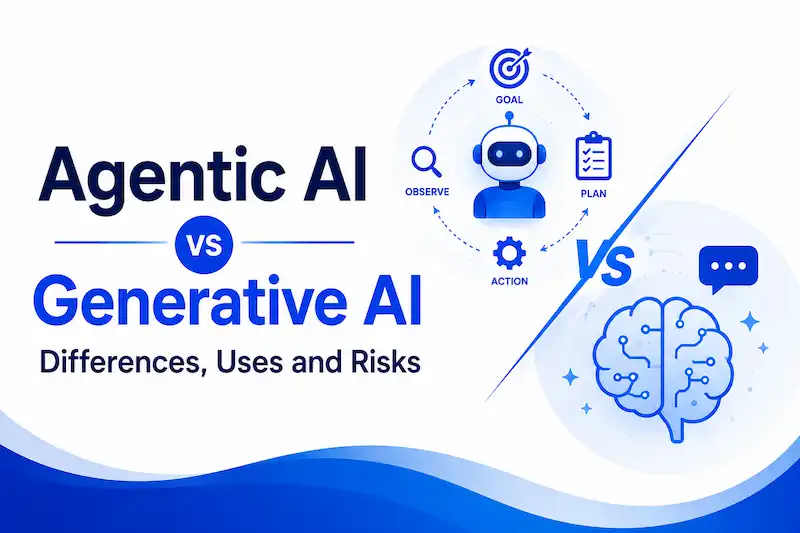
Agentic AI vs Generative AI: Differences, Uses and Risks
The difficult part of adopting AI is no longer determining whether a system can produce a useful answer. It is deciding how much authority that system should have after producing the answer.
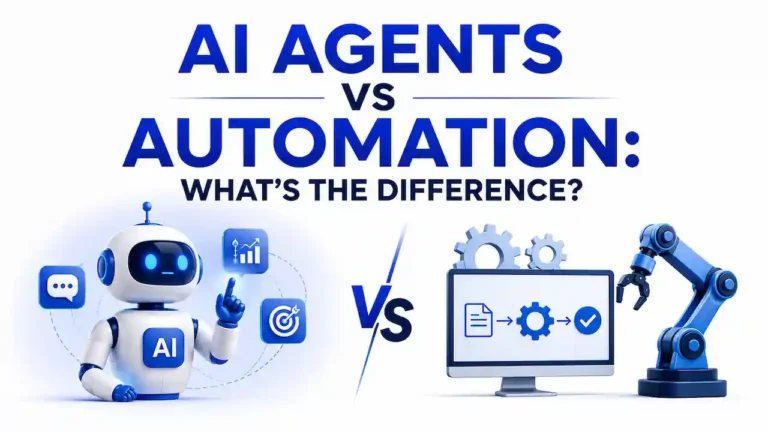
Generative AI creates new content from prompts and other inputs. Agentic AI pursues a goal by selecting steps, using available tools and adapting its actions as the task progresses.
It is what separates an AI system that drafts a customer response from one that investigates the request, updates the customer record and initiates an approved resolution. It is why moving from generation to action changes the cost, security and governance requirements of an AI deployment.
The two technologies are closely connected rather than direct alternatives. Many modern agentic systems use generative AI models for reasoning, language and planning. The difference lies in what surrounds the model, how the workflow is controlled and what the complete system is authorized to do.
In this blog, you will learn how agentic AI differs from generative AI, how the two technologies work together, where each approach fits, what current agents can reliably accomplish and how to choose an appropriate level of AI autonomy.
Key Takeaways
- Generative AI produces content, while agentic AI pursues goals.
- Modern AI agents often use generative models as reasoning engines.
- Agentic systems can plan, use tools and adapt across multiple steps.
- Tool access alone does not automatically make a system agentic.
- Greater autonomy introduces wider security and governance risks.
- Use the least autonomous design that can meet the business need.
Agentic AI vs Generative AI: The Short Answer
Generative AI produces content in response to prompts. Agentic AI uses models, tools and feedback loops to pursue goals across multiple steps. A generative model may draft an action, while an agentic system may decide when and how to execute it within defined permissions.
The NIST definition of generative AI covers AI models that emulate characteristics of input data to generate derived synthetic content, including text, images, video and audio.
The UK government defines agentic AI as systems composed of agents that can behave and interact autonomously to achieve objectives. Its guidance explains that large language models can help agents determine an appropriate course of action rather than simply follow a completely hard-coded path.
The distinction can be summarized as follows:
Generative AI changes what software can produce. Agentic AI changes what software can decide and do.
Agentic AI vs Generative AI Comparison
| Dimension | Generative AI | Agentic AI |
| Primary purpose | Produce new content | Achieve an objective |
| Typical input | Prompt, instructions or context | Goal, constraints and permissions |
| Typical result | Text, image, audio, video, code or data | Completed task, action, decision or combined result |
| Control flow | User-directed or application-defined | Dynamically selected within boundaries |
| Autonomy | Usually low to moderate | Moderate to high, depending on design |
| Planning | May generate a plan as content | Uses planning to direct execution |
| Tool use | Optional | Usually central to useful deployment |
| State | Often limited to the current interaction | Tracks progress and intermediate results |
| Human role | Prompt, review and apply | Set authority, approve sensitive actions and handle exceptions |
| Main risk | Incorrect or unsuitable content | Incorrect content plus harmful or unauthorized action |
| Cost profile | One or several model calls | Repeated model calls, tool operations and monitoring |
| Best fit | Creation, analysis and assistance | Adaptive, multi-step workflow execution |
These are common characteristics rather than rigid boundaries. Products frequently combine both approaches, and vendors do not always use terms such as “agent,” “agentic AI” and “agentic workflow” consistently.
What Is Generative AI?
Generative AI is a category of AI models that produces synthetic content based on patterns learned from data.
Its outputs can include written text, software code, images, audio, video, structured data or combinations of these formats. Common applications include drafting reports, summarizing policies, creating illustrations, translating material, generating code suggestions and extracting structured information from documents.
In a conventional generative AI interaction, the user or surrounding application defines the task. The model produces an output, after which a person or separate software process decides what happens next.
This distinction matters because generating an instruction is not the same as executing it. A model may draft an email without sending it. It may recommend changing a database record without having permission to make the change.
Generative AI applications can still be technically sophisticated. They may retrieve information from approved sources, maintain conversational context, process several documents or call narrowly defined functions. Complexity by itself does not make a system agentic.
The NIST Generative AI Profile identifies risks associated with generative AI, including confabulation, harmful bias, data privacy, information integrity and information security. It provides risk-management actions that organizations can use with the NIST AI Risk Management Framework.
What Is Agentic AI?
Agentic AI refers to systems designed to pursue an objective with some ability to determine and execute the necessary steps.
A typical agent receives a goal, evaluates the available context, chooses an action, uses a tool, observes the result and decides what to do next. The cycle continues until the goal is completed, the system reaches a defined limit or human intervention becomes necessary.
The OpenAI guide to building agents describes agents as systems that independently accomplish tasks on a user’s behalf. It identifies the model, tools and instructions as three foundational components. The model manages workflow execution, while tools allow the agent to retrieve information or take action in other systems.
An agentic system commonly combines the following capabilities:
| Capability | Purpose |
| Goal interpretation | Converts an objective into an actionable task |
| Planning | Determines the steps or strategy |
| Tool selection | Chooses an appropriate data or action tool |
| Execution | Carries out approved actions |
| State management | Tracks progress and intermediate results |
| Feedback | Observes what happened after an action |
| Adaptation | Revises the plan when conditions change |
| Termination | Stops when complete, blocked or outside authority |
| Escalation | Transfers uncertain or sensitive decisions to a person |
Not every agent requires persistent memory, several specialized agents or advanced long-term planning. A narrow single-agent system can still be agentic if it controls how a goal is pursued and can adapt according to the results it receives.
AI Agent vs Agentic AI
An AI agent is an individual software system designed to pursue a goal. Agentic AI is the broader category of architectures and behaviors that enables one or more agents to plan, use tools, take actions and adapt.
An agentic system might contain one agent, several collaborating agents or a combination of agents and deterministic software.
“Agentic” also describes a degree of behavior. One system may only select among a few approved tools, while another can create a multi-step plan and revise that plan over an extended task. Both may be described as agentic even though their authority and complexity differ substantially.
For this reason, organizations should evaluate what a system can access, decide and change rather than relying on the product label alone.
How Agentic AI and Generative AI Work Together
Agentic AI does not replace generative AI. In many current architectures, a generative model operates as the reasoning and language component inside a broader agentic system.
The model may interpret the objective, propose a plan, select a tool and interpret the tool’s response. Conventional software authenticates the request, executes approved functions, records the result and returns new information to the model.
A typical agent loop follows seven stages:
- A user or system supplies an objective.
- The agent interprets the objective and current state.
- The agent selects an appropriate action.
- A tool interacts with data, software or an external service.
- The tool result is returned to the agent.
- The agent evaluates progress and chooses the next step.
- The process completes, continues or escalates.
The Anthropic guidance on effective agents distinguishes between workflows and agents. In a workflow, predefined code determines the route. In an agent, the model dynamically directs its process and tool use. The guidance also recommends starting with the simplest effective solution because agentic complexity can increase latency, cost and the possibility of compounding errors.
This creates a continuum rather than a binary choice:
| System Design | Example | Degree of Agency |
| Single generation | Draft a customer reply | Very low |
| Retrieval-assisted generation | Draft using an approved knowledge base | Low |
| Fixed AI workflow | Classify, draft, validate and route | Low to moderate |
| Tool-using assistant | Search or calculate when directed | Moderate |
| Goal-driven agent | Select and execute steps toward an outcome | High |
| Multi-agent system | Coordinate specialized agents across a task | Potentially higher |
The correct position on this continuum depends on the workflow, consequences, uncertainty and available controls.
Seven Key Differences Between Agentic AI and Generative AI
1. Generated Output vs Completed Outcome
Generative AI is primarily optimized to produce an output. Agentic AI is designed to achieve an outcome.
If asked to prepare a meeting, generative AI might draft an agenda. An agentic system could review calendars, identify a suitable time, prepare the agenda, send invitations and reschedule the meeting if a conflict appears.
The outcome orientation can reduce manual coordination, but it also changes how performance must be evaluated. Teams must determine whether the task was completed correctly, not merely whether an individual response sounded convincing.
2. Prompt Following vs Goal Pursuit
Generative AI normally responds to a prompt or set of instructions. Agentic AI can receive a broader objective and determine the intermediate steps.
This does not mean an agent should act without precise instructions. Reliable agents need defined goals, constraints, available tools, completion criteria and escalation conditions.
“Resolve routine delivery inquiries using the approved compensation policy” provides clearer boundaries than “handle customer problems.”
3. Predetermined vs Dynamic Control Flow
In a generative AI interaction, the user or application usually decides what happens after each output. In an agentic workflow, the model may select the next step based on the current state and previous results.
A system that follows five hard-coded steps is automated, but it is not necessarily agentic. A system that chooses among several steps based on the objective and observed conditions displays more agency.
Dynamic control is useful when the correct path cannot be fully predicted in advance. It is unnecessary when a stable rules-based process already works well.
4. Content Creation vs External Action
Generative AI primarily produces information. Agentic AI may change the state of another system.
Tools can allow an agent to search, read documents, query databases, run code, create records, send messages or initiate transactions. Google’s AI tool documentation explains that tools can give models access to external information, computational capabilities and user-defined functions.
The difference between read and write access is particularly important. An agent that reads a calendar to recommend meeting times has less operational authority than one that can cancel or reschedule appointments.
5. Conversational Context vs Operational State
A generative AI application may retain the context of a conversation. An agentic system often needs operational state.
It must know what has been attempted, which actions succeeded, what remains incomplete and whether the environment has changed. Some agents also use longer-term memory for preferences or previous outcomes.
Memory can improve continuity, but it creates additional privacy, retention and accuracy concerns. Incorrect or outdated memory can influence future actions unless it is validated and governed.
6. Content Evaluation vs Process Evaluation
Generative AI evaluation commonly examines factuality, relevance, safety, bias, formatting and content quality.
Agentic AI requires those tests plus process-level evaluation. Teams must assess tool selection, action order, permissions, retries, recovery, escalation and stopping behavior.
An agent can produce a correct final answer after taking an unacceptable route. It can also produce a plausible answer while failing to complete the underlying task. Evaluating only the final response misses both problems.
7. Review Risk vs Execution Risk
An incorrect generated summary may mislead its reader. An incorrect agentic decision may also change a record, send a communication or trigger a financial process.
Agentic AI therefore expands the possible impact of familiar generative AI problems. Confabulation, bias, ambiguous instructions or prompt injection can affect not only content but also operational actions.
The OWASP guidance on agentic threats explains that integrating LLMs and generative AI with autonomous systems expands their capabilities and associated security risks.
How Capable Is Agentic AI in 2026?
Agent capabilities are improving quickly, but benchmark progress should not be mistaken for universal production reliability.
The 2026 Stanford AI Index reports that accuracy on OSWorld, a benchmark testing agents on computer tasks across operating systems, increased from approximately 12% to 66.3%. Despite that improvement, agents still fail roughly one in three attempts on structured benchmarks.
Performance also varies substantially according to task type, environment, available tools and evaluation method. A system that performs well on a controlled benchmark may behave differently when connected to changing data, ambiguous business rules or unfamiliar software.
The appropriate conclusion is neither that agents are unreliable nor that they are ready for unrestricted autonomy. It is that capability must be evaluated at the complete-task level within the actual deployment environment.
Verified Technical Example: An AI Coding Agent
Coding provides a useful example of agentic behavior because actions can be tested against observable results.
Anthropic describes coding agents that receive a software issue, inspect relevant files, make changes and run automated tests. Test failures provide environmental feedback, allowing the agent to revise its approach. Anthropic still identifies human review as necessary to confirm that the resulting change aligns with broader system requirements.
| Agent Stage | Coding-Agent Behavior |
| Goal | Resolve a described software issue |
| Planning | Identify relevant files and required changes |
| Action | Edit code using approved tools |
| Feedback | Run automated tests |
| Adaptation | Revise the solution after failures |
| Completion | Return the tested change for human review |
A basic generative coding assistant may create a code snippet. The agentic version continues through inspection, editing, testing and revision.
Use Cases for Generative and Agentic AI
| Business Need | Recommended Starting Point | Reason |
| Draft a policy summary | Generative AI | The result is reviewable content |
| Create product images | Generative AI | The objective is media generation |
| Summarize customer feedback | Generative AI | No operational action is required |
| Research and draft a report | Generative AI or fixed workflow | The steps can usually be reviewed or predefined |
| Resolve routine support cases | Constrained agent | Requires retrieval, decisions and system updates |
| Monitor inventory exceptions | Agentic AI | Conditions change and actions may span systems |
| Triage compliance alerts | Fixed workflow or constrained agent | The choice depends on variability and risk |
| Modify production infrastructure | Highly constrained agent | Strong permissions, testing and approval gates are required |
| Approve credit or medical treatment | Human-led process | Consequences and regulatory requirements demand heightened control |
AI can support analysis in high-impact settings, but greater technical capability does not automatically justify autonomous decision authority.
AI Action Authority Matrix
The right question is not simply whether to use generative or agentic AI. It is how much authority the AI system should receive.
The following matrix is editorial guidance for initial system design. It is not a formal standard or validated assessment method.
| Predictable Execution Path | Adaptive Execution Path | |
| Low-consequence outcome | Conventional automation or fixed AI workflow | Supervised, low-permission agent |
| High-consequence outcome | Deterministic workflow with mandatory approvals | Human-led process with tightly constrained AI assistance |
Predictable Path and Low Consequence
Use conventional automation or a fixed AI workflow. Examples include document classification, report formatting and routing internal requests according to stable rules.
Adding autonomous planning would introduce complexity without solving a meaningful problem.
Adaptive Path and Low Consequence
A supervised agent may be appropriate. Examples include researching public information, organizing non-sensitive files or preparing meeting options without booking them.
The agent can choose its route, but the effect of an error remains limited or reversible.
Predictable Path and High Consequence
Use deterministic rules with mandatory approvals. Examples include calculating a standard refund, preparing a regulated filing or generating a payment instruction.
AI may assist, but the execution path and approval authority should remain controlled.
Adaptive Path and High Consequence
Keep people responsible for the final decision and tightly limit AI permissions. Examples include employment decisions, access to production infrastructure, significant financial transactions and decisions affecting legal rights.
An agent may gather evidence or recommend actions, but open-ended autonomous execution is difficult to justify without exceptional safeguards.
Illustrative Scenario: A Supplier Compliance Review
The following hypothetical scenario shows how different system designs could handle the same business objective.
A generative AI system could summarize a supplier questionnaire, identify apparent gaps and draft follow-up questions. A compliance professional would verify the analysis, send the questions and decide whether the supplier could proceed.
A fixed AI workflow could extract questionnaire fields, compare them against predefined requirements, generate a summary and route the package to a reviewer. The sequence would remain predetermined.
An agentic system could inspect the submission, determine which evidence is missing, search approved repositories, request additional documents, evaluate the responses and route the case according to its findings. It might revise its plan if a document contradicted information in the questionnaire.
The agentic version could reduce coordination work, but it would also require access to sensitive information and communication systems. The organization would need to define which evidence the agent could retrieve, which messages it could send, which recommendations it could make and which decisions required human approval.
This scenario demonstrates why the decision is not about selecting the most advanced technology. It is about whether dynamic execution creates enough value to justify the additional authority and control requirements.
Risks and Governance Requirements
Both generative and agentic AI can produce incorrect, biased, insecure or inappropriate outputs. Agentic AI adds risks related to authority, tool use, state and extended execution.
| Risk | Generative AI Exposure | Additional Agentic Exposure |
| Confabulation | Incorrect content | Incorrect content may direct an action |
| Prompt injection | Manipulated response | Manipulated tool use or data access |
| Excessive permissions | Usually limited | Wider impact across connected systems |
| Sensitive-data exposure | Data may appear in output | Data may move between tools or memory |
| Goal ambiguity | Unsuitable response | Unintended sequence of actions |
| Error propagation | Usually one output | Errors can compound across multiple steps |
| Cost overrun | Excessive model use | Repeated loops and tool calls |
| Poor traceability | Unclear content provenance | Unclear decisions and action history |
| Automation bias | Overreliance on output | Overreliance on completed actions |
The 2026 Stanford AI Index responsible AI findings state that responsible AI benchmarking is not keeping pace with advances and deployment. This reinforces the need to evaluate agents for their specific tasks rather than treating general model benchmarks as evidence that a system is safe for a particular workflow.
Controls Should Follow the Agent’s Authority
An agent with read-only access should not receive the same controls as one that can send payments or alter customer accounts.
A low-risk deployment may require scoped data access, logging and output review. A higher-risk agent may also require a separate system identity, least-privilege permissions, tool allowlists, financial or transaction limits, mandatory approvals, retry limits, continuous monitoring and an immediate stop mechanism.
OpenAI’s agent guidance recommends human intervention when failure thresholds are exceeded and before sensitive, irreversible or high-impact actions. It also recommends evaluating tools according to factors such as write access, reversibility, permissions and financial impact.
A Safer Agentic AI Adoption Sequence
Organizations do not need to move directly from a generative chatbot to a highly autonomous agent.
- Define the objective and completion criteria. Specify what success means, what evidence is required and which conditions must stop the process.
- Test a simpler solution first. Determine whether one model call, retrieval-assisted generation or a predefined workflow can perform the task adequately.
- Add tools incrementally. Begin with read-only access where possible. Test each tool independently and document its intended purpose.
- Introduce bounded decision authority. Allow the agent to choose among narrowly defined actions rather than granting broad system access.
- Require approval for consequential actions. Place human checkpoints before irreversible, sensitive, regulated or financially significant actions.
- Evaluate complete trajectories. Review tool selections, intermediate states, retries, escalations, costs and stopping behavior alongside the final result.
- Expand only after evidence supports it. Greater autonomy should follow reliable task-level performance in the intended environment.
This staged approach allows an organization to stop at the simplest design that produces sufficient value.
Common Misconceptions
| Misconception | More Accurate Explanation |
| Agentic AI is a new foundation model | It is usually a system architecture or behavior built around one or more models |
| Every chatbot is an AI agent | A chatbot that only generates replies may not control workflow execution |
| Any tool-using model is agentic | A fixed or user-directed tool call may not involve autonomous planning |
| Agents operate without limits | Production agents should act within permissions and stopping conditions |
| More autonomy always creates more value | It can also increase cost, latency and failure impact |
| Agentic AI will replace generative AI | Modern agents often depend on generative models |
| Multi-agent systems are always better | Additional agents increase coordination and evaluation complexity |
| Agentic AI is automatically more accurate | Multi-step execution can improve results or compound errors |
Editorial Methodology
This comparison was developed from current government guidance, NIST definitions and risk-management publications, official developer documentation, industry security guidance and Stanford’s 2026 reporting on agent performance and responsible AI.
The comparison focuses on observable system characteristics: objectives, control flow, tool access, state, autonomy, human oversight and failure impact. It does not treat vendor descriptions as evidence that a product is fully autonomous, safe or appropriate for a particular organization.
The decision matrix and adoption sequence are editorial guidance intended to support initial evaluation. They are not formal standards or substitutes for technical, legal, security or risk assessments.
Conclusion
The central difference between agentic AI and generative AI is responsibility for the next step.
Generative AI produces content that a person or application can evaluate and use. Agentic AI can decide which steps to take, interact with external systems and adapt until it reaches an objective, stopping condition or approval point.
Use generative AI when the required result is a reviewable output. Use predefined automation when the process is stable. Consider an agent when adaptive, multi-step execution creates clear value and its permissions, actions and failure conditions can be controlled.
The best design is rarely the one with the most autonomy. It is the one that completes the task reliably while giving the AI system no more authority than it needs.