What Is Jev AI? How It Works, Features, Uses and Jev vs LLMs
Jev AI is a decision-oriented AI model from TypeSafe AI. It is built to sit inside software and answer structured questions, rather than to chat with people or write text. TypeSafe describes itself as an AI lab building machine-native intelligence infrastructure for automation, designed to make decisions within software, and Jev is its first public model.
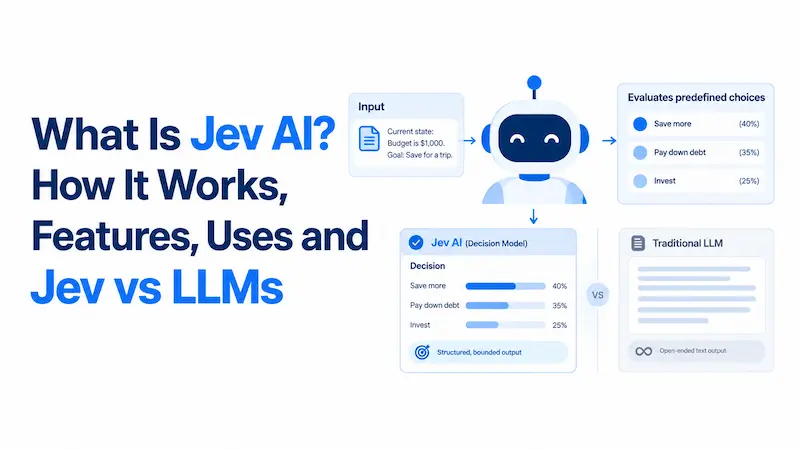
The short version: a conventional LLM produces written responses that an application must then interpret. Jev receives information from an application along with a defined question, and returns a typed answer (such as a selected option, a score or a probability) that the software can use directly.
A quick note on naming: “JEV” is also a common abbreviation for Japanese encephalitis virus. This article covers only Jev, the AI model from TypeSafe.
What Is Jev AI?
Jev is an AI model that evaluates a situation and returns a structured decision. According to TypeSafe’s System One documentation, a System One model evaluates a state and returns typed answers and probabilities, and like an LLM it understands natural-language input, but it returns typed decisions and probabilities rather than generated text.
The problem Jev targets is a mismatch many developers encounter. TypeSafe’s documentation argues that LLMs are designed to produce text for humans to read, which creates a mismatch when you need a model to make a judgment that your code will consume. Asking an LLM to answer “is this ticket urgent?” usually returns a string that the application must parse, validate and trust.
One independent developer summarized the idea this way: ordinary code branches on values it can compute, but that falls apart when the condition is a judgment, such as whether a support message is angry or whether an email is about billing. Jev is designed for those judgment-style conditions.
Who Created Jev AI?
Jev was created by TypeSafe AI, a San Francisco company. TypeSafe came out of stealth on September 15, 2026 with $40M in seed funding and Jev as its first public model. According to The Register, co-founder and CEO Diogo Almeida is a former OpenAI researcher and one of the co-inventors of RLHF and ChatGPT.
What Does Jev AI Do?
Jev answers bounded questions about a piece of information. The developer defines what the possible answers are, and Jev evaluates which answer fits.
TypeSafe’s documentation is explicit about what the model does not do: System One models do not write replies, produce code, or generate explanations of their reasoning. You define the possible answers through primitives.
Each answer carries probability information. TypeSafe states that every Jev decision includes an estimate of how confident the model is, so software can act when confidence is high and escalate when it is not. The model provides the judgment; the surrounding application decides what happens next.
How Does Jev AI Work?
The workflow follows five stages: application state, structured question, Jev evaluation, structured result and application logic.
Application State
The application first supplies the information to evaluate. The developer starts with a state value, which can be a JSON object or simply a string like “My card was charged twice.”
Structured Question
Next, the application defines one or more questions about that state, each with its allowed answers. For example, TypeSafe’s API reference shows a question asking which team should handle a message, with the defined options billing, technical and sales.
Jev Evaluation
Jev evaluates the questions against the state. Calls are made through TypeSafe’s client SDKs or POST /v1/systemone in the HTTP API, with a model field selecting which model handles the request. According to LangChain’s write-up, System One models evaluate every question in a request in parallel, so adding questions barely changes the response time. That latency characteristic is based on TypeSafe’s design description rather than independent testing.
Structured Result
Jev returns typed answers. In one example reported by The Register, a question asking the model to choose which of three departments should handle a customer query came back with probabilities of 0.08 for billing, 0.85 for technical and 0.07 for sales, with a confidence score of 0.82.
Application Logic
Finally, the application acts. Example: a hypothetical support system could route the ticket automatically when confidence is above a threshold the team has chosen, and send it to a human reviewer when it is below. Jev does not execute that routing; the developer’s code does.
What Is a System One Model?
“System One” is TypeSafe’s own name for its model category, not an established industry classification. TypeSafe says it was inspired by Daniel Kahneman’s Thinking, Fast and Slow, drawing on the distinction between fast, intuitive System 1 thinking and slow, deliberate System 2 reasoning. Notably, the company itself acknowledges that “System 1 thinking” has also implied error-prone.
TypeSafe positions this category against the chat-oriented training of mainstream LLMs. The company argues that RLHF creates issues such as mode dropping, overconfidence, and lack of reliability, and says it built System One models with a new architecture, a new sampler, and a new training algorithm called Reinforcement Learning for Calibrated Decisions (RLCD).
These architectural and training claims come from TypeSafe. The company has not, in the sources reviewed, published enough detail for independent verification. MindStudio’s analysis makes the same point, noting that “System 1” is TypeSafe’s own framing rather than an established category with independent verification yet. Jev is TypeSafe’s flagship model and the first System One model.
What Are the Key Features of Jev AI?
Jev’s documented features centre on structured, probability-bearing decisions:
- Typed outputs. Every answer matches the type of question asked. Every answer carries a type matching its question, and Choice and Score answers also carry a confidence between 0 and 1, derived from the answer’s probability distribution.
- Multiple questions per request. Several questions about one state can be sent together.
- Versioned models. The jev-latest alias currently resolves to jev-1.13.0 and will move when a new release ships, and the response’s model field reports the versioned ID that answered. Teams that tune thresholds may want to pin a specific version.
- Calibration focus. TypeSafe states that System One models are trained for calibrated decisions, with probabilities optimized against outcomes to reflect uncertainty.
What Types of Decisions Can Jev AI Make?
Every question asked of Jev must fit one of three primitives. TypeSafe calls them Noul, Choice and Score.
Choice
Choice selects one option from a list the developer supplies. It returns the selected option plus a probability for each candidate and a confidence. Options are capped at 255 per field; beyond that TypeSafe documents a two-stage pattern of scoring candidates independently and then choosing.
Score
Score places the state on an ordered rubric. TypeSafe’s API reference describes it as a question that rates the state along a rubric you define. A Cloudflare documentation example uses a frustration rubric of Calm, Frustrated and Very angry, returning a score, a confidence, a legend and a probability for each level.
Noul
Noul evaluates whether a single proposition is true. The API reference describes the answer as the yes/no answer on a scale from 0 (no) to 1 (yes), returned as a value such as 0.92. The key point is that Noul returns a probability, not a hard yes or no; the application decides what threshold counts as “yes.”
What Can Jev AI Accept as Input?
Jev currently works with text. TypeSafe’s documentation states that Jev currently accepts text input only. It evaluates strings, JSON objects, and arrays of text. Images, audio, and video are not supported (yet).
This means a surrounding application must convert other data into text first. For instance, one community project cited by DEV Community plays Super Mario Bros from emulator RAM translated to object-centric JSON, with no screenshots. The preprocessing is done by the developer’s code, not by Jev.
Inputs should also be focused. One developer guide advises sending only what the questions need, since accuracy falls as the state fills with content unrelated to the decision.
How Can Developers Use Jev AI?
Developers use Jev as a component inside their own code. TypeSafe offers client SDKs and an HTTP API, and its documentation examples use jev-latest, which is also the SDK default.
Beyond TypeSafe’s own API, two third-party routes are documented:
- LangChain. LangChain’s blog states that its integration exposes Jev through TypeSafeClassifier, installed via the langchain-typesafe package with a TYPESAFE_API_KEY.
- Cloudflare. Cloudflare’s AI documentation lists Jev as a model called typesafe/jev, describing it as TypeSafe’s structured evaluation model.
A practical design consideration: questions in a single request are independent. A community reference notes that if question B genuinely depends on the result of question A, the application should make a subsequent request once A has determined the new state, options or data required.
What Can Jev AI Be Used For?
Jev suits tasks where the possible answers are known in advance. The examples below are illustrative categories, not documented customer deployments:
- Classification: deciding whether an email concerns billing, support or sales.
- Routing: sending tickets to the right team.
- Scoring: rating customer frustration or risk on a defined rubric.
- Workflow decisions: deciding whether an item proceeds, pauses or goes to review.
- Tool selection: choosing which of several defined tools an agent should call next.
- Guardrails: estimating whether content meets a policy condition before an action is allowed.
- Prioritisation: flagging which items are urgent.
TypeSafe’s own evaluations cover similar territory. Its public evaluations run Jev on workflow tasks including triaging security alerts into close, escalate or contain; reviewing support-agent traces to decide whether a human should look; and deciding whether a vendor invoice is paid, held or returned.
How Can Jev AI Work With AI Agents?
Jev can act as a decision component within a larger agent system. LangChain describes the idea as using Jev’s results to guide what an agent does next, without a full chat LLM call for each decision.
A conceptual architecture (not an official reference design) could look like this:
- A general-purpose LLM handles open-ended reasoning, extraction or communication with users.
- Jev handles a bounded decision, such as “which tool should run next?”
- Application logic checks confidence and permissions before allowing the next action.
This division reflects the tools’ documented strengths. One developer guide suggests that if you need to extract a value, find the candidates with a regex or an LLM and let Jev pick the right one. Only LangChain and Cloudflare integrations are covered here; other agent frameworks should not be assumed to support Jev.
Jev AI vs Traditional LLMs
| Factor | Jev AI | Traditional General-Purpose LLM |
| Primary role | Structured decisions inside software | Text generation, reasoning and conversation |
| Output | Typed answers (Choice, Score, Noul) with probabilities | Free-form text, optionally shaped into JSON |
| Open-ended generation | Not supported | Core capability |
| Structured decisions | Native output format | Possible via prompting or structured output modes |
| Software integration | Results are typed values code can branch on | Output often needs parsing and validation |
| Typical workflow role | Decision component within application logic | Assistant, reasoning engine or content generator |
| Cost model | Billed on input tokens; output not charged (per TypeSafe) | Commonly billed on both input and output tokens |
| Latency considerations | TypeSafe reports fast, parallel evaluation | Depends on output length and model size |
| Example use cases | Routing, classification, risk scoring, guardrails | Chat, drafting, coding, summarisation |
On structured outputs specifically, an independent explainer notes that asking an LLM for JSON still produces text that can be malformed or drift from your schema, whereas Jev’s returned value already matches the type your code expects.
Speed and cost claims should be read in context. TypeSafe’s homepage headline states “193.6x Faster, 444.6x Cheaper,” based on workflows for System One tasks, with a comparison in which TypeSafe’s run cost $0.000081 and completed in 0.114s, against $0.013880 and 8.566s for LLMs. These are company-run comparisons on TypeSafe’s chosen tasks, not a universal measurement. On accuracy, DataCamp reports that on TypeSafe’s 4-workflow benchmark, Jev reaches about 68% accuracy, close to mid-tier LLMs.
What Can’t Jev AI Do?
Jev’s documented boundaries are clear:
- It does not write. It does not write replies, produce code, or generate explanations of its reasoning. Forcing text out of it is possible but, per one developer’s reading of the docs, works badly and slowly.
- It does not accept images, audio or video at present (text only, per TypeSafe’s docs).
- It does not invent its own answer options. The developer must define them.
- It does not act on its own. It returns decisions; software performs actions.
- It is not self-hostable. One independent developer guide states that Jev is delivered exclusively as a closed, managed API with no open weights and no self-hosting or VPC option.
- It is not a replacement for general-purpose LLMs. DataCamp describes it as the wrong tool for chat, code generation, or anything needing a written explanation.
Can Jev AI Make Incorrect Decisions?
Yes. A bounded output restricts what Jev can say, not whether it is right. As one developer FAQ puts it, it can return the wrong valid value.
Probabilities and confidence scores are estimates, not guarantees. TypeSafe’s own documentation states that calibration is measured across groups of predictions; it does not guarantee that an individual answer is correct. A 0.95 Noul still leaves room for error.
Inputs can also affect results in unintended ways. A developer guide notes that state is treated as data, and text written to steer the model can move the answer; TypeSafe says it expects to improve on adversarial content. For high-impact decisions, confidence thresholds, testing with hostile inputs and human review remain sensible safeguards.
Can Jev AI Hallucinate?
TypeSafe’s homepage claims “Zero Hallucinations.” This should be understood narrowly. Because Jev chooses from options the developer supplies, it cannot invent an answer outside that set, but it can still be wrong or over-confident.
In other words, Jev avoids the kind of hallucination where a model fabricates text, citations or facts. It does not avoid incorrect judgments, such as routing a billing ticket to the technical team.
How Reliable Is Jev AI?
At this stage, the reliability evidence comes mostly from TypeSafe. The company describes Jev as reliable, fast, self-consistent, and type-safe, and reports calibration-focused training.
Independent verification is limited so far. A DEV Community guide cautions that the performance figures are TypeSafe’s own numbers, self-run and unreproduced, and MindStudio notes that whether Jev generalizes beyond short-horizon, well-structured decision tasks, and holds up against adversarial or messy real-world inputs, is still an open question. Teams should evaluate Jev on their own data before relying on it.
How Much Does Jev AI Cost?
As of September 2026, TypeSafe’s homepage lists $42 per billion input tokens, equivalent to $0.042 per million input tokens. Output is not billed; pricing covers only the input state and questions you send, so the cost of a decision scales with how much context you hand Jev.
Any per-decision cost figure, including the homepage’s demo comparison, reflects specific inputs and will vary with state size and question count. TypeSafe’s site includes an FAQ entry on whether prices are temporary or subsidized, so pricing should be rechecked on the official site before budgeting. No free plan is documented in the sources reviewed.
Is Jev AI Available Now?
Jev is available in early access. TypeSafe says it is opening early access and bringing developers off the waitlist as quickly as it can. Access is through a waitlist at typesafe.ai, with API keys issued at console.typesafe.ai.
Access routes currently documented include TypeSafe’s own API and SDKs, the LangChain integration, and Cloudflare’s AI model catalogue. TypeSafe’s homepage also lists an Enterprise section, though its terms are not detailed in the sources reviewed.
Who Is Jev AI For?
Jev is aimed at people building software rather than end users looking for an assistant. Relevant audiences include:
- Software developers who need semantic conditions in code, such as “is this message urgent?”
- AI engineers building agents that make many small, repeated decisions.
- Product teams automating triage, review or routing workflows.
- Businesses running high-volume decisions where answers are known in advance.
DataCamp’s summary captures the fit: Jev is for high-volume, repeated decisions over a shared state where the possible answers are known up front. Teams whose main needs are writing, summarisation or coding will still need a general-purpose LLM.
Final Thoughts
Jev is a narrowly focused AI model from TypeSafe AI that returns structured decisions instead of text. Its distinctive idea is treating judgments as typed values: a developer supplies state and defines the question, and Jev returns a choice, a score or a probability that code can act on.
That design puts Jev alongside general-purpose LLMs rather than in competition with them. It is suited to bounded, repeated decisions, while LLMs remain the tool for writing, reasoning in language and open-ended tasks. TypeSafe’s speed, cost and hallucination claims are notable but still largely self-reported, and a structured answer can still be a wrong one. For developers with the right kind of problem, Jev is worth evaluating on their own data, with sensible thresholds and oversight in place.