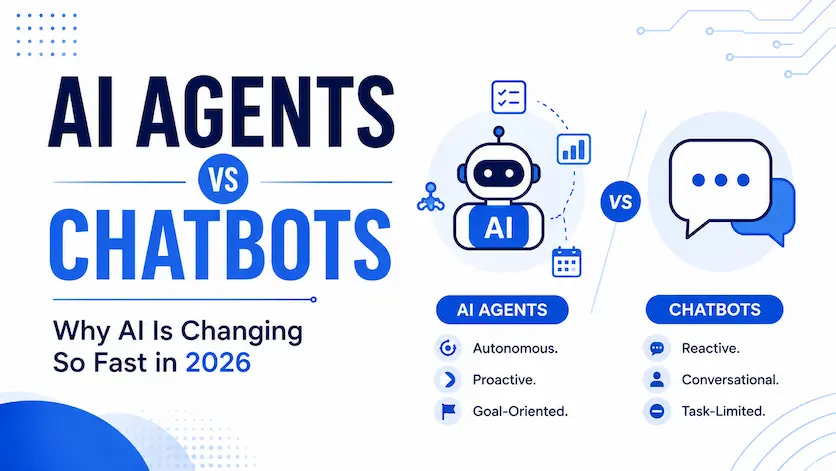
AI Agents vs Chatbots: Why AI Is Changing So Fast in 2026
Open any vendor website right now and you’ll see “AI agent” attached to everything: customer service tools, writing assistants, scheduling apps, sales software. The term has spread so fast it’s losing its meaning.
But AI agents and chatbots are not the same thing. The difference is architectural, not cosmetic, and it matters a great deal if you’re trying to understand what AI can actually do or figure out which tool is right for your situation.
This article explains what each one actually is, how they compare across the dimensions that matter, why the terminology has gotten so blurry, and why AI is evolving at a pace that feels almost impossible to keep up with.
What Is a Chatbot?
“Chatbot” is an old word that covers a wide range of different products. It helps to separate them.
Rule-Based Chatbots
The original chatbot follows a predefined script. A user selects an option, the bot responds with a fixed answer, and the conversation branches from there along a decision tree. These work well for simple, predictable interactions: booking a consultation, checking an order status, navigating an FAQ.
Rule-based chatbots are fast to deploy, inexpensive, and easy to audit. They fall apart when a user phrases a question differently than the script anticipated, or asks something the decision tree never covered.
LLM-Powered Chatbots
More recent chatbots run on large language models (LLMs), the same underlying technology behind Claude, ChatGPT, and Gemini. These feel dramatically more capable. They understand natural language, hold context within a conversation, and generate nuanced, flexible responses.
But even an LLM-powered chatbot, without additional architecture around it, is fundamentally reactive. A user sends a message. The model processes it and generates a response. Each message triggers a single model call. The bot reads, answers, and waits.
What it does not do is plan ahead, take action in an external system, or check whether the task was actually completed.
What Is an AI Agent?
An AI agent is built around a language model but adds the architecture that turns conversation into real action. Five things define it.
Planning. An agent can break a goal into steps and sequence them. It decides what to do next without requiring a human prompt for each action.
Tool use. An agent can call external systems: searching the web, querying a database, reading and writing files, executing code, updating a CRM record, sending an email.
Memory. An agent can maintain context across a session, and often across multiple sessions, referencing earlier information to inform later decisions.
Iteration. An agent observes the result of each action, evaluates whether it moved closer to the goal, and adjusts. If something fails, it retries or changes approach.
Autonomy. An agent can complete multi-step workflows with minimal human intervention at each stage.
A concrete example makes the distinction clear. A customer messages a support system: “Can you refund the second charge on my account from last Tuesday?”
A chatbot reads the message and explains the refund policy. It directs the customer to a form.
An AI agent reads the message, looks up the account, identifies the transaction, checks it against refund eligibility rules, initiates the refund, and sends a confirmation. No human touches it.
One answers. The other completes the work.
How Chatbots and AI Agents Compare
| Feature | Rule-Based Chatbot | LLM Chatbot | AI Agent |
| Primary function | Follow a fixed script | Generate conversational responses | Plan and execute multi-step tasks |
| Tool use | None | Minimal or none | Central to how it works |
| Memory | None or short session | Session context only | Persistent across sessions |
| Autonomy | None | Low | High |
| Handles unexpected inputs | Poorly | Moderately | Well |
| Best suited for | Predictable, bounded queries | Conversational Q&A | Goal-driven workflows across systems |
Why the Line Between Them Is Getting Blurry
Here is where things get complicated in 2026: the chatbot-to-agent distinction is a spectrum, not a hard boundary.
Add a single tool, such as an order lookup function, to an LLM chatbot and it moves toward the agent end of the spectrum. The distinction is more about degree of autonomy than a hard boundary. An LLM chatbot without a reasoning loop processes one request at a time, while an agent can chain multiple observations and actions to solve compound problems.
In 2026, three terms dominate every conversation about AI automation: chatbot, AI chatbot, and AI agent. They are used interchangeably in marketing copy, vendor pitches, and tech press. They are not the same thing.
Marketing has accelerated the confusion. Vendors have every incentive to label their products “AI agents” and very little incentive to be precise about what that label means. A useful test cuts through the noise: can the system decide what to do next without you specifying each step? Can it use tools to take real action in external systems? Does it evaluate its own output and adjust?
If the answer is yes to all three, it is behaving like an agent. If it answers your questions and waits for the next one, it is a chatbot.
Why AI Is Changing So Fast Right Now
The pace of AI development in 2025 and 2026 has been disorienting even for people inside the field. Several things converged in a short window.
Reasoning Models Changed What AI Can Do
For years, language models improved primarily by getting bigger and training on more data. That approach started hitting diminishing returns on complex, multi-step tasks. The breakthrough came from a different direction: instead of scaling the model, researchers focused on how it uses compute at the moment it generates a response.
Reasoning models represent a fundamental shift in how AI systems generate responses. Instead of producing an immediate answer based on pattern matching, these models allocate compute during inference to work through problems, exploring multiple solution paths, verifying intermediate results, and backtracking from failures before delivering a final response.
When reasoning models arrived in late 2024, they immediately boosted capability and cut costs, as reasoning enabled agents to map out tasks to be completed by less expensive models. OpenAI’s o1 was the first major commercial example. DeepSeek’s R1, released in January 2025 with open weights, demonstrated that similar reasoning capability could be achieved more efficiently without a proprietary API.
The International AI Safety Report 2026 documented that reasoning models showed substantially improved performance on hard mathematics, coding, and scientific tasks, because they evaluate multiple solution paths before settling on a final answer rather than completing a single forward pass.
The impact on AI agents was direct. Planning and self-correction, the core behaviors that make agents genuinely useful, became far more reliable.
Inference Became Much Cheaper
Better and cheaper do not usually arrive together. In AI, they have. The cost of running LLM inference has dropped sharply, making it economically viable to power agents that chain many model calls to complete a complex task. What once required enterprise infrastructure budgets is now accessible at consumer price points, which opened agent deployment to a far wider range of organizations and developers.
Standardized Protocols Reduced Friction
A practical barrier to building AI agents was the absence of standard ways to connect them to tools and data sources. Every integration required custom engineering work. Anthropic describes MCP as an open standard for secure, two-way connections between data sources and AI-powered tools. In December 2025, Anthropic donated MCP to the Linux Foundation’s Agentic AI Foundation. Complementary agent-to-agent communication protocols are emerging alongside it.
This may read like an infrastructure detail. But standardization is what allows ecosystems to grow. It lets builders connect agents to existing business systems without reinventing the same plumbing for every deployment.
Enterprise Tooling Became Accessible to Non-Engineers
Microsoft Copilot, Salesforce Agentforce, and IBM’s orchestration tools embedded agentic capabilities directly into platforms businesses already use. As IBM noted in its 2026 AI trends outlook, the ability to design and deploy intelligent agents is moving beyond developers, making it accessible to everyday business users rather than requiring a dedicated AI engineering team.
The market numbers reflect the shift. According to Gartner, 40% of enterprise applications are expected to embed task-specific AI agents by the end of 2026, up from less than 5% in 2025. The global agentic AI market was valued at approximately $7.3 billion in 2025 and is projected to reach $9 to $11 billion in 2026, with analysts forecasting growth to $139 billion by 2034 at a compound annual growth rate above 40%.
When a Chatbot Still Makes Sense
Agents are more capable, but capability alone is not the right basis for choosing a tool.
For interactions that are conversational, predictable, and bounded in scope, chatbots remain the practical choice. Good use cases include answering product questions, guiding users through a self-service process, collecting lead information, handling common support queries with well-documented answers, and routing inquiries to the right team or person.
For many companies, especially those on a budget, chatbots are still a practical and cost-effective solution for simple, high-volume tasks. They provide fast, scalable, and low-cost service.
Chatbots are also faster to deploy and easier to audit. When the task scope is well-defined and nothing needs to happen in an external system, the added complexity of an agent delivers no value.
The mistake is deploying a chatbot for work that genuinely requires action across systems, and then being surprised when it cannot complete the task.
When You Actually Need an AI Agent
Agents earn their complexity when the task requires more than a good answer.
Clear indicators that an agent is the right tool rather than a chatbot:
- The task involves multiple systems (CRM, email, calendar, database) that need to be accessed in sequence
- Completing it requires several steps that depend on each other
- The outcome varies based on per-user context or real-time data
- Humans are currently doing repetitive transfer work between tools
- You need the system to verify its own work and handle exceptions without escalating everything
- The task requires judgment that can be defined in rules, but the rules interact with each other in ways a fixed decision tree cannot handle
Real-world business deployments include customer support agents that draft responses or route issues using ticket context, and procurement agents that review intake requests, apply policy, and recommend the right approval path.
The Practical Takeaway
Chatbots and AI agents are architecturally different, even if vendors in 2026 have worked hard to blur that line. A chatbot answers messages. An AI agent pursues goals. The gap between them is not the language model. It is the wrapper: tools, memory, planning, and the ability to produce real effects in the world.
AI is moving this fast right now because several longstanding technical and commercial barriers were cleared in a compressed period: reasoning models made planning and self-correction reliable, inference costs fell sharply, integration protocols became standardized, and enterprise platforms removed the engineering barrier to deployment.
The clearest path forward is to start with the work, not the technology. If you need a system to respond to questions within a defined topic, a chatbot is likely sufficient. If you need a system to complete a task that touches multiple systems, requires judgment, and needs to verify its own output, you are describing what an AI agent is built for. Match the architecture to the actual job, and the technology choice becomes straightforward.
Frequently Asked Questions
Can a chatbot become an AI agent?
Yes, incrementally. Adding a single tool to an LLM chatbot moves it toward the agent end of the spectrum. The distinction is more about degree of autonomy than a hard boundary. Adding memory and a planning loop moves it further still.
Are AI agents replacing chatbots?
The industry trend is moving toward more capable, agentic systems, but chatbots are not disappearing. Many organizations will adopt a hybrid approach, using chatbots for routine tasks and AI agents for complex, high-value automation. The question is usually which tool fits the specific job, not which is universally better.
Is ChatGPT a chatbot or an AI agent?
It depends on how it is configured. In a standard back-and-forth conversation, it behaves as an LLM chatbot. With tools enabled, tasks assigned, and a goal to pursue, it can behave agentically. The underlying model is the same. The architecture and permissions around it determine the behavior.
Why does this distinction matter practically?
Deploying a chatbot where you need an agent means the system cannot complete work on its own, and humans still carry the burden. Deploying an agent where a chatbot would suffice adds cost, maintenance overhead, and governance complexity without benefit. Matching the tool to the actual task is where the real value comes from.