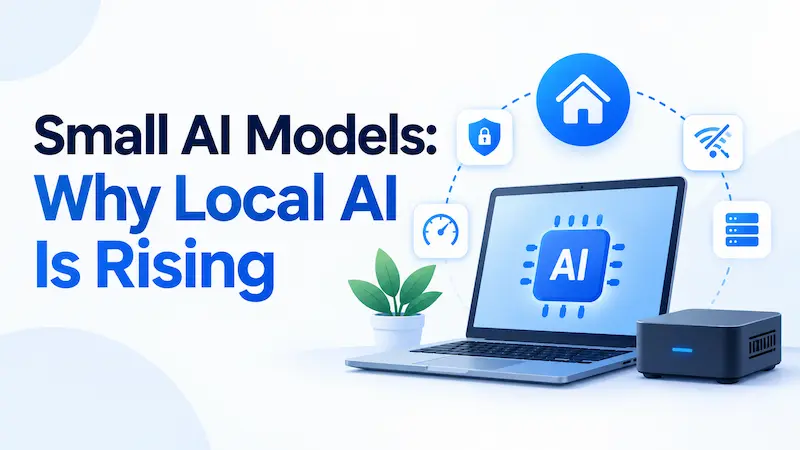
Small AI Models and the Rise of Local AI in 2026
AI deployment is no longer limited to sending every request to a large model hosted in a distant data center.
Small AI models are compact language, vision, audio or multimodal models designed to perform useful tasks with less memory and computing power than the largest general-purpose systems.
It is what allows AI to operate on phones, laptops, vehicles, industrial equipment and privately controlled servers. It is why local AI has become a credible production option for organizations that need faster responses, offline access, predictable infrastructure or tighter control over data.
These models have not made cloud AI obsolete. They have created a more useful choice: match each workload to the smallest sufficiently capable model and run it in the most appropriate location.
In this article, “small AI models” primarily refers to compact language and multimodal foundation models rather than every form of lightweight machine learning, such as traditional image classifiers or TinyML systems.
Key Takeaways
- Small AI models prioritize efficiency and task fit over maximum general capability.
- Local AI runs inference on user-controlled devices or infrastructure.
- Quantization, distillation and better hardware are expanding on-device capabilities.
- Local processing can improve latency, offline access and data control.
- Local deployment does not automatically make an AI system private, secure or compliant.
- Hybrid architectures can keep routine work local and escalate complex requests selectively.
What Are Small AI Models?
A small AI model is a relatively compact machine-learning model built or optimized to operate with fewer computing, memory and storage resources than a larger model in the same category.
Compact language models are commonly called small language models, or SLMs. They can perform tasks such as:
- Text classification
- Information extraction
- Summarization
- Translation
- Question answering
- Structured-output generation
- Tool selection
- Code assistance
Multimodal small models can also work with images, audio or video.
There is no universally accepted parameter threshold separating an SLM from an LLM. A four-billion-parameter model may be small enough for a laptop but too demanding for a low-power embedded device. A 12-billion-parameter model may be considered relatively small for a workstation while remaining unsuitable for many phones.
Parameter count is therefore only one measure. A deployment decision should also consider:
- Memory needed to load the model
- Active parameters during inference
- Numerical precision
- Storage size
- Context-window requirements
- Response time on the intended hardware
- Power or battery use
- Concurrent-user demand
- Quality on the intended task
Small models can be general-purpose systems in compact form or specialist models trained for a narrow function. A focused model does not need to match a frontier model across every benchmark. It needs to complete its assigned work reliably within the available resource and risk limits.
What Is Local AI?
Local AI means that model inference occurs on hardware controlled by the user or deploying organization instead of requiring every request to be processed by an external cloud model provider.
The hardware might be:
- A smartphone or tablet
- A laptop or desktop computer
- An organizational workstation
- A private server
- An industrial gateway
- A vehicle or robot
- An on-premises data center
A local system may still connect to external databases, synchronization services or cloud tools. Local inference and fully offline operation are therefore related but not identical.
Local, Edge, On-Premises and Self-Hosted AI
These terms frequently overlap, but they describe different aspects of deployment.
| Term | What It Usually Means |
| Local AI | Inference occurs on user-controlled or nearby hardware |
| On-device AI | The model runs directly on the end user’s device |
| Edge AI | Processing occurs near the source of data |
| On-premises AI | The organization operates the system in its own facilities |
| Self-hosted AI | The organization manages the model and infrastructure |
| Private-cloud AI | The system runs in a controlled cloud environment |
| Hybrid AI | Local and cloud models are used selectively |
A model running on a company laptop is local and on-device. A model running in a company data center is local to the organization and on-premises, but not on the end user’s device. A privately managed cloud deployment may be self-hosted without being physically local.
These distinctions matter because deployment location affects data flows, latency, infrastructure responsibility, update processes and security boundaries.
Why Local AI Is Rising in 2026
Local AI has long supported features such as predictive typing, face detection and voice activation. What has changed is the range of generative and multimodal tasks compact models can now perform.
Small Models Are Becoming More Capable
Model quality depends on more than scale. Training-data quality, model architecture, post-training, tokenization and task specialization can significantly affect performance.
Microsoft’s Phi family illustrates this approach. Microsoft describes Phi models as small language models designed for generative AI applications that can be deployed in cloud and edge environments.
Distillation, reinforcement learning and carefully selected training data can help smaller models reproduce specific capabilities associated with larger systems. These methods do not remove the smaller model’s capability ceiling, but they can make it highly effective within a defined domain.
Quantization Reduces Memory Requirements
Models normally store numerical weights at a particular precision. Quantization represents those values using fewer bits.
Reducing precision can:
- Decrease the model’s storage footprint
- Reduce the memory needed during inference
- Improve speed on compatible hardware
- Make deployment possible on less powerful devices
The trade-off is that quantization may reduce output quality or affect some tasks more than others. The result depends on the model, quantization method, hardware and use case.
Google’s work on quantization-aware Gemma models demonstrates how models can be prepared for lower-precision deployment on consumer hardware. Organizations should still evaluate the exact quantized version they intend to use rather than assuming it performs like the original model.
Modern Devices Contain Dedicated AI Hardware
Many phones, laptops and workstations now include GPUs, neural processing units or other accelerators designed for machine-learning workloads.
This hardware can reduce the burden on a general-purpose CPU, but a high advertised performance figure does not prove that a particular application will run well. Performance also depends on memory bandwidth, runtime support, model format, thermal limits and software optimization.
The growth of MLPerf Client 2.0 reflects the expanding importance of local AI performance. The benchmark covers workloads such as language generation, image generation and agentic AI on personal computers, with measurements that include responsiveness and throughput.
Standardized benchmarks can inform hardware comparisons, but application-specific testing remains essential.
Platform Providers Are Exposing Local Models
Application developers increasingly have access to models integrated into mainstream hardware and operating systems.
Apple’s third-generation foundation-model family includes on-device models. Apple describes AFM 3 Core as the next generation of its three-billion-parameter dense model and AFM 3 Core Advanced as a sparse model that activates a subset of its parameters according to the request.
Google’s Gemma 4 12B is designed for multimodal processing, including text, image, audio and video input, with local deployment supported through Google’s edge tooling.
These examples do not mean that every device can run every model. They show that local inference has become a platform and product-design consideration rather than a specialist experiment.
Organizations Want More Deployment Control
Cloud models provide substantial capability, elastic computing and managed infrastructure. They also introduce network dependence, external service boundaries, provider-specific pricing and possible changes to model behaviour or availability.
Local inference can reduce some of these dependencies. It allows organizations to decide:
- Where prompts and outputs are processed
- Which model version is used
- When updates are deployed
- Whether the system can operate offline
- Which requests may reach an external provider
This control comes with additional responsibility for hardware, security, testing, monitoring and maintenance.
The Small AI Model Landscape in 2026
The small-model market changes too quickly for a permanent universal ranking. Model suitability also depends on hardware, task, language, licence and quality requirements.
A more useful approach is to compare representative model categories.
| Model Category | Example | Typical Use | Key Consideration |
| Platform-integrated on-device model | Apple AFM | App features on supported devices | Platform and hardware restrictions |
| Mobile or edge-focused multimodal model | Gemma compact variants | Text, image and audio processing | Target-device compatibility |
| Local workstation model | Gemma 4 12B | Multimodal and agentic applications | Memory and runtime requirements |
| Compact task-oriented SLM | Microsoft Phi | Text, reasoning and tool-related tasks | Version-specific evaluation |
| Specialist model | Embedding or classification model | Search, routing and extraction | Narrower purpose than a chatbot |
This table is illustrative rather than exhaustive. It does not rank models or claim that one model family is the best choice for every organization.
Open-Weight Is Not Always Open-Source
A model that can be downloaded is not necessarily open-source in the same sense as conventional open-source software.
Open-weight models provide access to trained parameters. They may not include the complete training data, data-processing code or information needed to reproduce the model.
The Open Source AI Definition distinguishes an AI model, its parameters and the broader resources needed to study and modify an AI system.
Before deploying a downloadable model, review:
- The licence
- Commercial-use restrictions
- Redistribution terms
- Acceptable-use conditions
- Model card
- Training-data disclosures
- Known limitations
- Third-party components
- Update and security process
Do not assume that downloadable, open-weight and open-source mean the same thing.
How Small AI Models Run Locally
A local AI application is more than a model file. It normally contains several technical layers.
1. Model Weights
The weights contain the learned numerical parameters that influence how the model processes input and generates output.
The same model family may have multiple versions, sizes and quantized formats. These variants can produce different quality and performance results.
2. Inference Runtime
The runtime loads the model, sends computations to available hardware and manages token generation.
Runtime compatibility affects:
- Supported model formats
- CPU, GPU or NPU use
- Memory consumption
- Quantization support
- Response speed
- Operating-system support
A model being small enough to fit in memory does not guarantee that the available runtime can execute it efficiently.
3. Hardware
Different hardware components serve different functions:
- RAM stores the model and application data available to the main system.
- VRAM is memory attached to a GPU and is commonly used for accelerated inference.
- GPUs perform many model calculations in parallel.
- NPUs are specialized accelerators designed for selected AI workloads.
- CPUs can run local models but may be slower for demanding generation tasks.
Memory requirements also increase with longer context, larger batches and multiple simultaneous users.
4. Retrieval Layer
A small model does not need to contain every piece of organizational knowledge in its weights.
Retrieval-augmented generation, or RAG, can search an approved document collection and supply relevant passages to the model at request time. This can improve access to current or organization-specific information.
RAG does not guarantee accuracy. Retrieval can return irrelevant, incomplete or malicious content, and the model can still misinterpret a correct source. Teams need controls for document access, source quality and answer grounding.
5. Application and Policy Controls
The application determines what the model can access and do. It should control:
- Input length
- Permitted data sources
- Tool permissions
- Output formats
- Escalation rules
- Logging
- User access
- Human review
A local model should not receive unrestricted access to files, systems or transactions simply because it runs in a trusted environment.
Where Small AI Models Deliver the Most Value
Small models are most valuable when the task is bounded and local processing solves a genuine operational problem.
Private Document Processing
A local model can classify, summarize or extract information from documents without automatically sending the full content to an external inference provider.
Potential uses include:
- Extracting invoice fields
- Classifying internal support requests
- Organizing meeting notes
- Identifying document types
- Producing first-pass summaries
The model must be evaluated against the actual document formats, languages and data quality it will encounter.
Offline Applications
Local AI can support work in locations where connectivity is unavailable, inconsistent or expensive.
Examples include field-service assistance, equipment instructions, translation and structured data entry.
Tasks requiring current external information still need a secure update or synchronization process.
High-Volume, Repeatable Tasks
Sending every routine classification or formatting request to a large cloud model may add unnecessary cost and latency.
A smaller local model may handle predictable requests while referring uncertain or complex cases to a person or more capable model.
Personalized Device Experiences
Local inference can use context stored on a device, such as preferences, private notes or recent activity.
This does not grant unlimited permission to process personal data. Applications still need appropriate access controls, purpose limitations, retention rules and user choices.
Embedded and Real-Time Systems
Robots, vehicles, machinery and assistive devices may need to interpret data without waiting for a remote service.
Fast local inference is only one requirement in a safety-critical application. The complete system also needs defined operating limits, deterministic safeguards, validation and safe failure behaviour.
Small Models Versus Large Cloud Models
The correct question is not whether small models are better than large models. It is which architecture meets the requirements of the task.
| Decision Factor | Small Local Model | Large Cloud Model |
| General reasoning | Usually more limited | Usually stronger |
| Narrow repeated task | Often well suited | Capable but may be excessive |
| Offline operation | Possible | Usually unavailable |
| Network latency | Avoided after local loading | Depends on connection and provider |
| Data transmission | Can remain local | Usually crosses a service boundary |
| Hardware management | User or organization | Provider |
| Model updates | Must be managed locally | Commonly managed by provider |
| Variable inference fees | May be reduced | Commonly usage-based |
| Initial setup | Can require optimization | API access may be simpler |
| Scalability | Limited by local capacity | More elastic |
| Model consistency | Version can be fixed | Provider may change managed models |
| Complex open-ended work | Often weaker | Usually better suited |
A local model may be appropriate for stable document classification. A cloud model may be preferable for complex research, broad reasoning or tasks requiring very large contexts.
Many organizations need both.
Should AI Run Locally, in the Cloud or Both?
The following matrix is editorial guidance. It helps structure an initial decision but does not replace technical testing, security assessment or legal analysis.
| Criterion | Local Indicator | Cloud Indicator |
| Data sensitivity | Sensitive content should remain controlled | External processing is acceptable |
| Task complexity | Narrow and predictable | Broad or highly variable |
| Offline need | Essential | Unnecessary |
| Request volume | High and repetitive | Low or irregular |
| Response requirement | Immediate or real time | Moderate delay is acceptable |
| Hardware | Suitable capacity is available | Local capacity is insufficient |
| Information needs | Stable or locally available | Constantly changing external data |
| Maintenance | Internal capability exists | Managed service is preferred |
| Failure handling | Errors can be detected or contained | Greater model capability is required |
How to Interpret the Result
- Mostly local indicators: Begin by evaluating a small local model.
- Mostly cloud indicators: Begin with a managed cloud model.
- Mixed indicators: Consider explicit hybrid routing.
- High-impact use: Conduct a separate risk and compliance assessment regardless of deployment location.
Worked Example: Invoice Extraction
Consider a hypothetical company that needs to extract the supplier name, invoice number, date, currency and total from 25,000 recurring invoices each month.
The task has:
- A stable output format
- High request volume
- Potentially confidential supplier information
- A measurable accuracy threshold
- A clear exception process
- Limited need for open-ended reasoning
These conditions favour a local or privately hosted small model, possibly combined with deterministic validation rules.
The company should not assume the model is reliable because a demonstration looks convincing. It should create a representative evaluation set, measure field-level accuracy and route low-confidence or invalid outputs to human review.
The same architecture may not suit open-ended contract negotiation. That task requires more contextual reasoning, involves higher consequences and may be better served by a larger approved model or a hybrid workflow.
How a Hybrid AI Architecture Works
A hybrid system assigns work according to sensitivity, complexity and risk instead of choosing one model for every request.
Consider a hypothetical internal support assistant.
The local model first classifies the request and searches an approved internal knowledge base. It answers routine questions that fall within a defined scope.
If a request requires more advanced reasoning, the application applies a routing policy. Depending on the data involved, it may:
- Block cloud escalation
- Remove unnecessary sensitive content
- Ask the user for approval
- Send only the minimum required context
- Refer the request to a person
The cloud model returns a proposed response, but local controls validate the format and prevent unauthorized tool actions. High-impact outputs receive human review.
A controlled hybrid architecture separates five functions:
- Local task handling
- Sensitivity detection
- Capability-based routing
- Controlled cloud escalation
- Output validation and logging
Its value comes from selective escalation, not from giving every local application unrestricted cloud access.
The Benefits of Local AI Are Conditional
Local AI is frequently associated with privacy, security, low cost and sustainability. Each benefit needs qualification.
Privacy Depends on the Complete Data Flow
Keeping inference on a device can reduce transmission to an external model provider.
The application may still:
- Collect telemetry
- Synchronize conversation history
- Retain prompts
- Store embeddings
- Contact external tools
- Expose data through insecure local storage
Privacy depends on what the complete system collects, accesses, retains and transmits.
Security Responsibility Shifts to the Operator
Local deployment removes some external dependencies but creates local attack surfaces.
Risks include:
- Tampered model files
- Compromised devices
- Malicious retrieved documents
- Excessive tool permissions
- Insecure logs
- Outdated runtimes
- Unauthorized model extraction
The OWASP prompt-injection guidance remains relevant to local systems that process untrusted documents or instructions. Prompt injection can influence the model even when the malicious instruction is embedded in content rather than typed directly by a user.
A downloaded model should also be treated as a software and data supply-chain component. Verify its source, licence, integrity and dependencies before deployment.
Lower API Spending Does Not Mean Zero Cost
A local system may reduce usage-based API fees, especially for high-volume workloads. Its total cost can still include:
- Hardware
- Engineering
- Model optimization
- Evaluation
- Security testing
- Deployment management
- Electricity
- User support
- Monitoring
- Updates
- Incident response
Cost comparisons should cover the expected system lifetime and workload, not only the price of an API request or device.
Smaller Does Not Automatically Mean More Sustainable
A compact model will generally require fewer resources than a much larger model under comparable inference conditions.
The environmental result also depends on:
- Hardware utilization
- Electricity source
- Device replacement
- Model efficiency
- Request volume
- Duplicate local capacity
- Cloud data-center efficiency
Organizations should measure the whole deployment rather than treating “local” or “small” as proof of sustainability.
Risks and Limitations of Small AI Models
Capability Ceilings
A small model may struggle with unfamiliar domains, rare languages, long instructions, broad research, complex reasoning or very large contexts.
Fine-tuning can improve selected behaviours, but it cannot reliably give a compact model every capability of a frontier-scale system.
Confident Errors
Small models can produce unsupported or incorrect content just as larger models can. Local execution does not make an answer factual.
The NIST Generative AI Profile addresses risks including confabulation, information security, data privacy and harmful content. Its risk-management approach remains relevant regardless of whether inference occurs locally or in the cloud.
Benchmark Limitations
A model’s published benchmark score does not establish suitability for a specific business process.
Benchmark results may be affected by:
- Prompt format
- Quantization
- Runtime settings
- Hardware
- Context length
- Test-set contamination
- Average scores that hide weak task categories
- Vendor-reported rather than independently reproduced results
Use benchmarks to create a shortlist, then test the shortlisted models on representative organizational data.
Device Fragmentation
Performance can differ across operating systems, processors, memory configurations and runtime versions.
A model that runs well on a developer workstation may be slow, unstable or unavailable on older end-user devices.
Model and Application Updates
Local deployment requires a secure way to distribute changes.
Teams should know:
- Which version is running
- Where it is deployed
- What changed
- Whether previous evaluations remain valid
- How updates are authenticated
- How a defective version can be rolled back
- When an unsupported model will be retired
Intellectual-Property Exposure
Distributing model weights to user devices can increase the risk of extraction or unauthorized reuse.
Organizations should also examine whether fine-tuning data, prompts, retrieval content or proprietary business logic can be recovered from the application.
Shadow Local AI
Employees and departments may download models or local AI tools without passing through normal security and governance processes.
This can create unmanaged systems with unknown licences, untested outputs, excessive permissions and no update process.
Local AI should therefore be included in the organization’s AI inventory and acceptable-use controls.
Local Deployment Does Not Remove Compliance Obligations
An AI system does not become legally exempt merely because it runs on a laptop, phone or private server.
Applicable requirements depend on:
- Jurisdiction
- Intended purpose
- Organizational role
- Type of data processed
- Affected individuals
- Sector
- Risk classification
- Consequences of the output
In the European Union, the EU AI Act assigns requirements according to defined roles, systems, models and risk categories. It does not establish a general exemption merely because inference occurs locally.
Data-protection, employment, consumer-protection, intellectual-property, product-safety and sector-specific rules may also apply.
A proportionate local AI record should document:
- Intended purpose
- Prohibited uses
- System owner
- Model source and version
- Licence
- Data categories
- Hardware and software dependencies
- Evaluation method
- Known limitations
- Security controls
- Human oversight
- Escalation process
- Update and retirement procedure
The required depth should reflect the system’s impact and legal context.
How to Run a Responsible Local AI Pilot
1. Define One Bounded Task
Describe the input, required output, response-time requirement and consequence of an error.
“Build an AI assistant” is too broad.
“Extract five defined fields from approved invoice formats” is measurable.
2. Classify the Data
Determine whether inputs may include:
- Personal data
- Trade secrets
- Financial information
- Health information
- Credentials
- Privileged material
- Regulated records
Map not only the prompt but also logs, outputs, embeddings, cached files and telemetry.
3. Establish Success Criteria
Choose task-specific measures such as:
- Field-level extraction accuracy
- Classification precision and recall
- Format compliance
- Grounded-answer rate
- Refusal behaviour
- Unsupported-claim rate
- Response time
- Memory use
Define the minimum acceptable threshold before selecting the model.
4. Shortlist Multiple Model Sizes
Compare at least one compact candidate with a more capable reference model.
The objective is to find the smallest model that reliably meets the requirement, not the smallest model that produces a persuasive demonstration.
5. Test on the Target Hardware
Measure performance on the device or infrastructure that will run the final application.
Test:
- Memory use
- Response time
- Throughput
- Long-context behaviour
- Concurrent requests
- Battery or thermal impact
- Failure recovery
- Quantized-model quality
6. Use Representative and Adversarial Inputs
Include incomplete, unusual, multilingual and poorly formatted examples.
If the model will process documents or external content, test for prompt injection, misleading instructions and unauthorized data requests.
7. Restrict Tools and Permissions
Grant the minimum access required.
Validate model outputs before using them to:
- Execute code
- Send messages
- Modify records
- Approve transactions
- Access confidential files
- Control physical systems
8. Create an Escalation Path
Define what happens when the model:
- Has low confidence
- Produces invalid output
- Receives an unsupported request
- Detects sensitive content
- Encounters a high-impact decision
- Fails to retrieve an adequate source
Possible actions include asking for clarification, routing to a person or sending minimized context to an approved larger model.
9. Monitor and Update
Track:
- Error categories
- User corrections
- Latency
- Hardware compatibility
- Security events
- Escalation frequency
- Model drift
- Version adoption
Reassess the system whenever the model, data, application, hardware or intended use changes.
What Local AI Means for Organizations Beyond 2026
The shift toward local AI does not mean every application will move away from the cloud. It means model selection can occur at the workload level.
An organization may use:
- A compact classifier to route requests
- A local model to process sensitive context
- An embedding model for private search
- A specialist model for a stable workflow
- A larger cloud model for complex exceptions
- Deterministic software where generation is unnecessary
- Human review where consequences are significant
This modular approach can improve control, but it also creates new governance questions.
Organizations need to know:
- Which model handled a request
- What data it accessed
- Which version was running
- Why escalation occurred
- What tools were available
- Who approved the deployment
- Who remains accountable for the output
The strongest local AI strategy is not to run everything on a device. It is to use the smallest sufficiently capable system in the most appropriate location, with controls matched to the consequences of failure.
Conclusion
Small AI models are making local AI practical across personal devices, private infrastructure and embedded systems. Better training methods, quantization, dedicated hardware and platform support have expanded the work these models can perform.
The strongest use cases are narrow, repeatable tasks where responsiveness, offline access, high request volume or control over data creates a clear advantage.
The limitations remain significant. Small models have capability ceilings, local infrastructure requires maintenance, downloadable models introduce supply-chain and licensing concerns, and local processing does not automatically provide privacy, security or compliance.
Organizations should begin with one measurable task, evaluate multiple model sizes on the target hardware and map the complete data flow. If the smaller model cannot handle every request reliably, a controlled hybrid architecture can retain routine work locally while escalating complex cases selectively.
The goal is not to choose local AI because it is fashionable. It is to select a deployment architecture that meets the task’s quality, privacy, security, operational and governance requirements.